
AI Transformation · Authority
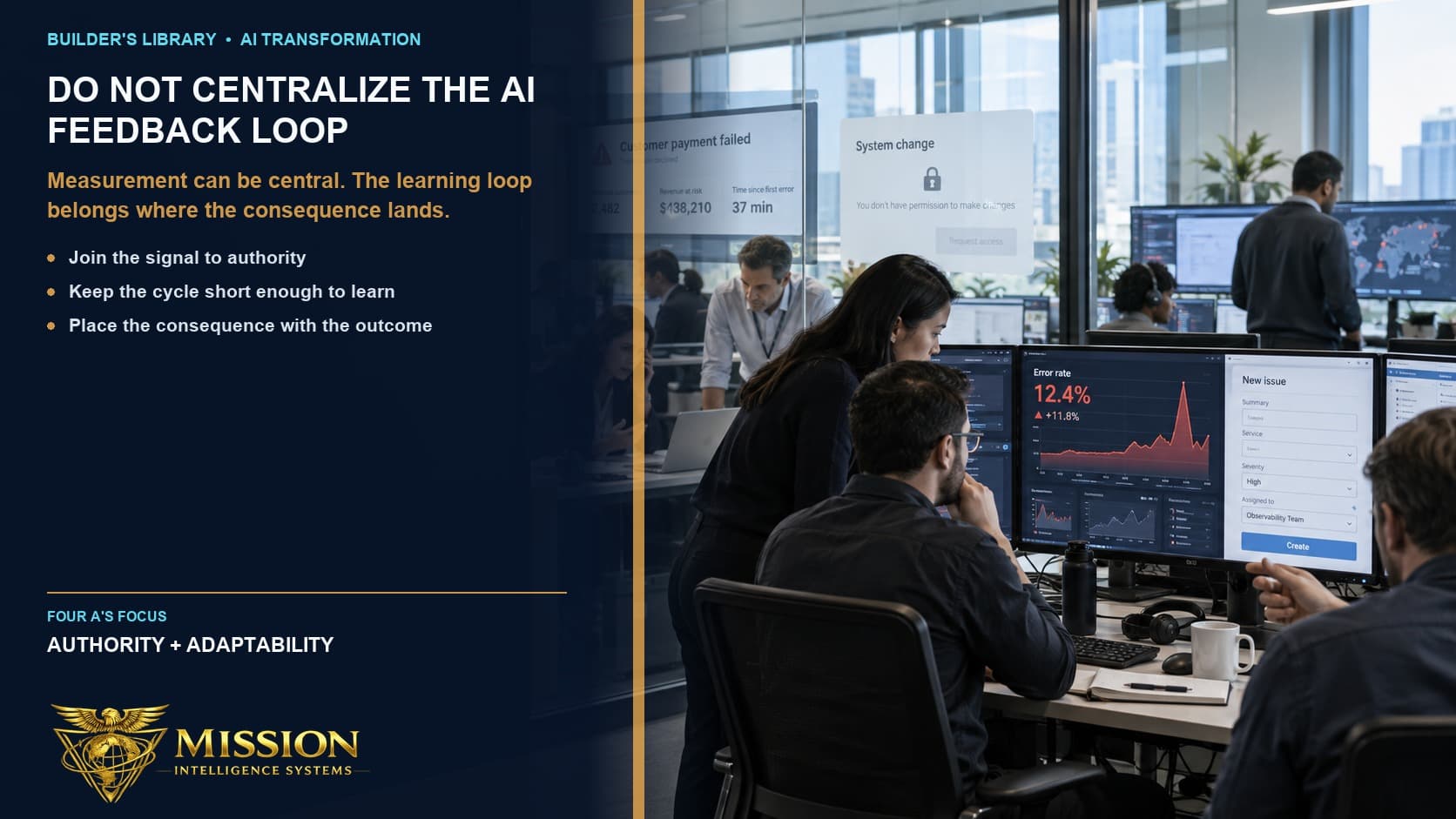
Do Not Centralize the AI Feedback Loop Away From the Outcome
Measurement can be central. The learning loop belongs where the consequence lands.
Key Takeaways
- A central AI team can legitimately own measurement, observability, standards, escalation and scarce skills. It cannot own the learning loop for a result it does not bear, because a loop is closed by someone changing their own behavior and a team without the consequence has nothing to change.
- Separating them produces a loop that is technically complete and organizationally open: the signal arrives where nobody can act, the action sits where nobody sees the signal, and it presents as a reporting problem rather than a decision-rights one.
- Owning the loop requires four things together. Sight of failures, authority to change something, a cycle short enough to attribute, and the budget consequence. Three out of four is not a transfer.
What a central team is genuinely for
The case for a center is strong and this piece does not argue against it. Specialist skills are scarce and no single function can justify holding them. Observability is expensive to build twice. Standards that differ by department are worse than standards that are imperfect. Escalation support needs somebody whose job it is. All of that is real, and all of it is better central.
The error is a category one rather than a degree one. Having correctly centralized measurement, organizations centralize the thing measurement feeds, and those are different artifacts with different requirements.
| Belongs | What sits there |
|---|---|
| Central | Measurement, model and system observability, shared infrastructure, standards, escalation support, scarce specialist skills, and the cross-cutting view no single function has. |
| The function that owns the outcome | The learning loop: seeing the failures, deciding what changes in response, doing it on a cycle short enough to attribute, and carrying the cost when it degrades. |
Why the split breaks the loop
A feedback loop closes when someone changes their behavior in response to a result. That is the whole mechanism, and it requires the observer and the actor to be the same party, or at least to share an interest. Separate them and each half functions correctly while the loop does not exist: the central team sees drift and error rates and cannot change the process; the business function sees the customer and the exception and cannot change the system.
Both parties will be diligent. Reports will be produced and read. What will not happen is learning, because Argyris and Schön's condition is unmet: detecting error and correcting it have to be joined, and here they are held by different budgets.
Why pilots work and rollouts do not
A pilot run by a central team closes its loop inside that team. The people observing the result are the people adjusting the system and the cycle is days. Handing the result to a business function without handing over the loop removes exactly the mechanism that made the pilot succeed. The failure then gets attributed to scale, or to change resistance, and the transfer is never examined.
Four requirements, and three is not enough
Sight of the outcome, failures included
A dashboard of usage is not sight of the outcome. The function needs the cases where the system was wrong, in enough detail to see why, and it needs them without asking anyone.
Authority to change something
A threshold, a prompt, a routing rule, a scope, or the decision to stop. A function that can observe and not act does not hold a loop, it holds a complaint channel, and it will use it that way.
A cycle short enough to attribute
Cause and effect have to stay connected. A quarterly review of an autonomous system that acts thousands of times a week is not a feedback loop, it is a retrospective, and nobody learns a pattern from an annotated summary of one.
The budget consequence
The function that gains from improvement should pay for degradation. Where the central team absorbs the cost of poor performance, the business has no economic reason to close the loop, and closing it is work.
The fourth is the one most often omitted and the one that determines whether the other three are used. Where a central team absorbs the cost of poor performance, the business function has no economic reason to close a loop that is genuine work, and it will not, whatever the operating model says on paper.
The conflict this creates, and why it is the right one
A function that owns the loop will sometimes change things the central team would not have chosen, and standards will fray at the edges. That is the cost, and it is worth paying, because the alternative is uniformity in a system nobody is improving. The center's role is to make deviation visible and to hold the boundary that must not move, not to prevent local adjustment inside it.
This is Weick and Sutcliffe's deference to expertise in an operating-model form: authority migrating in the moment to whoever holds the relevant knowledge, with the center supplying the picture rather than the decision.
The Four A's reading
This is Authority and it closes the series where it began. Authority Should Expire asked whether a grant still holds; this asks whether the party that carries the consequence was ever given the rights that determine it. An organization can be correct about every centralization decision and still have no learning anywhere, because the one artifact that had to be local was the one it moved.
Adaptability is the outcome at stake. A loop is how an organization changes in response to what it finds, and an organization that has centralized all its loops has one learning cycle where it needs many, running at the speed of its slowest reporting line.
About the Author
Dan Flynn
Creator of The Four A's of Organizational Readiness™ · Enterprise Transformation Executive · Author, Builders Build
Dan Flynn has spent thirty years inside federal, defense, and commercial organizations: diagnosing the invisible conditions that determine whether capable people produce extraordinary results. He is the creator of The Four A's of Organizational Readiness™ framework, has reached more than 11,000 professionals across corporate, civic, and national security contexts, and took a federal data platform from one release every six months to seventy-two every two weeks by changing organizational conditions: not people.
His book, Builders Build: The Four A’s of Organizational Readiness™, is forthcoming.