Field Evidence · U.S. Office of Personnel Management
From 20 unreliable processes to 1,600+ automated. Same team. Different conditions.
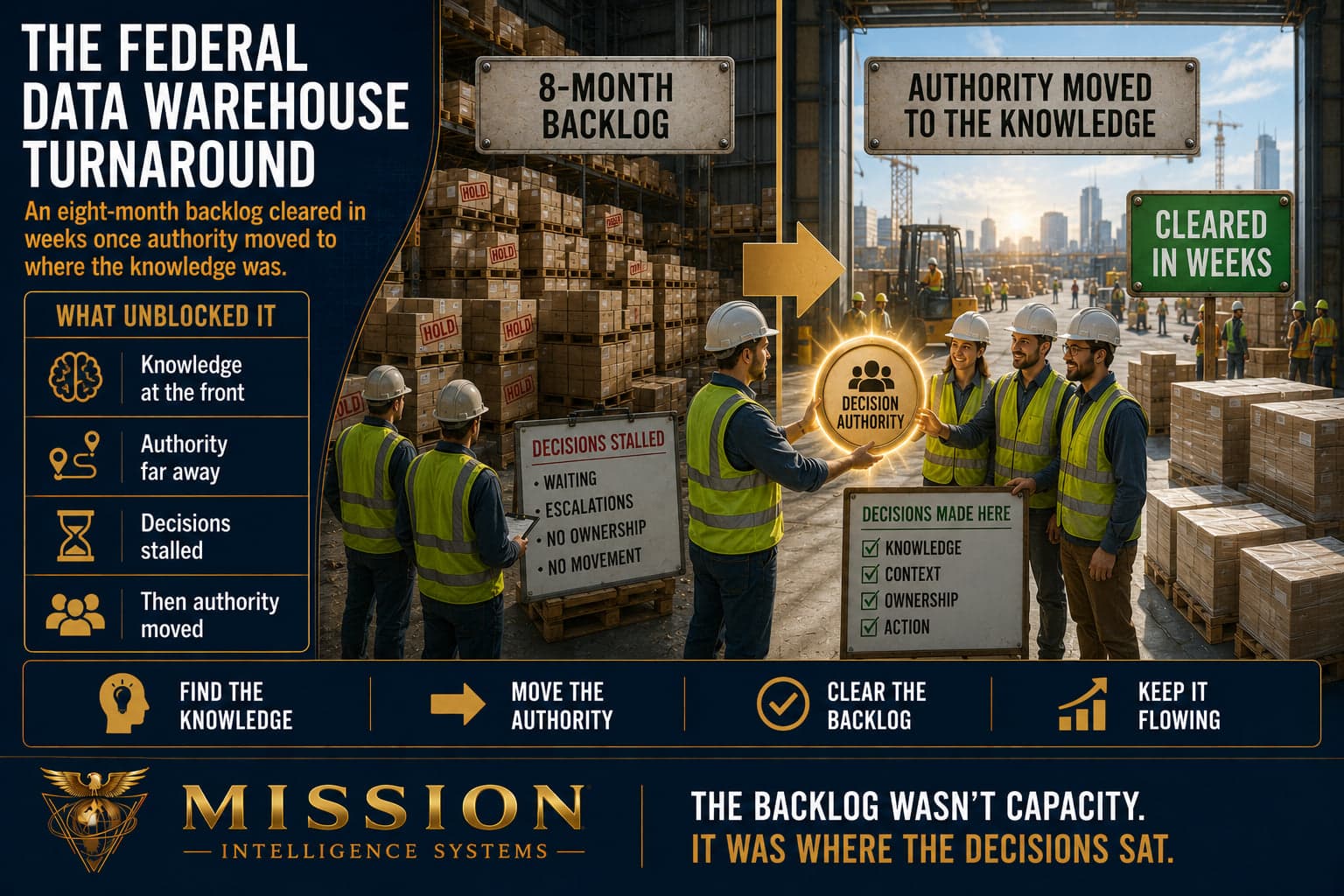
Six years into building a data warehouse, the U.S. Office of Personnel Management had roughly 20 fragile daily processes, most of them failing. Queries took hours or days to return. The team was capable. The operating conditions around them were not.
20 → 1,600+
Automated production processes, running 9× daily
6 weeks → <1 hr
Issue diagnosis and remediation time
6 years → 8 months
Stalled effort, then a new warehouse in production
New branch
The work led OPM to stand up its data reporting branch
The Situation
Six years of effort. A system that couldn't be trusted.
The U.S. Office of Personnel Management had been building a critical data warehouse for six years. The system served as the operational backbone for workforce data flowing to leadership, finance, and downstream HR functions across an organization of more than 7,000 employees.
After six years, the system ran on approximately 20 production processes, and those processes were fragile. Most of them failed on any given day. Queries against the warehouse took hours, and in some cases days, to return. Failures were frequent. When a failure occurred, diagnosing the root cause could take days. Remediation could take weeks. In the meantime, downstream consumers of the data, the people making workforce decisions, were operating on stale, incomplete, or unreliable information.
The standard assumption in these situations is that the technology is wrong, the team is underqualified, or the original design was flawed. None of these were true. The technology was sound. The team was experienced. The architecture was defensible.
The constraint was not technical. It was organizational. No one had clear authority to act independently when something broke, and the organization had never built a mechanism for converting failures into permanently better processes.
The Diagnostic
Reading the organization, not the technology
The Four A's diagnostic did not begin with the codebase or the data architecture. It began with how the organization actually operated: how decisions were made under pressure, who had authority to act when things broke, and whether the team was learning from failures or just surviving them.
Attention
Not the primary constraint
The team was not distracted: they were focused. The problem was that their focused effort was directed at symptoms rather than causes. Every major incident triggered a manual all-hands response that consumed days. Attention was abundant; it was just absorbed by firefighting.
Alignment
Partial gap
Strategic intent was clear: build a reliable data warehouse. Where alignment broke down was at the operational level: different team members had different mental models of what "reliable" meant and what the acceptable failure response looked like. These divergent assumptions produced inconsistent decisions under pressure.
Authority
Primary constraint
This was the root cause. When production failures occurred, no individual had clear authority to diagnose, isolate, and remediate independently. Every response required consensus across multiple stakeholders. A six-week issue cycle was not a technical problem: it was a decision problem. The knowledge to fix the issue existed. The authority to act on it did not.
Adaptability
Structural gap
The organization was accumulating experience with failures but not converting it into changed behavior. Each incident was treated as unique. Root cause analysis, when it occurred, did not produce updated process designs. The system was built to survive failures: not to learn from them.
The Intervention
Building conditions, not fixing symptoms
The intervention addressed the two primary constraints: Authority and Adaptability. The work was structural: not a training program, not a new methodology, not a technology replacement.
Demonstrated the standard before asking anyone to adopt it
The first move was not a reorganization. It was two months spent identifying the fifty worst-performing queries and rewriting them. That did two things at once. It removed the most acute pain, and it established in working code, rather than in argument, what the correct approach actually looked like. Every structural change that followed had something concrete to point at.
Clarified decision rights for production operations
Established clear individual authority for production issue diagnosis and initial remediation. Removed the consensus requirement for first-response actions. Defined escalation paths with explicit time triggers. A team member who identified a failure now had the authority, and the obligation, to act without waiting for group consensus.
Built a learning mechanism from production failures
Designed a structured failure review process that converted each production incident into a documented pattern: with a designated owner, an updated process design, and a verification step. Experience stopped being accumulated and started being converted. Within weeks, the same failure types stopped recurring.
Rebuilt the production architecture with authority in mind
The 20 fragile processes were not patched: they were redesigned with modular ownership. Each process component had a clear owner with full diagnostic and remediation authority. The new design produced 1,600+ processes, each running nine times daily, each with transparent failure signals and a designated responder.
Established a production health operating rhythm
Created a daily production health review: not a status meeting, but a structured diagnostic cadence. Issues were surfaced, triaged, and assigned within hours. The six-week diagnosis cycle became a historical artifact within the first quarter.
The Results
What changed, and what didn't
The team did not change. The core technology did not change. The fundamental mission, build a reliable data warehouse, did not change. What changed were the conditions under which the team operated.
20 → 1,600+
Production processes
From roughly 20 fragile daily processes to more than 1,600 automated production processes, each running nine times per day with clear ownership and transparent failure signals.
6 weeks → <1 hour
Issue diagnosis and remediation
The cycle time from failure detection to diagnosis, fix, testing, and redeployment dropped from as long as six weeks to under one hour: without new tooling or additional headcount.
Eliminated
Manual intervention requirement
Manual daily intervention, previously required to keep the system running, was eliminated. The system became self-sustaining within normal operational parameters.
Sustained
Reliability under load
The redesigned system maintained reliability as data volumes and process counts scaled. The conditions that produced reliability were structural: they held as the system grew.
Requested by name
Demand from outside the agency
Other federal agencies began approaching OPM directly to ask for team Raza's data services. Reputation moved ahead of the org chart, which is the clearest external signal that the conditions, and not only the output, had changed.
A new branch
Institutional outcome
The result proved durable enough that OPM stood up a dedicated data reporting branch on the back of it. The engagement did not only repair a system. It changed the shape of the organization built around it.
Performance is a product of conditions: not of effort alone. This team had been applying maximum effort for six years. What changed the outcome was not more effort. It was different conditions.
What This Case Teaches
Three things every leader should take from this
A six-week diagnosis cycle is never a technology problem
It is always an authority problem. When diagnosis takes weeks, someone is waiting for permission to act, or multiple people are waiting for each other. The first question in any reliability investigation is not "what is wrong with the system?" It is "who has authority to find out and fix it?"
Experience without a learning mechanism is just exposure
This organization had six years of production experience. It had not converted that experience into better processes. The mechanism for learning, structured failure review with designated owners and verified process updates, was missing. Organizations that survive failures and organizations that learn from failures are not the same thing.
Scale is a conditions problem, not a technology problem
Going from 20 processes to 1,600+ was not primarily a technical achievement. It required building conditions in which 1,600+ processes could be owned, monitored, diagnosed, and fixed by a distributed team with clear individual authority. The technology enabled the scale. The organizational conditions made it sustainable.
Related Reading
The Knowledge-Authority Gap
Why placing decisions at the wrong level is the hidden cause of most organizational slowdowns.
Organizational Friction Index
How workarounds and manual interventions signal broken organizational design.
What Great Builders Do
The six laws that govern how conditions are built, and sustained.
Work With Us
Facing a similar constraint?
Every organization described in these case studies faced the same fundamental question: are the conditions we have built capable of producing the results we need? Mission Intelligence Systems diagnoses that question and builds toward the answer.