
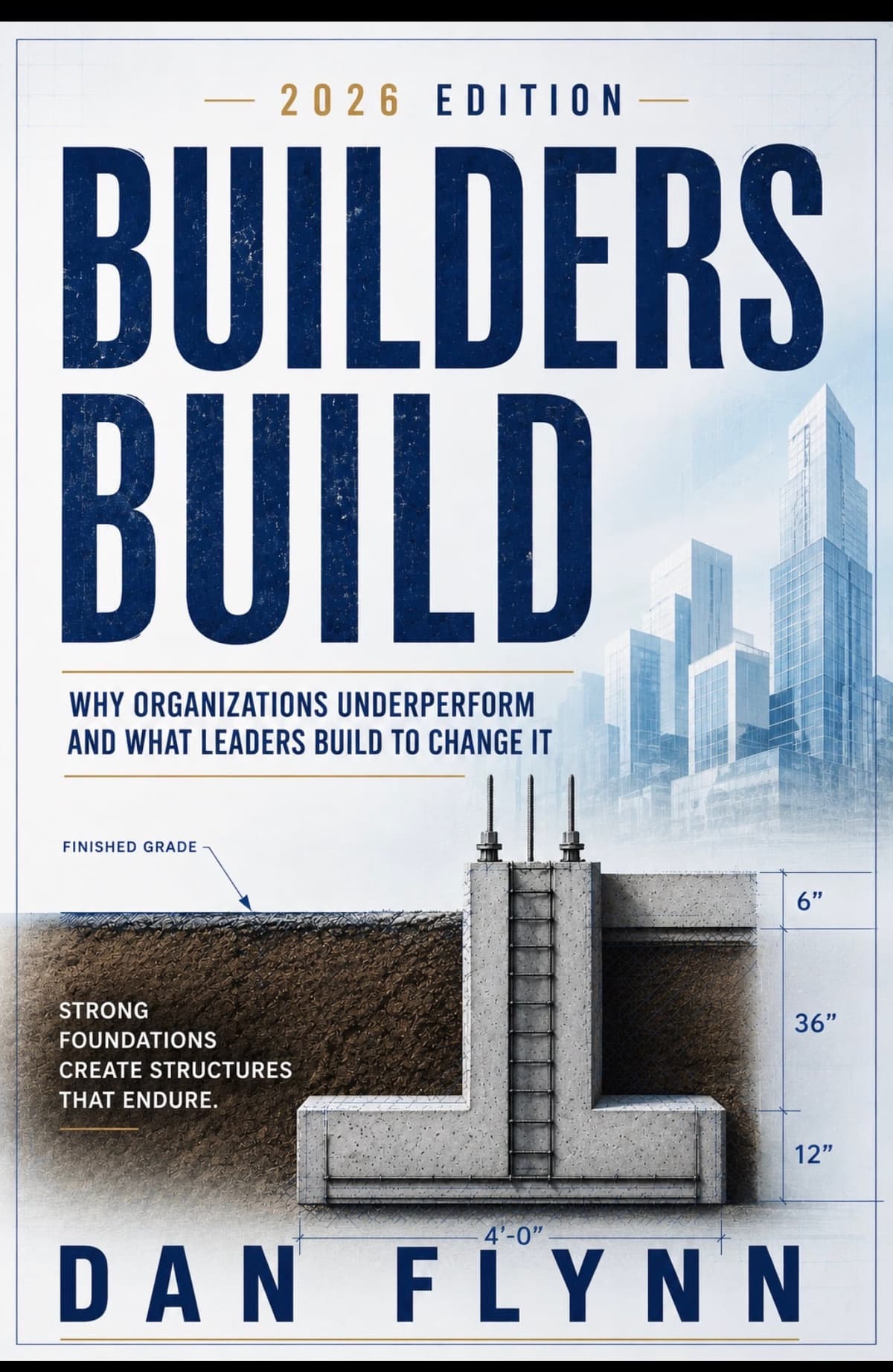
Coming in the fall of 2026
Builders Build
The Four A’s of Organizational Readiness™
Dan Flynn
Performance is not a people problem. It is a conditions problem. This book is for leaders who are done hoping and ready to build.
Drawing on three decades of organizational work, Builders Build gives leaders a framework for diagnosing why organizations underperform, and a clear method for building the conditions that change it.
Free Preview
Read Chapter One free.
“Builders Build”: the opening chapter, in full. Enter your name and email and it downloads immediately.
No spam. Just the chapter.
Coming in the fall of 2026
Be notified when the book launches.
Enter your email and you will be among the first to know when Builders Build is available - along with occasional field notes from Dan on organizational performance.
No spam. Unsubscribe anytime.
What the book covers
Strong foundations create structures that endure.
Why organizations underperform
The real reason transformation stalls has nothing to do with strategy or talent. It has to do with conditions: the invisible architecture that determines what is actually buildable.
How builders read the land
Before breaking ground, builders study the soil. This book teaches leaders to see what others miss: the gravity, the friction, the antibodies that make change difficult.
The Four A’s of Organizational Readiness™
Attention, Alignment, Authority, and Adaptability: the four conditions that determine whether an organization can move when its leaders lead.
What it means to build builders
The measure of a builder is not what they build. It is who they leave behind. This book ends where great leadership begins.
“Farmers don't grow crops. They create conditions where crops grow. Leaders don't create performance. They create conditions where performance naturally emerges.”
- Dan Flynn

About the Author
Dan Flynn
Dan Flynn is an organizational readiness consultant and the founder of Mission Intelligence Systems. For over 30 years he has worked inside some of the country's most complex organizations - building teams, designing systems, and developing the people who lead them.
He built his framework not from theory but from repeated exposure to the same question: why do organizations with talented people and clear goals still fail to deliver? Builders Build is the answer.
Inside the Book
Every idea on this site begins here.
Builders Build is built in three parts: first you learn to see, then you learn the four conditions that determine performance, then you learn to sustain them. Below is the chapter map that the rest of the site draws from.
That Won't Work Here
The four words that can end a meeting, bury an idea, or explain an entire culture, and the question a builder learns to ask instead.
“That won't work here” is sometimes wisdom and sometimes fear, and they sound identical from the outside. Learn to hear which one is talking.
Builders Build
How a childhood on construction sites became a way of seeing organizations: you do not order performance, you build the conditions that allow it.
You do not create performance. You create the conditions in which performance becomes possible.
Study the Land
Why every engagement begins by reading the ground rather than reaching for answers. Diagnosis before prescription.
Before you change anything, read the ground. Diagnosis comes before prescription.
Build the Picture
Assembling the complete picture of an organization before acting on any single part of it, so the intervention fits the whole.
See the whole before acting on the part. Assemble the picture the organization cannot see of itself.
Every Organization Has Soil
AdaptabilityOrganizations, like ground, have conditions that determine what can grow. Change the soil and the same seeds produce a different harvest.
Organizations produce what their conditions allow. The soil determines what can grow.
People Want to Build
The person written off as not leadership material was capable all along. People are almost always better than the results their conditions allow.
People are almost always better than the results they are getting. Capability is rarely the constraint.
The Organization Is Talking
AttentionAn organization is constantly telling you what is true, not in its strategy deck but in its calendar, its workarounds, and its artifacts.
The organization is always telling you what is true. The calendar, the workarounds, and the artifacts speak louder than the strategy deck.
What Doesn't Travel
Problems rarely reach leadership at the size they started. What fails to travel upward is where the real risk quietly accumulates.
Problems rarely reach leadership at the size they started. What does not travel upward is where the real risk hides.
The Moth Effect
AttentionSome organizations are drawn to urgency the way a moth is drawn to flame. The reward for crisis prevents the calm that would end it.
Some organizations are addicted to urgency. The reward for crisis quietly prevents the calm that would end it.
The Pattern I Couldn't Ignore
A running record across engagements revealed the same constraints appearing everywhere. Out of that pattern came the Four A's.
The same constraints appear across every organization. The Four A's are the pattern that would not go away.
The Builder's Mind
How a builder thinks before touching the work: in conditions, sequence, and preparation, the discipline that makes execution look effortless.
A builder thinks in conditions and sequence before touching the work. Preparation is the discipline that makes execution look easy.
The Calendar Never Lies
AttentionLeaders can describe their priorities however they wish. The calendar shows where attention actually goes, and it never lies.
You cannot hide priorities from the calendar. Where attention actually goes is the truest diagnostic an organization has.
Once you can see, the same four conditions determine what happens next: Attention, Alignment, Authority, and Adaptability. Part Two is where the Four A’s of Organizational Readiness become the working language of diagnosis.
Seeing clearly and naming the conditions is not enough if they erode the moment attention moves on. Part Three is about sustaining the conditions that make building possible, so the results hold.
Work with the author now
Don't wait for the book.
The framework is available now through consulting engagements and speaking. If your organization is ready to build, let's talk.
Work With Us