Mission Intelligence Systems Framework
The Four A's of Organizational Readiness™
Not designed around a theory: discovered through thirty years of organizational failures that kept clustering around the same four missing conditions: Attention, Alignment, Authority, and Adaptability.
Framework Definition
What are the Four A's of Organizational Readiness™?
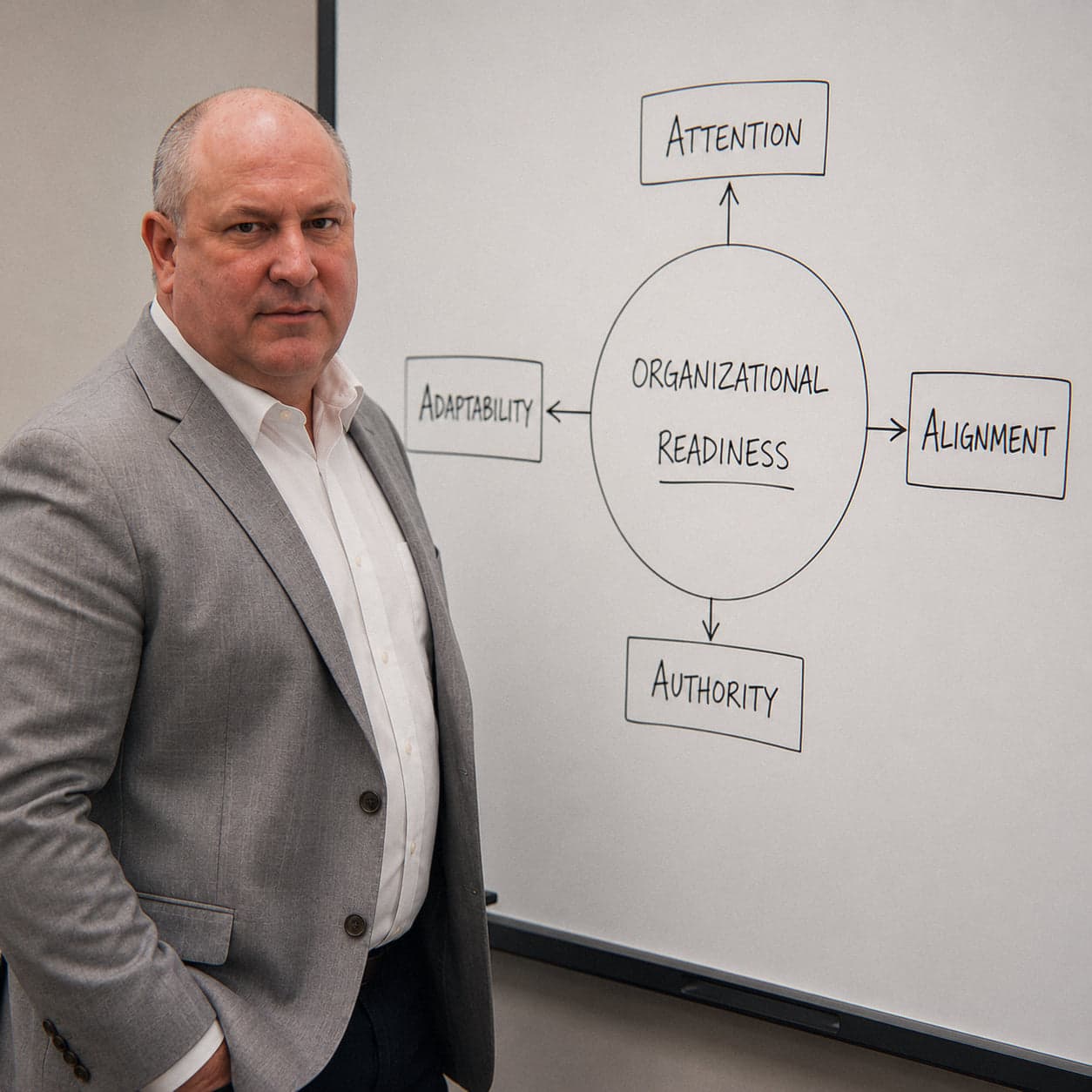
The Four A's of Organizational Readiness™ are four structural conditions that determine whether capable people and sound strategies produce results. Developed by Dan Flynn, Mission Intelligence Systems. Each condition can be diagnosed, built, and measured.
- 1.Attention: The condition that determines what the organization notices, and what it treats as worthy of sustained human focus. Awareness is passive. Attention is chosen. The question is whether the organization's attention reflects what actually matters, or whether it has drifted toward what is visible, urgent, and loud rather than what is important. Every organization allocates its attention somewhere, and it always tends to drift.
- 2.Alignment: The condition that determines whether the people doing the work share a clear enough picture of what they are building that their individual efforts combine rather than collide. Alignment is not agreement. You can have complete agreement and zero alignment, everyone nodding at the same words while carrying different pictures of what those words mean in practice. Real alignment is visible: it shows up in decisions made consistently without escalation, in teams that can answer the same question about priorities the same way, in work that connects rather than accumulates.
- 3.Authority: The condition that determines whether the people who understand a problem have the ability to solve it. Not formal authority, actual authority: the ability to make a decision, act on it, and have the action stick. Without rerouting through an approval structure that adds time and removes accountability. In most organizations, formal authority and actual understanding run in opposite directions. The people closest to the work understand it best and can change it least. The people furthest from it can change it most and understand it least. That inversion is one of the most reliable producers of organizational underperformance I have ever encountered.
- 4.Adaptability: The condition that determines whether the organization learns. Not whether it survives disruption, whether it extracts insight from experience and applies it forward. High-performing organizations treat friction, error, and failure as data, with real mechanisms for capturing what they learned and changing what they do as a result. Every organization encounters friction, error, surprise, and failure. The difference is whether the mechanisms are real ones, not aspirational ones. Organizations without this condition repeat the same mistakes under different names, launch the same initiatives that failed before under different banners, and accumulate institutional knowledge that lives only in the heads of individuals who eventually leave.
Attention aims the organization's focus, Alignment keeps everyone pointed the same way, Authority puts the power to act where the knowledge lives, and Adaptability turns what the organization sees into what it changes.
The operating sequence
A strategy becomes performance only when it can travel through all four conditions.
The Four A's are not four values to admire or four initiatives to launch. They form a connected system. A break anywhere limits what the whole organization can produce.
- 01
Attention
What deserves protected focus?
Leadership makes the tradeoffs that turn a long list of priorities into a usable direction.
Choose what matters
- 02
Alignment
What must we understand the same way?
People carry the same meaning into the decisions they make after the meeting ends.
Create shared intent
- 03
Authority
Who can decide and act?
The people closest to the relevant information can act within clear boundaries.
Move decisions to knowledge
- 04
Adaptability
What did reality teach us?
Evidence changes the plan, the operating conditions, and what receives attention next.
Update the system
The diagnostic principle
The weakest condition sets the ceiling. Strengthening a later condition cannot compensate for an earlier break in the sequence.
AI increases capability. It does not automatically increase capacity.
Many organizations approach AI transformation as a technology adoption problem. The deeper challenge is organizational: whether leaders can focus attention, align priorities, clarify decision authority, and adapt quickly as conditions change.
The Four A's of Organizational Readiness™ gives leaders a simple way to diagnose whether the operating model can absorb new capability and turn it into performance.
The framework is built on a single premise: conditions over blame. When capable people underperform, the instinct is to change the people. The real problem is almost always the conditions - the invisible architecture that shapes behavior regardless of who is in the room.
From Builders Build
This idea is developed in Part Two: The Four Conditions, Chapter 12, What I Kept Finding.
Attention
What must stop so the critical work can move?
Attention is not just about what the senior leader focuses on. It is about what the organization focuses on: what gets measured, reviewed, celebrated, and starved. In complex environments, unmanaged priorities fragment decision-making, slow learning, and create hidden capacity constraints that no headcount increase can solve.
Alignment
Do leaders share a common understanding of what matters most?
Alignment is the difference between an organization that moves when you lead and one that moves only when you push. Most organizations share work. Very few share understanding. When leaders interpret the same direction differently, the gap becomes a tax on every decision made below them.
Authority
Are decisions being made at the right level with enough speed?
Authority determines whether the organization can act on what it knows. When decisions stack up waiting for approval, capability isn't the problem: architecture is. Decision rights that live too high in the organization slow execution and quietly teach people that their judgment does not count.
Adaptability
Can the organization learn faster than conditions change?
Adaptability is the capacity to sense change, learn from feedback, and reconfigure work before conditions make the original plan obsolete. Organizations that cannot adapt do not fail suddenly. They drift, one quarter at a time, until the gap between what they planned and what is real becomes too wide to close.
Each Condition in Depth
What each dimension actually means, and what its absence looks like
The Four A's are not abstract values or aspirational qualities. Each one is a specific organizational condition that can be diagnosed, built, and measured. Here is what each dimension means in practice, and what leaders observe when it is missing.
Attention
What must stop so the critical work can move?
Attention is not about time management. It is the leadership discipline of protecting organizational focus as a scarce resource. Every priority added to a list is a claim on the same finite pool of leadership capacity. When that pool is oversubscribed, nothing advances at the speed the strategy requires, not because the people are wrong, but because the cognitive and organizational load has exceeded what the system can carry.
The Attention problem in most organizations is not that people are not working hard. It is that too much work is in motion simultaneously, fragmenting the judgment and decision capacity that makes any of it move. Attention management begins not with addition, a new system, a new meeting, a new process, but with subtraction. What has to stop so the important work can move?
Warning signals: Attention is the primary constraint when:
- • Every initiative is on the priority list, and none are advancing at the expected rate
- • Leaders are in meetings most of the day and doing "real work" early in the morning or late at night
- • Teams are perpetually in reactive mode: rarely completing anything before something more urgent arrives
- • The same work is in progress at the next quarterly review as it was at the last one
Alignment
Do leaders share a common understanding of what matters most?
Alignment is not agreement. Agreement is what happens in the room. Alignment is what happens after the room: when teams make decisions without checking, when tradeoffs are made consistently at every level, when a junior analyst and a senior executive would both describe the organization's top priority the same way. That kind of alignment is rare. And its absence is one of the most expensive operating conditions in any organization.
Misalignment does not usually look like conflict. It looks like unnecessary escalation: decisions that should be made at one level traveling upward because teams are not confident enough in the shared direction to act. It looks like wasted effort: teams working hard in directions that are locally logical and globally incoherent. It looks like the same strategic conversation happening again at the next offsite, with the same conclusions and the same lack of change.
Warning signals: Alignment is the primary constraint when:
- • Senior leaders describe the organization's top priority differently when asked separately
- • Teams escalate decisions that the leadership team believes they should be making independently
- • Strategic commitments made at the leadership level do not translate into changed work at the team level
- • The same misunderstandings recur across different teams and time periods
Adaptability
Can the organization learn faster than conditions change?
Adaptability is the ability to sense change, learn from feedback, and reconfigure work before conditions make the original plan obsolete. It is not agility: a term that often describes speed of delivery within a fixed approach. Adaptability is about the organization's capacity to update its understanding of what is true and change direction in response.
Most organizations have sophisticated mechanisms for reporting on experience. Almost none have mechanisms for learning from it. There is a structural difference between an organization that accumulates experience and one that converts experience into changed behavior. Adaptability is the latter, and it requires deliberate design. Retrospectives that produce no process changes, feedback that reaches no decision-maker, and failure reviews that identify root causes without changing anything: these are organizations with experience but without adaptability.
Warning signals: Adaptability is the primary constraint when:
- • The same types of problems recur across successive cycles, despite retrospectives or reviews
- • The organization is surprised by conditions that were visible in advance but not acted upon
- • Feedback from the field does not reach decision-makers in time to change anything
- • The organization continues executing a plan long after its premises have changed
The same symptom, different conditions
Which one is it?
Reading the four conditions is the easy half. The hard half is that most symptoms are produced by more than one of them, and the wrong repair usually makes the situation worse rather than leaving it unchanged. Pick something you recognize.
A status report shows movement and not cause, so three different conditions produce a stall that reads identically on the page where somebody notices it.
If it is Attention
Where the organization actually spends its focus.
It was never resourced with attention. It sat on a list of eleven priorities and got the share of focus that arithmetic allows.
The question that tells you
How many other initiatives were live in the same quarter, and can the sponsor name them without checking?
More than a handful, or the sponsor hesitates. Nothing was starved on purpose, which is exactly the problem.
First move
Count the simultaneous priorities and cut rather than sequence. Sequencing keeps them all alive and keeps them all costing something.
Read AttentionIf it is Authority
Whether decisions sit where the knowledge is.
It reached a decision nobody present could make. Somebody had to choose, no one had the standing, and so it waited.
The question that tells you
Can you name the specific decision it is waiting on, and the one person who could make it alone?
The decision is nameable and the person is not, or three people get named and each would defer to the others.
First move
Give that one decision to one person with a date on it, before anything structural is touched.
Read AuthorityIf it is Adaptability
Whether change survives contact with the organization.
It moved and then came back. The old way is still running underneath, so the new way was extra work laid on top of it.
The question that tells you
Is the thing this replaced actually gone?
It is still there, or nobody can say who turned it off and when.
First move
Find what the old way was protecting. There is usually something real, and until that is handled the reversion is rational.
Read AdaptabilityWhat this does not do
This narrows and it does not diagnose. Every symptom here is produced by more than one condition, which is the point: a tool that returned a single answer would be guessing on your behalf and sounding certain while it did. The discriminating questions are what separate the branches, and each is answered by looking at your own organization rather than by clicking. Where you want a measurement instead of a differential, the diagnostics do that, and they state what they cannot tell you as well.
See the diagnosticsScholarly foundation
Attention
↗Attention Residue
Switching between tasks leaves cognitive residue: incomplete work claims working memory and reduces performance on what comes next. Leaders who fragment their teams' attention pay a measurable, hidden productivity cost.
Leroy (2009) · Organizational Behavior and Human Decision Processes, 109(2), 168–181
Alignment
↗The Engagement Gap
Only 21% of employees globally are engaged at work. Managers account for 70% of the variance in team engagement. Misalignment is not a culture problem - it is a conditions problem, hiding at scale across every sector.
Gallup · State of the Global Workplace 2024
Authority
↗Decision Role Clarity
Ambiguity over who is accountable for which decisions is one of the most common causes of organizational slowdown. Organizations with clear decision authority execute faster and waste less talent on internal friction.
Rogers & Blenko (2006) · Harvard Business Review
Adaptability
↗Psychological Safety & Learning
Teams that feel safe surface problems earlier, share information more freely, and recover from failure faster. Without it, organizations lose early warning signals and adapt more slowly than their environment demands.
Edmondson (1999) · Administrative Science Quarterly, 44(2), 350–383
Foundational
↗Exploration & Exploitation
Organizations must balance exploiting existing strengths with exploring new capabilities. March's foundational work shows that over-investment in either direction produces brittleness - stagnation or instability.
March (1991) · Organization Science, 2(1), 71–87
Foundational
↗Dynamic Capabilities
Sustained advantage comes from an organization's ability to sense change, seize opportunities, and reconfigure its resources. Organizations that cannot adapt their capabilities lose ground even when current execution is strong.
Teece, Pisano & Shuen (1997) · Strategic Management Journal, 18(7), 509–533
The Four A's of Organizational Readiness™ is a framework developed by Dan Flynn and Mission Intelligence Systems. It draws from established organizational learning, strategy, and leadership research while translating those ideas into practical executive conversations.
Framework Dynamics
The Four A's are not independent: they compound
The Four A's interact. Addressing one in isolation produces partial improvement. Understanding how they relate to each other is what makes the framework a diagnostic tool rather than a checklist.
Attention enables Alignment
When everything is a priority, alignment is impossible. You cannot align around everything. Attention, the discipline of making real tradeoffs about what matters most, is the precondition for the kind of alignment that produces consistent execution. Organizations that have not made real priority tradeoffs do not have an alignment problem. They have an attention problem that looks like an alignment problem.
Alignment enables Authority
Decision rights can only be delegated when there is sufficient shared clarity about what the organization is trying to produce. Without alignment, delegating authority produces inconsistent decisions: each locally rational, collectively incoherent. Leaders feel compelled to re-centralize authority not because they want to micromanage but because the alignment conditions that would make distributed authority safe do not exist.
Authority enables Adaptability
Organizations cannot adapt if the authority to act on new information lives too far from the information itself. When every adjustment requires executive approval, adaptation is slow by structural design: not by intent. Placing authority close to the people who see change first is the enabling condition for the kind of fast organizational learning that Adaptability requires.
Adaptability reinforces all three
An organization that learns from experience, that converts feedback into changed behavior, continuously improves its Attention discipline, its Alignment clarity, and its Authority design. Adaptability is not just the fourth condition. It is the mechanism by which the other three stay calibrated as conditions change.
This is why the diagnostic sequence matters. Deploying an Alignment solution into an Attention problem produces effort without traction. Delegating Authority without Alignment produces speed in the wrong direction. The Four A's are most useful not as a list of things to improve, but as a lens for identifying which condition is the primary constraint, and addressing it in the right order.
Ready to evaluate your organization?
Use the Executive Organizational Diagnostic to evaluate attention, alignment, authority, adaptability, and organizational friction.
Featured Executive Resource
The Executive Guide to Organizational Readiness in the AI Era
Download the complete Mission Intelligence Systems guide introducing The Four A's of Organizational Readiness™, Attention, Alignment, Authority, and Adaptability, and how leaders can use them to strengthen transformation performance.
Real Results
Eight years of attempts, delivered in 45 days.
The breakthrough did not come from new technology or new staffing. It came from establishing what the result actually needed to do, and then discarding eight years of inherited work that had been built on a different reading of the problem.
From the Builder's Library
The Four A's in practice
Attention
The Calendar Never Lies
What leaders' time actually reveals about organizational priorities, and why the calendar is the most honest document in any organization.
Read →
Authority
Organizational Gravity
The structural force that pulls behavior back toward existing patterns, and what builders do when they understand it is not a people problem.
Read →
Adaptability
That Won't Work Here
Four words that carry eight distinct meanings, and what leaders learn to hear in them changes everything about how they build.
Read →
How It Differs
The Four A’s vs. traditional maturity models.
Most readiness and maturity models grade whether processes exist. The Four A’s diagnose whether the conditions let capable people perform. The difference is diagnosis versus scoring.
| Aspect | Traditional Maturity Models | The Four A’s of Organizational Readiness |
|---|---|---|
| Unit of analysis | Process and capability maturity levels | Organizational conditions that determine performance |
| Core question | Do the right processes exist and are they documented? | Do the conditions let capable people actually perform? |
| Where it looks | Artifacts, policies, and self-reported checklists | Behavior: calendars, decision paths, authority, workarounds |
| View of people | People are a maturity input to be upgraded | Conditions, not people, are the constraint |
| Output | A maturity score or level to advance | The primary constraint and the highest-leverage move |
| Improvement logic | Climb to the next maturity level across the board | Remove the one condition holding the others down |
| Stance | Prescriptive framework applied to the organization | Diagnosis before prescription, read from the organization |
Change management is the other comparison readers ask for, and it is a different question: it helps people adapt to a change already decided, while this diagnoses why the organization cannot execute in the first place. The Four A’s vs. change management →
Explore by Condition
Every dimension, with its definitions, insights, and proof.
Each of the Four A’s connects to a cluster of supporting material: the definition, the essays that develop it, a real outcome that demonstrates it, and the diagnostic that measures it.
Attention
Where leadership focus actually goes
Definitions
Alignment
Shared understanding that survives the room
Definitions
Authority
Decisions at the point of knowledge
Definitions
Adaptability
The soil that decides what can grow
Definitions
Outcomes from the work
A data warehouse stalled for nearly six years shipped to production with 1,600+ ETLs, same people, reassembled as a fresh team.
An organization demonstrated more throughput than it had in nearly thirty years, with no new people and no new technology.
A contract underbid by nearly a million dollars still reached profitability within a year, at higher pay rates.
Engagements from a thirty-year career in federal, defense and commercial organizations, every one of them delivered before Mission Intelligence Systems was founded. The framework was abstracted from them.
Explainer
The Four A's, in about two minutes
What you leave with: Which of the four conditions is most likely the binding constraint where you work.
Why capable organizations underperform
Most explanations for underperformance point at people or at technology.
Four conditions decide whether capable people produce the results they are capable of, and all four are structural. They are set by how the organization is arranged, not by who is in it.
Attention: Where the organization actually spends its focus.
The hidden performance cost paid when leadership focus is fragmented across too many simultaneous priorities. The calendar, not the strategy deck, tells the truth.
You are looking at: too many priorities, executive overload, meeting fatigue.
Alignment: What governs behavior after the meeting ends.
Agreement is what happens in the room. Alignment is what governs behavior after everyone leaves. The gap between them is where execution fragments.
You are looking at: everyone agreed, nothing moved, execution fragments, rework and drift.
Authority: Whether decisions sit where the knowledge is.
Knowledge accumulates at the front. Authority accumulates at the top. The gap between them is where organizational performance goes to slow down.
You are looking at: decisions take too long, people wait for approval, escalation for small calls.
Adaptability: Whether change survives contact with the organization.
Every organization has a structural force pulling behavior back toward existing patterns. Change that ignores it reverts, regardless of what leaders intend.
You are looking at: change reverts, initiatives stall, best people disengage.
What to do with this
The four are not a scorecard and they do not rank. One of them is usually the binding constraint, and work on the other three moves very little until that one is addressed.
Finding out which one is the point of measuring at all.