Adaptability
Organizational Antibodies
Why organizations attack new ideas the way a body fights infection.
Every organization has an immune system. It protects existing conditions from change. Understanding it is not optional: it is the first work of building.
Key Takeaways
- Every organization has an immune system designed to protect existing conditions from disruption - the organizational antibodies that reject new initiatives are not a sign of bad people but of a healthy defense mechanism doing its job.
- Builders who do not understand organizational antibodies will find their best initiatives rejected before they reach scale, for reasons that appear reasonable from the inside of the organization.
- Working with organizational antibodies rather than against them requires understanding what the existing system is protecting and designing change that accommodates - or deliberately renegotiates - that protection.
When a new initiative fails: when the strategy that was brilliant in the boardroom dies in the field, when the technology that worked in the pilot cannot be scaled, when the leader who came in with mandate and energy is gone in eighteen months with little to show for it: the explanation offered is almost always about execution.
The team didn't follow through. The middle layer didn't buy in. The culture resisted. The organization isn't ready.
These explanations are true as far as they go. What they miss is the mechanism.
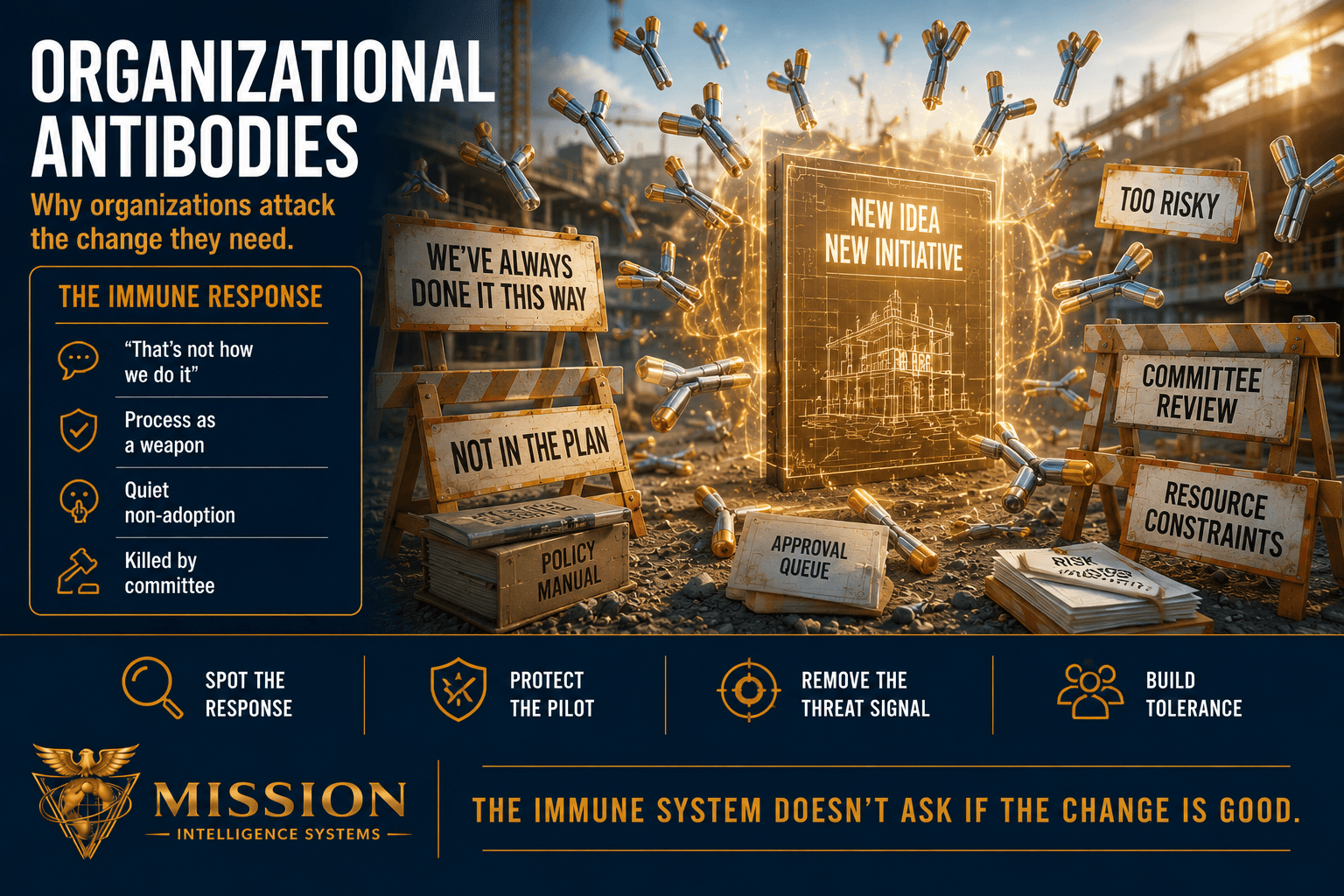
Every organization has an immune system. It is not a failure of the organization: it is a feature. The immune system exists to protect the organization from things that might destabilize it. It distinguishes foreign agents from native ones. It mobilizes to neutralize threats. And it is extraordinarily good at its job.
The problem is that the immune system cannot distinguish between a change that will harm the organization and a change that will improve it. It responds to novelty. It responds to threat to existing power arrangements. It responds to uncertainty. And most of what leaders call “change initiatives” qualify on all three counts.
Three Forms of Antibody Response
The organizational immune system deploys primarily through three mechanisms. Understanding which one you are facing is the first diagnostic question.
Procedural Friction
The process requirement that appears when it did not appear before. The approval step: that is now mandatory. The stakeholder review that must be completed before the next phase can begin. The policy exception that requires executive sign-off.
Procedural friction is the most socially acceptable form of antibody response because: it arrives wrapped in legitimacy. No one is blocking the initiative. They are simply following the process. The initiative slows. It misses its window. The sponsor loses patience. The energy dissipates. The process wins.
Social Withdrawal
The informal cooperation that quietly disappears. The person who used to provide: the workaround that made things actually function now has less time. The colleague who used to give early warning of problems before they became crises is now more formal, more distant, more careful.
Social withdrawal is harder to name because it is nearly invisible. Nobody can be accused of it. But the initiative that depends on the informal network, and every initiative eventually does: finds itself without it. Things that used to be easy become difficult. The friction is real but attributable to nothing.
Resource Starvation
The budget that is committed but never quite fully available. The staff who are allocated but whose other obligations always seem to take priority. The timeline: that is approved but whose dependencies on other teams are never quite resolved.
Resource starvation is the most patient form of antibody response. It does not kill initiatives outright. It puts them on a slow diet until they are too weak to succeed and too small to be worth saving. The initiative eventually fails not with opposition but with a quiet acknowledgment that it did not deliver on its promise.
The Immune System Is Not the Enemy
The most common mistake leaders make when they encounter organizational antibodies is to treat them as opposition to be overcome. This produces an escalating adversarial dynamic that almost always ends badly: either the change is pushed through in a way: that damages the relationships required to sustain it, or the pushback outlasts the leader's tenure and the change is quietly reversed.
The builder-leader reads the immune system as signal. When the antibody response is strong, it means one of two things: either the change is genuinely threatening to the organization in ways that deserve attention, or the change is legitimate but has not yet been understood as such by the people most affected. Both interpretations require a diagnostic response, not a forcing one.
The immune system is not the enemy. It is the environment. And builders build in the environment that exists, not the one they wish they had.
Why Smart Change Efforts Get Rejected
The most common mistake leaders make when facing organizational antibody responses is to conclude that the resistance proves they are right. The logic runs: if the organization is pushing back this hard, the change must be threatening something important. Resistance equals validation.
This is occasionally true and often false. Organizations resist change for reasons that have nothing to do with whether the change is correct. They resist it because it is unfamiliar. Because it disrupts established power relationships. Because it requires people to learn new things. Because it was introduced without adequate preparation of the immune system. Because the leader who introduced it has not yet built the credibility to make the change legible.
Distinguishing legitimate resistance from antibody response is one of the most important diagnostic skills in organizational change. Legitimate resistance contains specific objections grounded in knowledge of the situation: concerns about implementation sequencing, resource constraints, unintended consequences in parts of the system the change leader has not considered. This resistance should be taken seriously. It often contains information the change leader needs.
Antibody response contains general objections that apply to any change: “this is not how we do things here,” “we tried something like this before and it did not work,” “now is not the right time.” These are not arguments. They are reflexes. Treating them as arguments, debating them, trying to win the logical case, is the wrong intervention. The immune system does not respond to evidence. It responds to conditions.
The builder who can tell the difference between these two types of resistance will respond to each correctly: incorporating the first into better design, and reducing the conditions that produce the second.
Building With the Immune System
The builder who understands organizational antibodies designs accordingly. They identify: which form of resistance is most likely before the initiative begins. They build the conditions that reduce the immune response: not by suppressing it, but by making the change less threatening to the parts of the organization that would otherwise mobilize against it.
For procedural friction: they work within the process where possible, and they secure explicit sponsorship from the authority level that can move the process before it becomes a blocker.
For social withdrawal: they identify the informal leaders: the people whose cooperation gives the change legitimacy regardless of their title, and they engage them first, honestly, with enough information to make informed support possible.
For resource starvation: they make the resource allocation decision explicit and visible at the right authority level before the initiative begins: not as a budget line, but as a commitment with named owners and visible accountability.
The immune system will respond. The builder plans for it. That is the difference between an initiative that thrives and one that does not.
Dan Flynnis the creator of The Four A's of Organizational Readiness™ and author of Builders Build: The Four A’s of Organizational Readiness™ (forthcoming).
Related reading: The Courage to Stop · The Organizational Friction Index · The Four A's Framework
About the Author
Dan Flynn
Creator of The Four A's of Organizational Readiness™ · Enterprise Transformation Executive · Author, Builders Build
Dan Flynn has spent thirty years inside federal, defense, and commercial organizations: diagnosing the invisible conditions that determine whether capable people produce extraordinary results. He is the creator of The Four A's of Organizational Readiness™ framework, has reached more than 11,000 professionals across corporate, civic, and national security contexts, and produced a documented 1,033% improvement in delivery velocity by changing organizational conditions: not people.
His book, Builders Build: The Four A’s of Organizational Readiness™, is forthcoming.