
The Real Cost of a Continuing Resolution Is Attention
The money usually arrives. The planning does not come back.
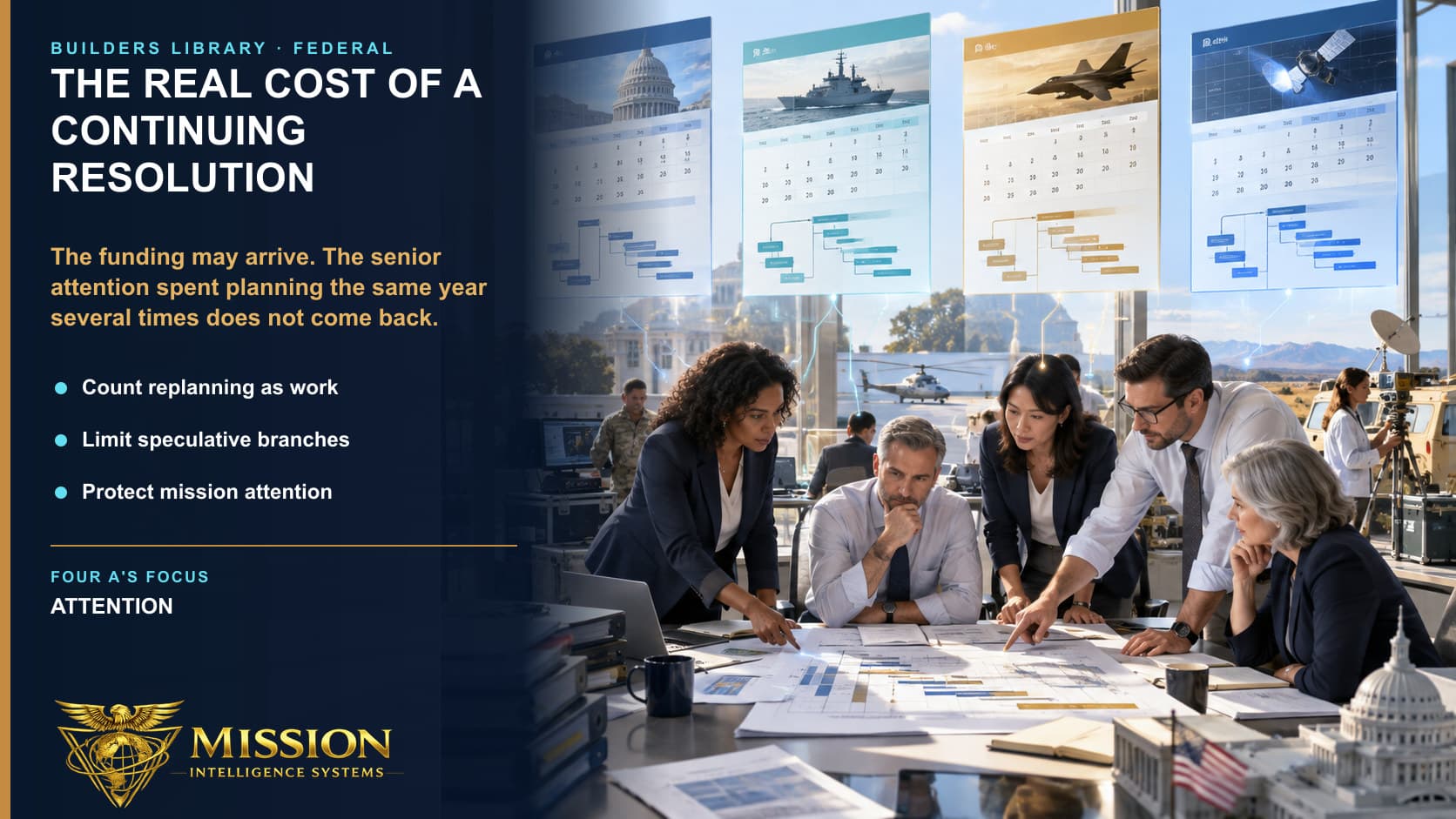
A continuing resolution is discussed as a funding problem and managed as a funding problem. Its more durable cost sits somewhere else entirely, in the senior attention spent planning one fiscal year three or four times, and no supplemental restores that.
Published
Key Takeaways
- F-35 program officials told GAO they constantly replan their budget under a continuing resolution, and put 20 percent of their financial management staff's time against adjusting it. That is a fifth of a function, spent on work that produces no capability.
- The standard advice, prepare for several funding scenarios, is itself the largest single source of the cost. A program that builds three plans will execute one, and the other two were attention spent producing nothing.
- So the decision worth making in advance is not which scenario to prepare. It is how much of the year is allowed to be replanned at all, and who is permitted to reopen it.
Research foundation
Three GAO reports supply the measurement, across seventeen years and both halves of the government, and each is cited for its own scope rather than blended: GAO-09-879 on six civilian agencies, GAO-22-104701 on three departments, and GAO-26-107065 on the Department of Defense. Kasdin, in The American Review of Public Administration, supplies what happens after a continuing resolution ends. The attention mechanism is Ocasio on the attention-based view and Leroy on attention residue, and the second of those is a laboratory finding about individuals rather than a study of federal programs, which is stated in the text where it is used.
Somebody says the word and the room does the same arithmetic it did last year. How long, what is at the old rate, what cannot start, what happens if it runs to February. The arithmetic is not hard and it is not the cost.
How much of this is normal?
Almost all of it, which changes what a program should be planning against.
GAO reported in 2022 that the federal government had operated under a continuing resolution in all but three of the previous 46 years. In January 2026 it reported that the Department of Defense had carried out its national security mission under one in all but 12 of the previous 49. The two numbers differ because the scopes do, government-wide against one department, and both say the same thing: the on-time appropriation is the exception.
A program that treats the full-year appropriation as the base case and the continuing resolution as a disruption has built its plan around the rarer event. That is not a forecasting error so much as a category error, and it is the reason the same surprise arrives every autumn.
What does it actually consume?
Staff time in the finance and program offices, at a rate somebody has measured.
GAO surveyed Department of Defense programs and reported in January 2026 that F-35 program officials constantly replan their budget during a continuing resolution, and estimate that 20 percent of their financial management staff's time is spent adjusting it to manage within the constraints. That is a fifth of a function, indefinitely, against work that produces no aircraft and no capability. In the same review, about half the acquisition programs surveyed, 36 of 74, reported schedule effects such as delays in awarding contracts or in delivering and fielding equipment.
The pattern is not new and it is not defense-specific. GAO found in 2009, across six civilian agencies, that uncertainty limited management options and increased workload, and in 2022 that agencies did additional work to operate inside the constraints, issuing shorter-term grants and contracts several times where one award would otherwise have done. The most common inefficiencies reported were delays and repetitive work. That second word is the whole subject.
Why call it attention rather than cost?
Because the money is mostly recoverable and the attention is not.
When the appropriation passes, the funding arrives. The hours spent building the plan that was discarded do not, and neither does the executive judgment that went into them. Ocasio's attention-based view of the firm makes the reason precise: what an organization does is decided by how it channels and distributes the attention of its decision makers, and that attention is the scarce input rather than the money. A program that has spent its senior attention on funding arithmetic has not merely been busy. It has been deciding, by omission, that other questions get less.
There is a smaller and more mechanical version of the same effect, and it is worth naming because people feel it without having a word for it. Leroy showed that switching between tasks leaves attention residue, a part of the mind still working the previous task, which lowers performance on the next one. That is a laboratory finding about individuals and not a study of appropriations, so it is offered as a mechanism rather than as evidence about federal programs. Applied here it says something ordinary: the cost of being interrupted four times is more than four interruptions.
What happens when the money finally lands?
The deferred work arrives compressed, and compression changes what gets bought.
Kasdin examined federal contracting around continuing resolutions and found that agencies restricted during one rush to complete contracting after it ends, which encourages sole-source awards over competitive ones and cost-reimbursement designs over fixed-price. Read that as a second-order effect rather than a delay. The schedule slip is visible and gets reported. The change in what the government bought, and on what terms, is not visible on any schedule and outlasts the fiscal year it happened in.
So the honest accounting has three lines rather than one. Attention spent replanning, capability delayed, and contracts written under time pressure that would have been written differently with a month more.
Why the usual advice makes it worse
Prepare for several funding scenarios is the standard counsel, and following it is how the bill gets paid.
A program that builds a full-year plan, a six-month plan and a hard-stop plan has done three planning cycles and will execute one. Two of them were attention spent producing nothing, and they were spent by the most senior people available, because scenario planning is not delegable in the way execution is. The preparation is not free and it is not insurance. It is the cost, paid in advance, in the currency that has no supplemental.
None of which argues for planning nothing. It argues that the number of scenarios is a decision somebody should make deliberately, with a cost attached, rather than a default that reads as prudence.
What is the decision worth making?
How much of the year may be reopened, and who is allowed to reopen it.
Write down, before October, which commitments are fixed regardless of the funding path and which are genuinely contingent. Most programs discover the fixed list is longer than the conversation assumes: people already hired, contracts already awarded, work already in progress. Those do not need a scenario. What needs one is the smaller set that actually branches.
Then name who may reopen a plan. Absent that, everyone with a stake reopens their own piece on their own schedule, which multiplies the replanning by the number of offices rather than doing it once. This is the same failure named in Priority Without Cost Is Not Priority: a decision that costs nobody anything is not a decision, and neither is a replan nobody had to authorize.
Why this is an Attention problem
Because everything about the funding is already understood and the drain continues anyway.
Nobody in a program office is confused about what a continuing resolution does. The rules are published, the constraints are known, and the arithmetic is routine. What is missing is any account of what the response costs, and so the response is unbudgeted: the organization spends its scarcest input on the most predictable event in its calendar, every year, without anyone approving the expenditure. The attention tax is exactly this, an outflow nobody authorized because nobody priced it.
The diagnostic fits in one question, asked of a program manager in November. How many versions of this year have you built? If the answer is more than one and nobody decided that in advance, the number is not preparation. It is the bill.
Evidence matrix
| Claim | Evidence tier | Source |
|---|---|---|
| A fifth of F-35 financial management staff time goes to replanning under a CR | Government audit | GAO-26-107065 (January 2026) |
| 36 of 74 surveyed acquisition programs reported schedule effects | Government audit | GAO-26-107065 (January 2026) |
| Agencies perform repetitive work, issuing shorter awards several times | Government audit | GAO-22-104701 (June 2022) |
| Uncertainty limited management options and increased workload | Government audit | GAO-09-879 (September 2009) |
| Post-CR rush favors sole-source and cost-reimbursement contracting | Peer reviewed | Kasdin (2021), ARPA |
| Behavior follows how an organization distributes decision-maker attention | Peer reviewed | Ocasio (1997), SMJ 18 |
| Task switching leaves residue that lowers performance on the next task | Peer reviewed, individuals in a laboratory | Leroy (2009), OBHDP 109(2) |
| Preparing for every scenario is the cost rather than the insurance | Four A's interpretation | Builders Build, Attention |
What to do with this
Before the next fiscal year opens, write two lists. What is fixed regardless of the funding path, and what genuinely branches. Then name the one person who may reopen the second list, and the threshold at which they do. Most of the replanning a program does is not required by the appropriation. It is required by the absence of anybody entitled to say that a plan stands.
References
- U.S. Government Accountability Office. Defense Budget: Effects of Continuing Resolutions on Selected Activities and Programs Critical to DOD's National Security Mission. GAO-26-107065, January 2026 (reissued with revisions 4 February 2026). gao.gov/products/gao-26-107065.
- U.S. Government Accountability Office. Federal Budget: Selected Agencies and Programs Used Strategies to Manage Constraints of Continuing Resolutions. GAO-22-104701, June 2022. gao.gov/products/gao-22-104701.
- U.S. Government Accountability Office. Continuing Resolutions: Uncertainty Limited Management Options and Increased Workload in Selected Agencies. GAO-09-879, September 2009. gao.gov/products/gao-09-879.
- Kasdin, Stuart Roy. “Continuing Costs: The Impact of Continuing Resolutions on Federal Contracting.” The American Review of Public Administration, 2021. doi.org/10.1177/02750740211010347. Volume, issue and page numbers were not confirmed and are therefore omitted.
- Ocasio, William. “Towards an Attention-Based View of the Firm.” Strategic Management Journal, vol. 18, 1997, pp. 187–206. doi.org/10.1002/(SICI)1097-0266.
- Leroy, Sophie. “Why Is It So Hard to Do My Work? The Challenge of Attention Residue When Switching Between Work Tasks.” Organizational Behavior and Human Decision Processes, vol. 109, no. 2, 2009, pp. 168–181. doi.org/10.1016/j.obhdp.2009.04.002. Cited as a mechanism observed in individuals, not as evidence about federal programs.
About the Author
Dan Flynn
Creator of The Four A's of Organizational Readiness™ · Enterprise Transformation Executive · Author, Builders Build
Dan Flynn has spent thirty years inside federal, defense, and commercial organizations: diagnosing the invisible conditions that determine whether capable people produce extraordinary results. He is the creator of The Four A's of Organizational Readiness™ framework, has reached more than 11,000 professionals across corporate, civic, and national security contexts, and took a federal data platform from one release every six months to seventy-two every two weeks by changing organizational conditions: not people.
His book, Builders Build: The Four A’s of Organizational Readiness™, is forthcoming.