
Field Evidence · Defense HR Modernization
10 hours of daily processing. Reduced to under 2. Not by replacing the technology.
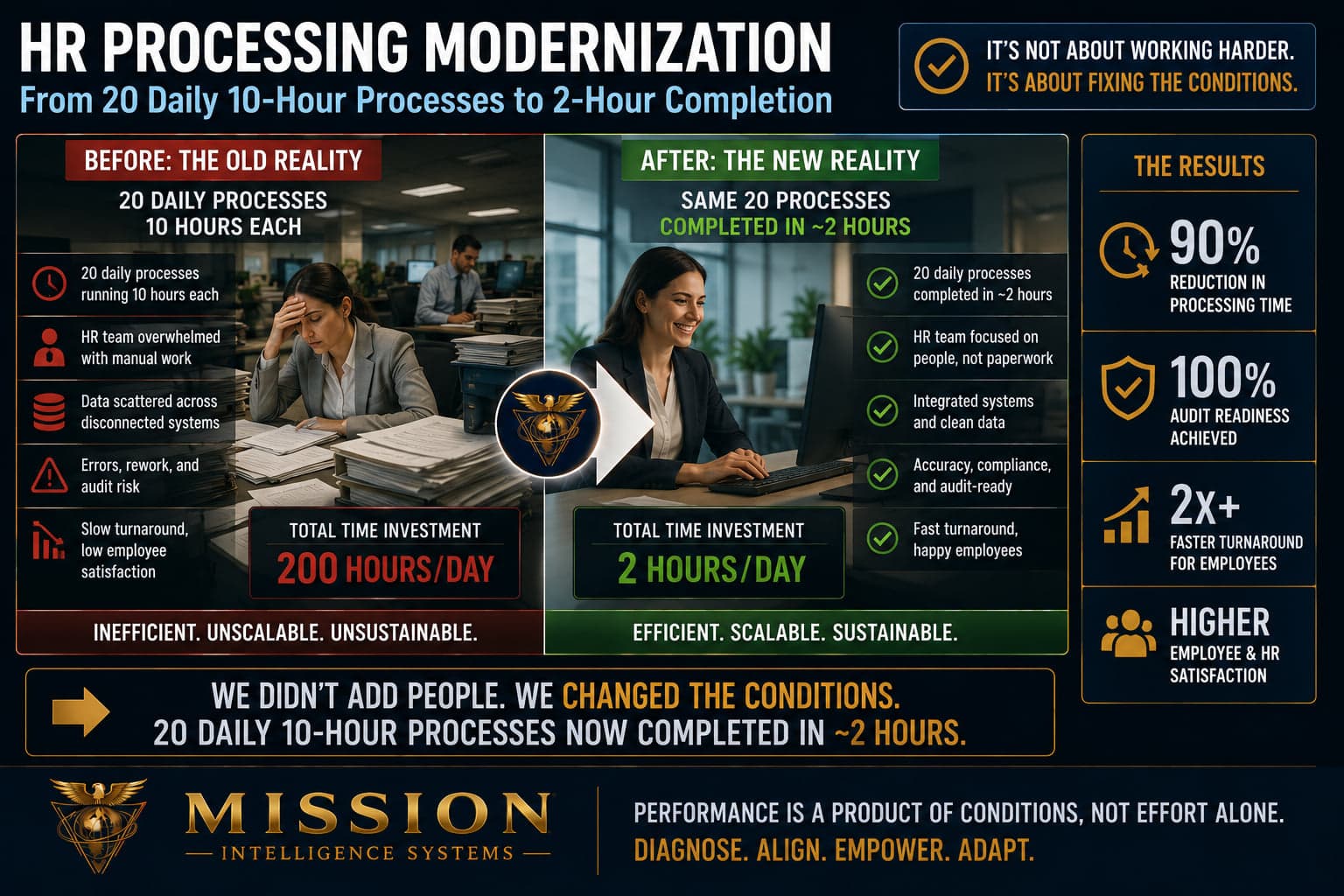
A major defense department HR data program was spending most of each working day running a single daily pipeline. The constraint was not computational: it was organizational. Misaligned ownership, accumulated complexity, and diffuse authority had turned a manageable process into a 10-hour daily obligation.
80%
Reduction in daily processing time
10 hrs → <2 hrs
Critical daily HR data pipeline
8+ hours
Capacity freed for higher-value analytical work
Alignment + Attention
Primary conditions addressed
The Situation
A pipeline that consumed the day before the work could begin
A defense department program responsible for civilian HR data was running a critical daily ETL pipeline that processed workforce records for tens of thousands of employees. The data produced by this pipeline fed into leadership dashboards, workforce planning tools, and downstream HR functions.
The pipeline took approximately 10 hours to complete each day. By the time it finished, the technical team had less than two hours before the next cycle had to begin. The analytical work the function existed to do, identifying patterns, surfacing insights, supporting leadership decisions, had almost no time in which to happen. The team was fully capable. Their capacity was entirely consumed by the operational reality they were working inside.
The standard prescription would have been infrastructure upgrades: more compute, a different data platform, a new ETL framework. That prescription would have been wrong. The pipeline was slow not because of what was running it, but because of what was in it: years of accumulated requirements, undocumented dependencies, redundant transformations, and competing data sources that no one had authority to rationalize.
The pipeline was a record of every team that had ever added something to it and no team that had ever owned the whole. That is not a technology problem. It is an alignment and authority problem.
The Diagnostic
What the Four A's revealed
The diagnostic did not start with the pipeline. It started with the organizational conditions around the pipeline: who owned what, who could decide what, and what the team was capable of doing once those conditions were clarified.
Attention
Significant gap
The team responsible for the daily HR data pipeline was spending the majority of each workday on a single recurring operational process. By the time the 10-hour pipeline completed, there was almost no time left for analysis, improvement, or anything beyond the next cycle. Attention was entirely consumed by operational throughput. No capacity existed for the higher-value work the function was supposed to produce.
Alignment
Primary constraint
The pipeline had been built incrementally over several years, with different teams owning different components at different times. By the time this engagement began, no one had a complete picture of what the pipeline actually did, why each step existed, or which components were load-bearing. Teams were aligned around their piece: not the whole. Redundant steps, competing data sources, and undocumented dependencies had accumulated unnoticed because no one owned the full picture.
Authority
Contributing gap
Because no one had full picture clarity, no one had clear authority to change anything. Pipeline modifications required consensus across multiple stakeholders who each owned a portion and none of whom were accountable for the whole. The cost of this diffuse authority was visible in the accumulated weight of the pipeline: every team had added their requirements; no team had authority to remove anything.
Adaptability
Not primary
The team was capable of learning, and did, once the conditions supported it. Once alignment and authority were established and the pipeline was redesigned, the team built monitoring, flagged anomalies, and made iterative improvements. Adaptability was not absent; it was blocked by the conditions above it.
The Intervention
Alignment first. Redesign second.
The intervention followed the diagnostic. Because the primary constraint was alignment, no one owned the full picture, the first step was establishing that ownership before any technical changes were made. Redesigning the pipeline before aligning on what it needed to do would have rebuilt the same problem with newer code.
Mapped the full pipeline with unified ownership
Conducted a complete end-to-end mapping of every pipeline step, data source, transformation, and output: bringing together every team that owned a component into a single shared view for the first time. Ambiguities were surfaced and resolved. Redundancies were identified. The team that would own the redesign saw the full system before touching it.
Established clear decision authority for pipeline architecture
Designated a single technical owner with full authority over the pipeline architecture, including the authority to remove steps, consolidate data sources, and rationalize transformation logic without requiring consensus from every historical stakeholder. This was the enabling condition for the redesign that followed.
Rationalized the pipeline based on actual downstream requirements
With unified ownership and clear authority in place, the team conducted a systematic review of every pipeline component against actual downstream requirements. Components that existed for historical reasons, not current needs, were removed. Data sources were consolidated. Transformation logic was simplified and parallelized where possible.
Protected dedicated analytical time in the daily operating rhythm
Restructured the daily team schedule so that analytical capacity was protected as a first-class obligation: not whatever time was left after the pipeline finished. This was an attention intervention: it made explicit that the function existed to produce analysis, not to run a pipeline, and structured the day accordingly.
The Results
Eight hours returned. Every day.
The redesigned pipeline ran in under two hours. The technical team had not been replaced. The data had not moved to a new platform. The fundamental mission, process HR data reliably, daily, had not changed. What changed was the organizational conditions under which the work was done.
80%
Processing time reduction
Daily pipeline runtime reduced from approximately 10 hours to under 2 hours: not through infrastructure upgrades, but through pipeline rationalization enabled by unified ownership and clear authority.
8+ hours
Capacity freed daily
More than eight hours of technical capacity returned to the team every day: capacity that had previously been consumed entirely by pipeline operations. That capacity was reallocated to the analytical work the function existed to produce.
Eliminated
Redundant data processing
Significant redundancy in transformation logic, data sourcing, and intermediate processing steps was identified and removed. The pipeline became smaller, faster, and more maintainable: owned by a team that understood every step in it.
Improved
Data reliability and leadership confidence
With faster processing and clearer ownership, pipeline failures became detectable and fixable in near-real-time. Leadership confidence in the data, previously undermined by latency and occasional unexplained anomalies, improved materially.
The pipeline was a conditions problem wearing a technology costume. Once the conditions changed, aligned ownership, clear authority, protected analytical time, the same team produced dramatically different results with the same tools.
What This Case Teaches
What leaders should recognize in this story
Accumulated complexity is always an alignment failure
When no one owns the whole, every team adds their requirements and no one removes anything. The result is not a technology problem: it is the visible residue of years of misaligned ownership. The right diagnostic question is not "how do we make this faster?" It is "who owns this, and what are they accountable for producing?"
Diffuse authority produces resilient bloat
When removing something requires consensus from everyone who ever added something, nothing gets removed. Organizations protect against this by assigning clear architectural ownership with explicit authority to rationalize: not just to build. The cost of absent authority is paid in accumulated weight, indefinitely.
Attention is a structural question, not a scheduling question
Telling a team to "spend more time on analysis" while their day is consumed by a 10-hour pipeline changes nothing. Protecting analytical time requires changing the operating conditions that produce the time constraint: not asking people to work differently inside the same conditions.
Related Reading
Work With Us
Recognize this pattern?
Accumulated complexity, diffuse ownership, and consumed capacity are patterns Dan has diagnosed across federal, defense, and commercial organizations. The conditions that produce them are identifiable. The interventions that resolve them are deliberate and structural.