Leadership · Builder Development
Building Adaptability When It Doesn't Come Naturally
Execution is a strength. The cost is not learning from what happens. Here is how to build both.
Strong executors finish things. They drive toward completion, push through friction, and deliver. These are real strengths. The shadow side is that execution-focused contributors often move so quickly from one thing to the next that the learning available in what just happened never gets extracted. Problems recur in slightly different forms. The same mistakes repeat under new names. The team gets better at doing without getting better at knowing.
Research Foundation
- Double-loop learning (Argyris and Schon)
- The learning organization (Senge)
- Self-efficacy and observational learning (Bandura)
- The Builders Build Framework
Key Takeaways
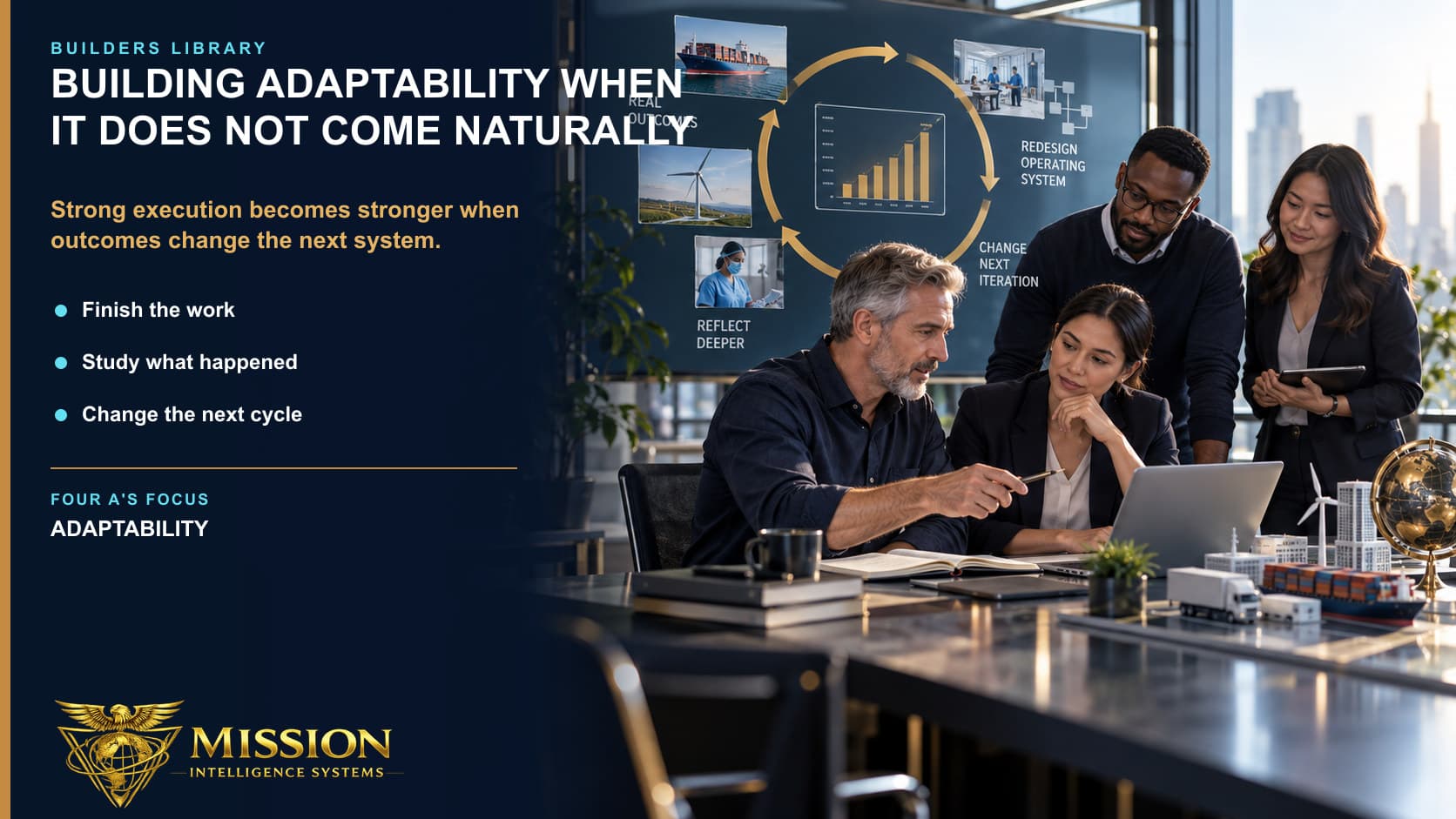
- Strong executors finish things. The gap is the learning that happens between projects, not during them.
- The entry point for building adaptability is one question after anything goes wrong: what would have needed to be different in our system for the right outcome to happen?
- This is an Adaptability condition: contributors who build learning habits create organizations that get better over time, not just organizations that get things done.
What natural adaptability builders actually do
Natural adaptability builders do not move faster. They stop at a different moment. After something goes wrong, or even after something goes right but differently than expected, they pause and ask what the outcome tells them about the system that produced it. They are not looking for who made the mistake. They are looking for what would have needed to be different for the right thing to happen. That question is the entire discipline, and it is learnable.
The cost of single-loop execution
Argyris and Schon's foundational work on organizational learning distinguishes single-loop from double-loop learning. Single-loop learning corrects errors within existing assumptions: we missed the deadline, so we will work faster next time. Double-loop learning questions the assumptions that produced the error: we missed the deadline because our estimation process does not account for the handoffs between teams, so we will change the process. Executors are often excellent single-loop learners. The gap is double-loop: changing the system, not just the behavior within it.
If your team keeps solving the same problem in slightly different forms, you are single-loop. The answer is not more effort. It is a question about the system that keeps producing the problem.
The one question that builds the habit
After anything goes wrong, ask: what would have needed to be different in our system for the right outcome to happen? Not who made the mistake. Not what should they have done differently. What would have needed to be different in the structure, the process, the information flow, or the expectations for the right outcome to be more likely? This question is the gateway to double-loop learning. It does not require a reflective personality. It requires a deliberate pause and one question.
Senge's work on learning organizations shows that this discipline is the difference between organizations that improve over time and organizations that execute with increasing efficiency until a structural problem breaks them. The question is not overhead. It is the investment that makes execution sustainable.
Developing others as an adaptability practice
Bandura's research on observational learning shows that people learn more from watching skilled practitioners than from being told what to do. The most powerful adaptability practice available to a strong executor is deliberate teaching: passing on what you know, explicitly and on purpose, to the people around you. Not because it is generous, though it is. Because the organization's capacity to deliver does not scale with your own capacity. It scales with the number of people who can do what you do.
This is the adaptability contribution that natural executors most often leave on the table. They finish. They deliver. They move to the next thing. The knowledge stays in their heads and leaves the organization when they do. The practice is simple: when you finish something well, spend thirty minutes writing down what you learned about how. Not the what. The how.
When to stay the course
The shadow of strong adaptability builders is changing when stabilization is what the team needs. Building this skill is not about becoming a constant change agent. Adaptability is most valuable when the system produced a bad outcome and needs to learn. It is not valuable as a default mode. For strong executors developing this skill, the entry point is the post-incident question, not wholesale adoption of a more change-oriented posture. Learn to ask the question after something goes wrong. The rest will develop from there.
Through the Four A's
Adaptability building is the condition that ensures the other three keep working. Attention, Alignment, and Authority are all organizational designs that need to evolve as the environment changes. A team that can learn from what happens maintains those conditions over time. A team that only executes without learning will eventually find that the conditions that worked have eroded, and no one changed them because no one was watching.
Evidence matrix
| Claim | Research | Field evidence | Four A's |
|---|---|---|---|
| Single-loop corrects; double-loop improves the system | Argyris & Schon (1978) | Teams that question assumptions stop repeating structural problems | Adaptability |
| Learning organizations outperform over time | Senge (1990) | Organizations that extract learning compound capability | Adaptability |
| Observational learning transfers tacit knowledge | Bandura (1977) | Deliberate teaching multiplies individual capability across teams | Adaptability |
Reflection questions
- The last time something went wrong on your team, did you ask what the system produced or who made the mistake?
- Is there a problem your team keeps solving in slightly different forms? What would need to change for it to stop recurring?
- When did you last pass on something you know to someone who needs to know it?
- How much of your team's capability lives in your head and leaves when you do?
Builder actions
After the next thing that goes wrong, ask the system question before the blame question: what would have needed to be different in our structure, process, or expectations for the right outcome to happen? Write the answer down and share it with the team. Then pick one person on your team and spend thirty minutes explicitly passing on something you know how to do. Not the what: the how. These two practices, the learning question and the deliberate teaching moment, are the entire adaptability discipline for strong executors. They build the habit that makes the team better over time, not just faster in the moment.