
The Four A's · Adaptability
Change Fatigue
Why repeated change leaves organizations too tired to change again.
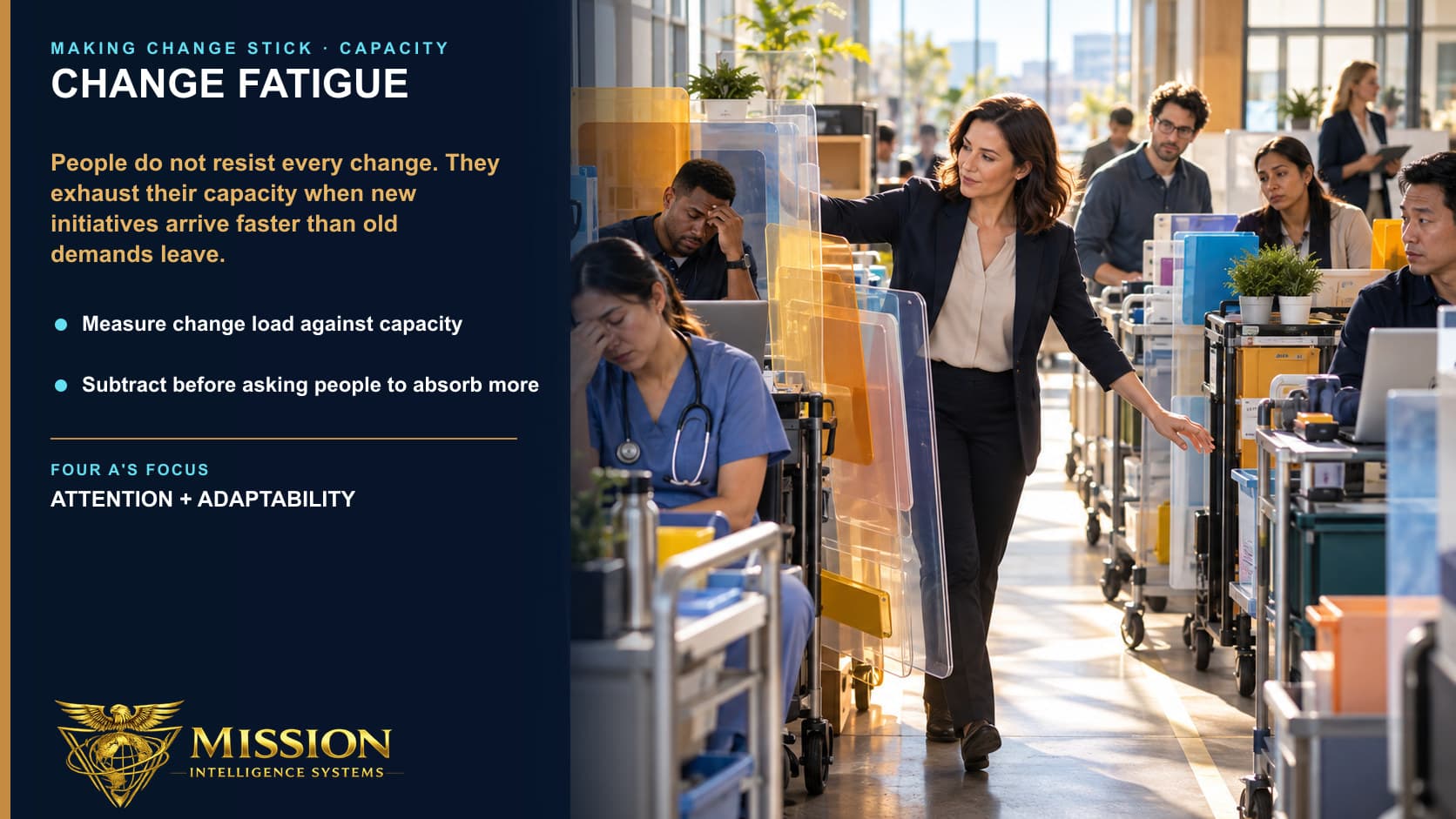
Most transformations are not defeated by people who disagree with them. They are defeated by people who have simply run out of capacity to absorb one more change. The data on this is stark, and it points to a different playbook.
Research Foundation
- Peer-reviewed organizational and change research
- Institutional research (Gartner, HBR)
- Executive leadership literature
- Enterprise transformation field experience
- The Builders Build Framework
Key Takeaways
- Gartner found that employee willingness to support enterprise change fell from 74 percent in 2016 to 38 percent in 2022, while the average employee absorbed ten planned changes a year, up from two.
- Change fatigue is measurable and expensive: fatigued employees are markedly more likely to leave, and saturated organizations revert to prior behavior regardless of what leaders intend.
- The Four A's treat this as an Adaptability problem: whether an organization has the capacity to change and retain the change, not just the ambition to launch it.
The capacity has collapsed
Gartner's research, reported in its Q1 2023 Business Quarterly, found that the share of employees willing to support enterprise change fell to 38 percent in 2022, from 74 percent in 2016. Over the same period the average employee experienced around ten planned enterprise changes a year, up from two. Harvard Business Review, drawing on the same body of work, described employees as losing patience with change initiatives. The pattern is not that people became more resistant. It is that the volume of change outran the human capacity to absorb it, and willingness gave way to exhaustion. Gartner also found that fatigued employees were substantially more likely to consider leaving.
Why change reverts
Kurt Lewin's foundational model described change as a sequence that must be refrozen, or behavior snaps back to its prior state. Chris Argyris and Donald Schon showed that durable change requires altering the underlying routines and assumptions that govern behavior, not just the visible process. Peter Senge described the systemic forces that pull organizations back toward familiar patterns. Under fatigue, none of the refreezing work happens: the organization launches, moves on to the next initiative, and the change quietly reverts. What looks like failure of will is usually failure of capacity and consolidation.
A change that is launched but never learned is not a change. It is a cost the organization pays and then forgets.
The Four A's reading
The research establishes the phenomenon. The Four A's of Organizational Readiness provide the executive lens. Change fatigue is an Adaptability failure: the organization has more change in flight than it can metabolize and retain. It sits on top of an Attention failure, because too many simultaneous initiatives fragment the focus each one needs to stick, and an Alignment failure, because people cannot commit to change they do not share a reason for. In one large defense enterprise, the breakthrough was not a better change program. It was fewer changes, sequenced, each given enough sustained attention to be consolidated before the next began.
The loop this creates
Left unexamined, the condition reproduces the very result that seems to justify it, and the organization keeps treating a structural problem as a people problem.
The condition
A structural condition (unclear authority, no safety, no slack) is in place.
The behavior
People behave rationally given the condition: they wait, hedge, stay silent, or defend.
The result
The organization gets the outcome the condition was always going to produce.
The interpretation
The result is read as proof the people or the plan were the problem, so the condition is left untouched.
Loops back to the condition
Because the condition is never changed, it produces the same result again. Adaptability breaks the loop by changing the condition, not by trying harder at the behavior.
Evidence matrix
| Claim | Research | Field evidence | Four A's |
|---|---|---|---|
| Willingness to support change has collapsed | Gartner (2023); HBR (2023) | A large defense enterprise | Adaptability |
| Change reverts without consolidation | Lewin (1947); Argyris & Schön (1978); Senge (1990) | Initiatives that quietly rolled back | Adaptability |
| Too many changes fragment the focus each needs | Change saturation research | Overlapping transformation programs | Attention |
What executives should do
Manage change as a scarce capacity, not an unlimited mandate. Count the changes already in flight before launching another, and sequence rather than stack them. Budget for consolidation, the unglamorous work of refreezing a change into routine, and do not declare victory at launch. Fewer changes, given enough sustained attention to actually stick, will outperform more changes that all revert.