
The Four A's · Adaptability
Deployment Is Not Transformation
Why deploying AI tools does not produce transformation.
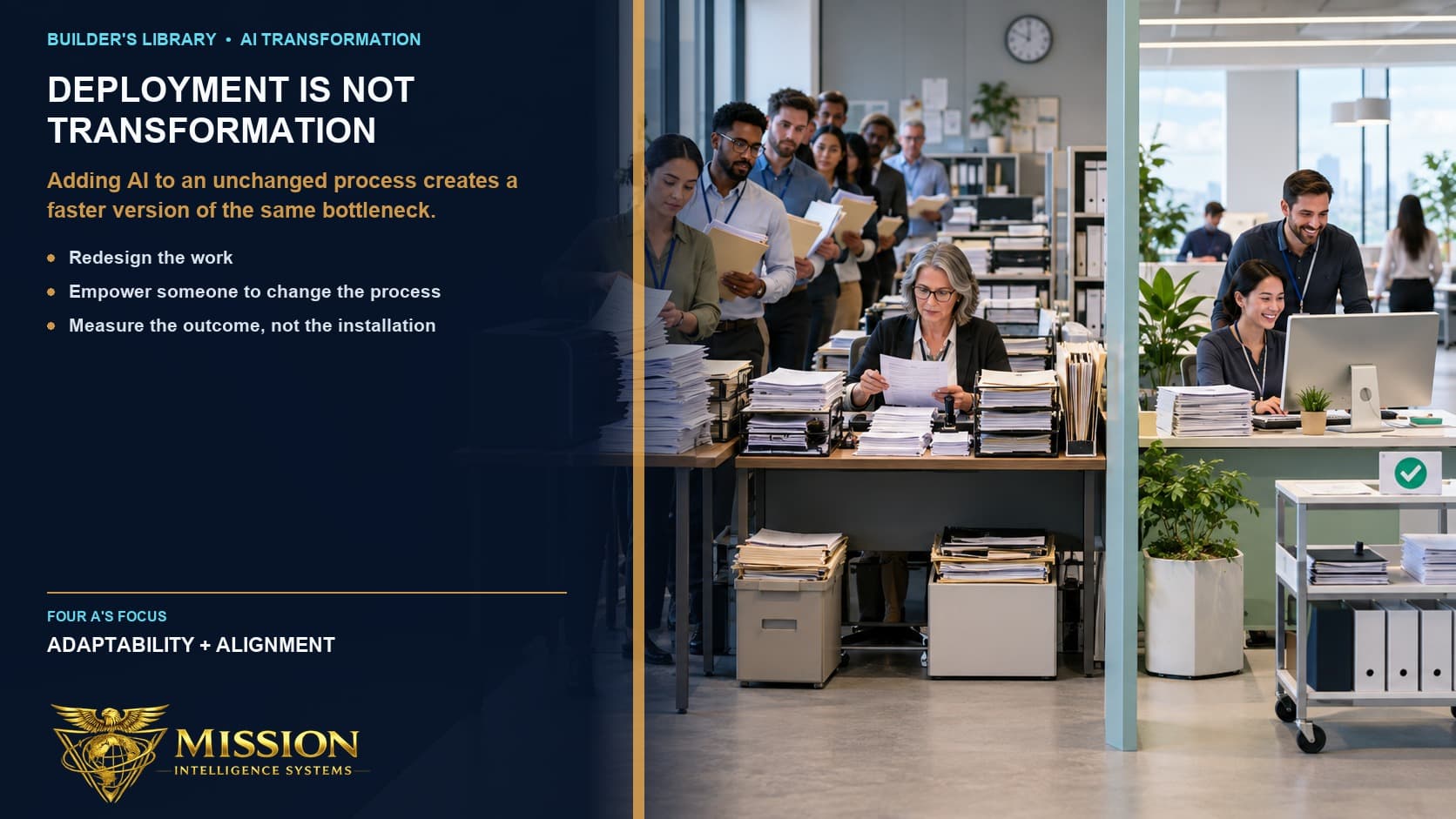
Most organizations have deployed AI. Very few have transformed with it. The difference is not effort or budget. It is whether the organization changed how the work is actually done, or simply added a powerful tool to a process it left untouched.
Research Foundation
- Management science and information systems research
- AI and technology research (MIT)
- Executive leadership literature
- Enterprise transformation field experience
- The Builders Build Framework
Key Takeaways
- MIT's 2025 GenAI Divide found that value concentrated where organizations changed the work: the largest returns came from redesigned back-office processes, not from tools layered onto sales and marketing as they already ran.
- This mirrors decades of research: process reengineering and technology acceptance both show that technology delivers value only when the surrounding work is redesigned around it.
- The Four A's treat transformation as an Adaptability and Alignment task: changing how work is done and aligning the organization on the new way, not installing a capability and hoping.
The value is in the redesign
MIT's Project NANDA found in 2025 that although generative AI budgets flowed mostly to customer-facing tools, the measurable returns concentrated in back-office processes that organizations were willing to rebuild. The pattern was not about where AI is flashiest. It was about where the organization actually changed the work. Michael Hammer made the same argument a generation earlier: do not automate a broken process, obliterate and redesign it. Fred Davis's Technology Acceptance Model showed that adoption and value depend on usefulness inside real work, which is another way of saying the work has to be reshaped for the tool to matter. Deployment installs capability. Transformation changes the process that capability runs through.
Why installing without redesigning fails
Erik Brynjolfsson and colleagues described the productivity J-curve: general-purpose technologies first cost more than they return, because the payoff requires complementary changes to process, structure, and skills that take time and will to build. Organizations that stop at deployment sit at the bottom of the curve and conclude the technology failed. In truth they never did the second half of the work. A model bolted onto an unchanged process produces faster versions of the old outputs, and the old outputs were never the point.
Adding AI to a process you refuse to change gives you a faster version of the results you already had.
The Four A's reading
The research establishes the phenomenon. The Four A's of Organizational Readiness provide the executive lens. Transformation is first an Adaptability task, changing how work is done and sustaining the change, and an Alignment task, getting the organization to share the new design rather than quietly running the old one. It also requires Authority, because someone must be empowered to redesign the process and the decision rights inside it, and Attention, because redesign needs concentrated focus, not a side project. Deployment touches none of these. That is why deployment is common and transformation is rare.
Evidence matrix
| Claim | Research | Field evidence | Four A's |
|---|---|---|---|
| Value concentrates where the work is redesigned | MIT Project NANDA (2025); Hammer (1990) | A manufacturing modernization | Adaptability |
| Payoff requires complementary changes | Brynjolfsson et al. (2021) | Tools bolted onto old process | Alignment |
| Adoption depends on usefulness in real work | Davis (1989) | Unused deployments | Authority |
What executives should do
Stop measuring deployment and start measuring redesign. For each AI initiative, ask what process is being changed, who is empowered to change it, and how the organization will align on and sustain the new way of working. Fund the second half of the curve, the complementary work that turns a capability into a result. A tool installed is a cost. A process transformed is the return.