Operating Model
Execution Friction
Why coordination overhead quietly drains the capacity to execute.
Most organizations measure output. Very few measure what output costs them in coordination. That cost has a name - execution friction - and for many leadership teams it is the single largest and least visible drain on the organization's capacity.
Key Takeaways
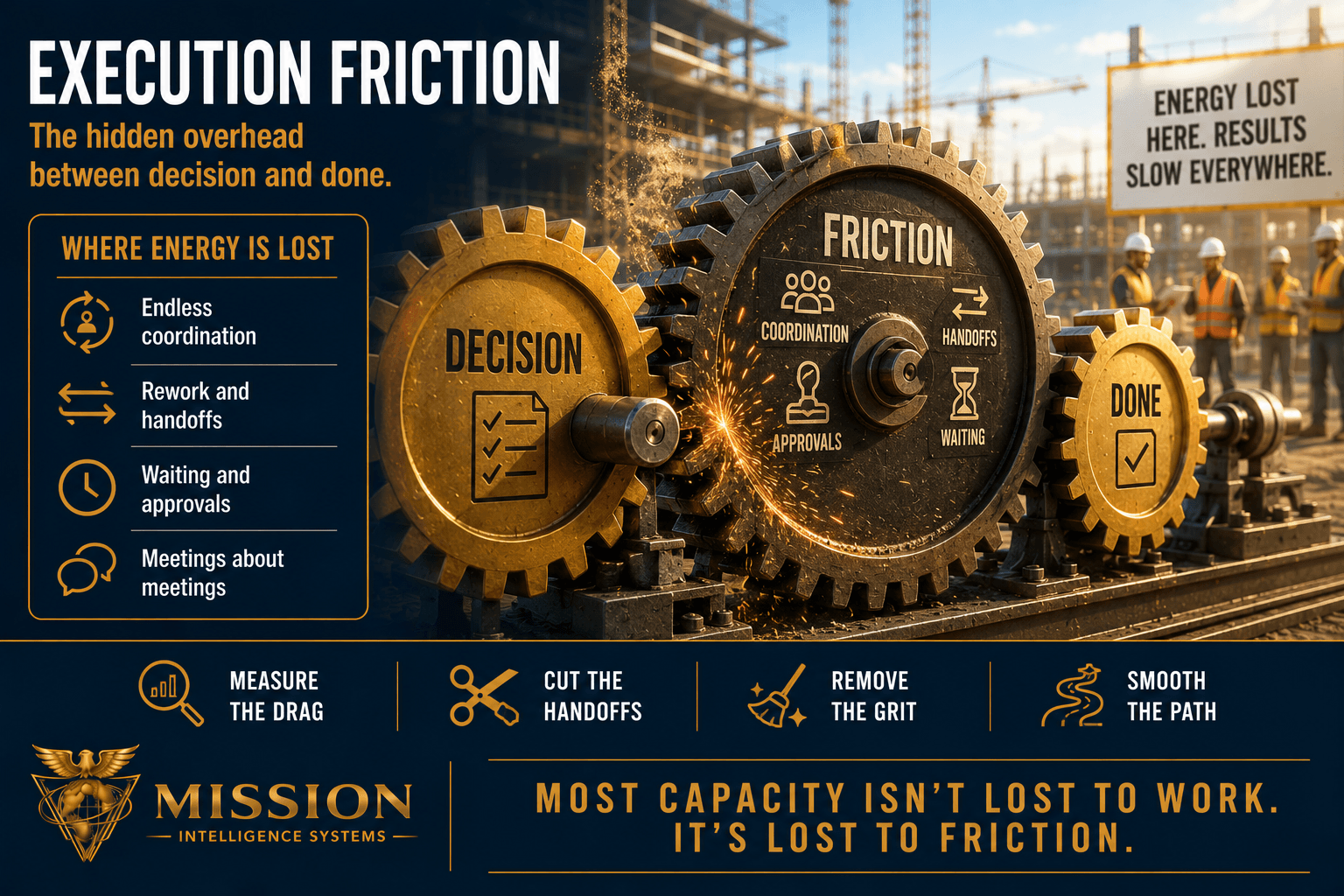
- Execution friction is the total overhead of coordination relative to the value it produces: process load, meeting inefficiency, and reporting burden. Unlike most metrics, lower is better.
- It hides because every individual meeting, approval, and report looks reasonable. It accumulates like sediment until the organization feels slow without being able to name why.
- In high-friction organizations, coordination consumes 20 to 35 percent of leadership attention. The fix is surgical, not a broad efficiency campaign: remove the meetings and approvals that were never earning their keep.
Why it stays invisible
Friction hides because every individual piece of it looks reasonable. The status meeting exists because someone once needed status. The approval step exists because a decision once went wrong. The weekly report exists because an executive once asked a question it happened to answer. Each was a sensible response to a real moment. None of them are ever removed. And so friction accumulates the way sediment does - slowly, invisibly, and until one day the river barely moves.
By the time a leadership team feels it, they rarely name it as friction. They say the organization is slow, or busy but not productive, or that everyone's in meetings all day. Those are the symptoms. Execution friction is the condition underneath them.
What high friction actually costs
In organizations where execution friction sits in the high band, coordination consumes twenty to thirty-five percent of leadership attention - attention that was supposed to go to judgment, strategy, and developing people. That is not a soft cost. It is a third of your most expensive capacity spent moving information between meetings instead of moving the organization forward.
The compounding harm is subtler. High friction slows the feedback loop between a decision and its result, which means the organization learns more slowly, corrects course later, and pays more for each mistake before it is caught. Friction doesn't just tax the present. It dulls the organization's ability to improve.
The three sources
Process load is the weight of the steps, sign-offs, and handoffs that sit between agreed work and completed work. Process is not the enemy - the absence of process is chaos - but process that is never pruned becomes pure drag. Meeting effectiveness is whether the time leaders spend together produces decisions and commitments or merely produces more meetings. The test is simple and unforgiving: did this meeting produce a decision, a commitment, or a clear next action? Reporting burden is the effort spent feeding information upward that no one uses to make a decision. A report that changes a choice is worth its cost. A report that is produced, circulated, and filed is a tax.
Friction is not a project you finish. It is a condition you maintain.
How to reduce it
The instinct with friction is to launch an efficiency initiative - a broad campaign against meetings and process. That usually fails, because it treats all friction as equal and removes the useful along with the wasteful. The better move is surgical. Audit the last three months of senior leadership meetings and ask, of each recurring one, whether it produced a decision, a commitment, or a clear next action. Reschedule or eliminate the ones that did not. Take the three most common decisions currently routed through multiple approvals and give each a single named owner with an explicit authority limit.
One redesigned weekly cadence typically recovers three to five hours of strategic capacity per executive per week - not by working harder, but by removing the coordination that was never earning its keep. The capacity you recover was there the whole time. It was just being spent on the overhead of staying coordinated instead of the work of moving.
About the Author
Dan Flynn
Creator of The Four A's of Organizational Readiness™ · Enterprise Transformation Executive · Author, Builders Build
Dan Flynn has spent thirty years inside federal, defense, and commercial organizations: diagnosing the invisible conditions that determine whether capable people produce extraordinary results. He is the creator of The Four A's of Organizational Readiness™ framework, has reached more than 11,000 professionals across corporate, civic, and national security contexts, and produced a documented 1,033% improvement in delivery velocity by changing organizational conditions: not people.
His book, Builders Build: The Four A’s of Organizational Readiness™, is forthcoming.
Related Articles
Friction
The Organizational Friction Index
A way to see the coordination tax that never shows up on a balance sheet.
Attention
The Calendar Never Lies
Where leadership attention actually goes, versus where leaders say it goes.
Operating Health
The Builder Index
Your organization's operating health in a single number.
Measure your friction
Execution Friction is one of the ten metrics in the Executive Organizational Diagnostic, powered by Builder Intelligence™ and the Four A's of Organizational Readiness™. Run a self evaluation to see where your organization's friction is highest.