
From Research to Readiness · Organizational Behavior
From Research to Readiness: Amy Edmondson
Teams do not learn because they are smart. They learn because it is safe to say what is actually happening.
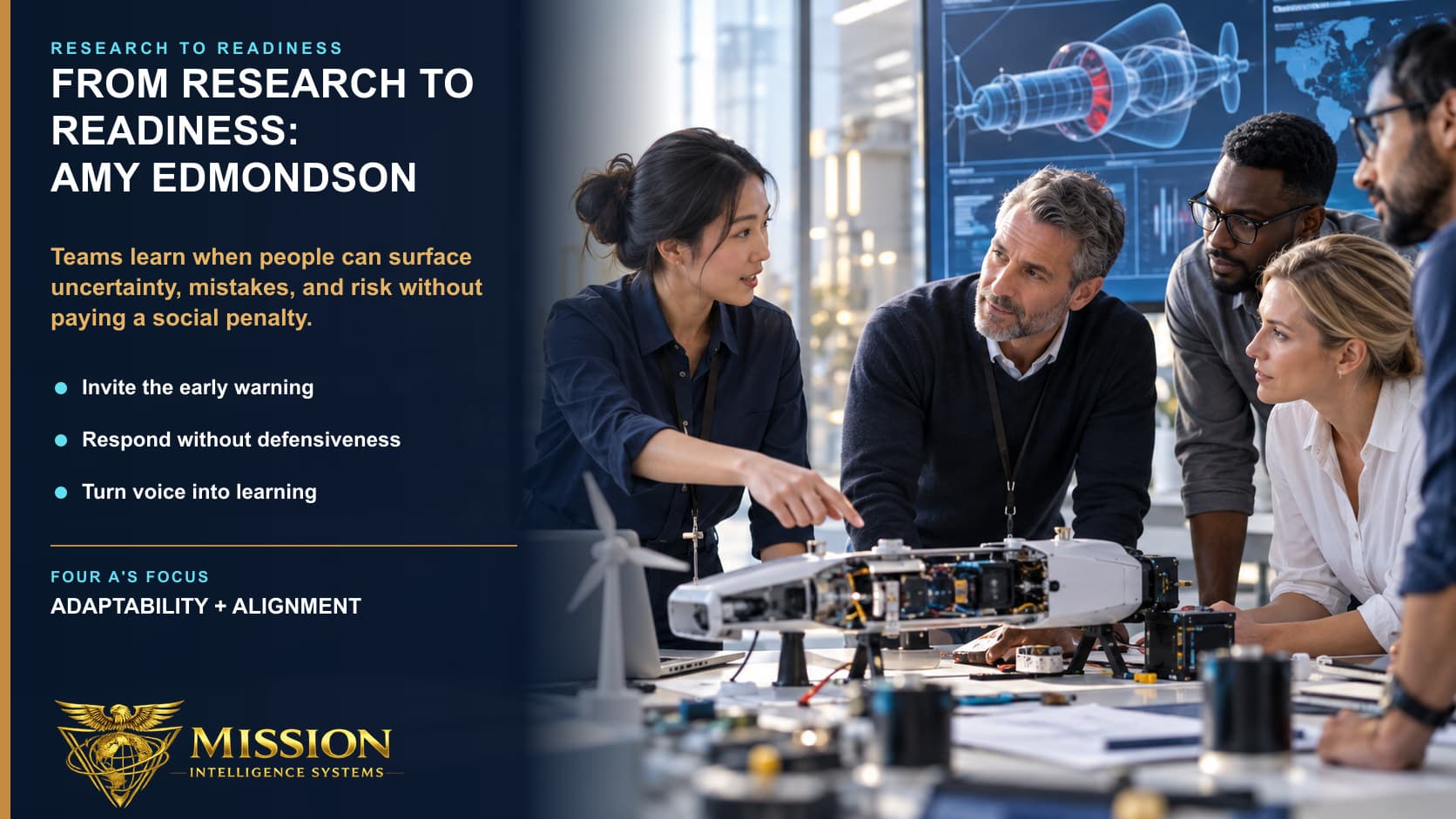
Amy Edmondson established that the teams that learn and perform best are not the most talented but the ones where people feel safe to take interpersonal risks: to admit error, ask for help, and raise concerns without fear. She called it psychological safety, and the crucial point for leaders is that it is a condition they build, not a mood a team happens to have.
Research Foundation
- Organizational behavior and team research
- Psychological safety research
- The Four A's of Organizational Readiness
- The Builders Build Framework
Key Takeaways
- Psychological safety, the shared belief that it is safe to take interpersonal risks, predicts team learning and performance.
- Without it, problems hide, errors repeat, and the information leaders need arrives late or not at all.
- This is an Adaptability condition, built by a leader's consistent, non-punitive responses over time.
What Edmondson found
In her foundational study, Edmondson found that teams differed sharply in whether members felt safe to speak up, and that this safety, not talent, predicted how much they learned and how well they performed. Counterintuitively, safer teams reported more errors, not because they made more, but because they surfaced them instead of hiding them. Google's later Project Aristotle reached the same conclusion about its own teams.
Why it matters inside organizations
When it is unsafe to speak, the organization goes blind. Problems stay hidden until they are expensive, the same mistakes recur under new names, AI and other new tools get quietly avoided, and bad news reaches leadership too late to act. Every one of those failures is a learning failure, and learning failures trace back to whether it was safe to tell the truth.
A team's intelligence is capped not by its talent but by what it is safe to say out loud.
The condition it affects
This is about learning and candor: whether the organization surfaces what it knows or buries it. Safety is what converts the knowledge dispersed across an organization into information leaders can actually use. Its absence is not quiet harmony. It is a slow accumulation of unspoken problems that eventually arrive all at once.
Through the Four A's
This lands on Adaptability, with a strong Alignment component. Adaptability, because learning is how an organization changes with reality, and safety is its precondition. Alignment, because candor is what keeps everyone working from the same honest picture. Readiness here means people can say what is true without it costing them.
Evidence matrix
| Claim | Research | Field evidence | Four A's |
|---|---|---|---|
| Psychological safety predicts learning and performance | Edmondson (1999) | Safe teams surface problems early | Adaptability |
| Safety is built by leader behavior | Edmondson (2018) | Non-punitive response earns candor | Alignment |
| Fear buries the information leaders need | Edmondson (1999) | Silence delays every fix | Alignment |
Executive reflection questions
- Is it genuinely safe on your team to admit an error or ask for help?
- When someone brings you a problem, does your response make the next person more or less likely to?
- How much of what your organization knows never reaches you, and why?
- Where has quiet harmony been hiding accumulating problems?
Builder actions
Build safety deliberately. Respond to bad news with curiosity rather than punishment, because the next person is watching how you react. Frame uncertain work as learning rather than flawless execution. Ask for the problems directly, name your own errors first, and reward the person who surfaces a risk. Safety is not softness. It is the condition that decides whether your organization learns or repeats itself.