
The Four A's · Adaptability
The AI Talent Trap
Why hiring AI talent into broken conditions does not produce results.
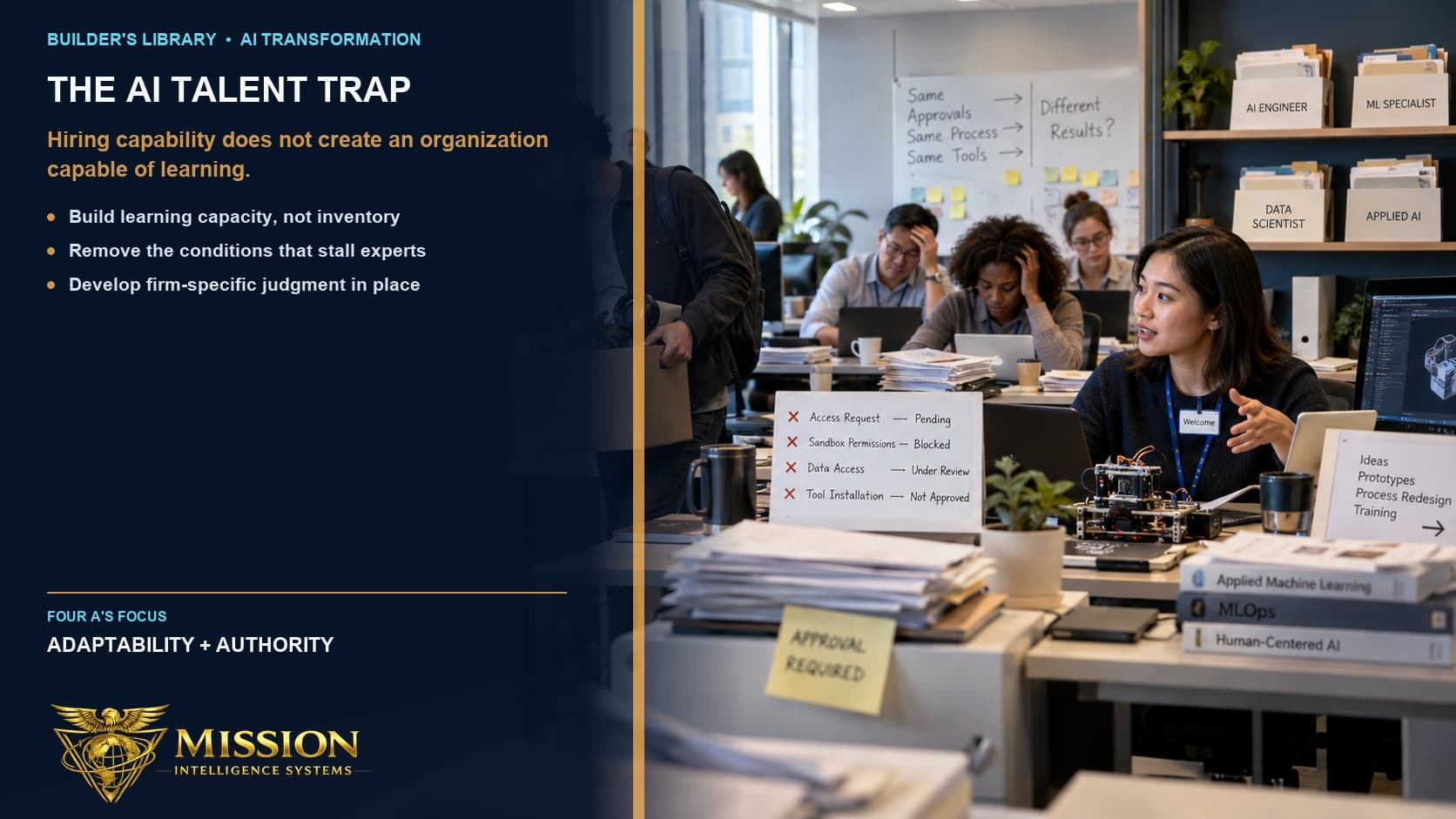
Asked why their AI efforts stall, most executives answer talent. So they hire, and the effort still stalls. The talent framing is a trap because it treats a condition of the organization as an attribute of individuals. You cannot staff your way out of a system that cannot learn.
Research Foundation
- Institutional research (World Economic Forum)
- Organizational learning and human capital research
- Executive leadership literature
- Enterprise transformation field experience
- The Builders Build Framework
Key Takeaways
- The World Economic Forum's Future of Jobs Report 2025 found that 39 percent of workers' core skills will change by 2030, and that the skills gap is the single largest barrier to business transformation, cited by 63 percent of employers.
- A skills gap that large cannot be closed by hiring, because the target keeps moving. It can only be closed by building the organizational capacity to learn continuously.
- The Four A's treat AI talent as an Adaptability condition: whether the organization can absorb new capability and keep absorbing it, not whether it has acquired the right people once.
The gap is real, and it is moving
The World Economic Forum's Future of Jobs Report 2025, drawn from more than 1,000 companies across 55 economies, found that employers expect 39 percent of workers' core skills to change by 2030. When asked to name the biggest barrier to transforming their business, more employers pointed to skills gaps than to any other cause, at 63 percent. The instinct is to read this as a hiring mandate. But the same data shows the target is not fixed: skills that are scarce today are the ones being automated tomorrow. An organization that hires to close this year's gap has not become ready. It has bought a snapshot of a moving picture.
Readiness is a capacity, not an inventory
Research on organizational learning explains why. Chris Argyris and Donald Schon showed that organizations that improve are the ones that change how they learn, not merely who they employ. Peter Senge described the learning organization as one whose advantage is its rate of learning, not its current stock of skills. Human capital theory, from Gary Becker onward, distinguished general capability from firm-specific know-how that must be developed in place. New hires bring the first and lack the second, and the second is where AI value lives, in knowing how this organization's work should change. Talent acquired without the conditions to develop and retain it reverts to the mean of the organization it entered.
You do not have an AI talent shortage. You have an organizational learning shortage that a talent shortage makes visible.
The Four A's reading
The research establishes the phenomenon. The Four A's of Organizational Readiness provide the executive lens, and AI talent is an Adaptability question. Adaptability asks whether change survives contact with the organization and whether the organization can keep absorbing it. A firm with strong Adaptability turns average hires into capable contributors and keeps its capability current as the frontier moves. A firm without it burns through excellent hires, who arrive, hit the same conditions that stalled everyone before them, and leave. Attention matters, because learning needs protected focus, and Authority matters, because people must be empowered to change the work they are learning to do. But the trap itself is Adaptability.
Evidence matrix
| Claim | Research | Field evidence | Four A's |
|---|---|---|---|
| Skills gap is the top transformation barrier | World Economic Forum (2025) | Stalled modernization efforts | Adaptability |
| Advantage is rate of learning, not stock of skills | Argyris & Schön (1978); Senge (1990) | Capable hires who stalled | Adaptability |
| Firm-specific capability must be built in place | Becker (1964) | The 18-month calibration effect | Adaptability |
What executives should do
Before the next hiring push, ask whether your best current people are able to apply what they already know, or whether the conditions defeat them. Invest in the organization's capacity to learn continuously, not only in acquiring a fixed set of skills. Fix the conditions that convert capable people into calibrated ones, and the talent you have becomes the talent you needed. Hire into a learning organization and it compounds. Hire into a stalled one and it evaporates.