
Authority
The Knowledge-Authority Gap
Why decision authority sits above the people with the knowledge.
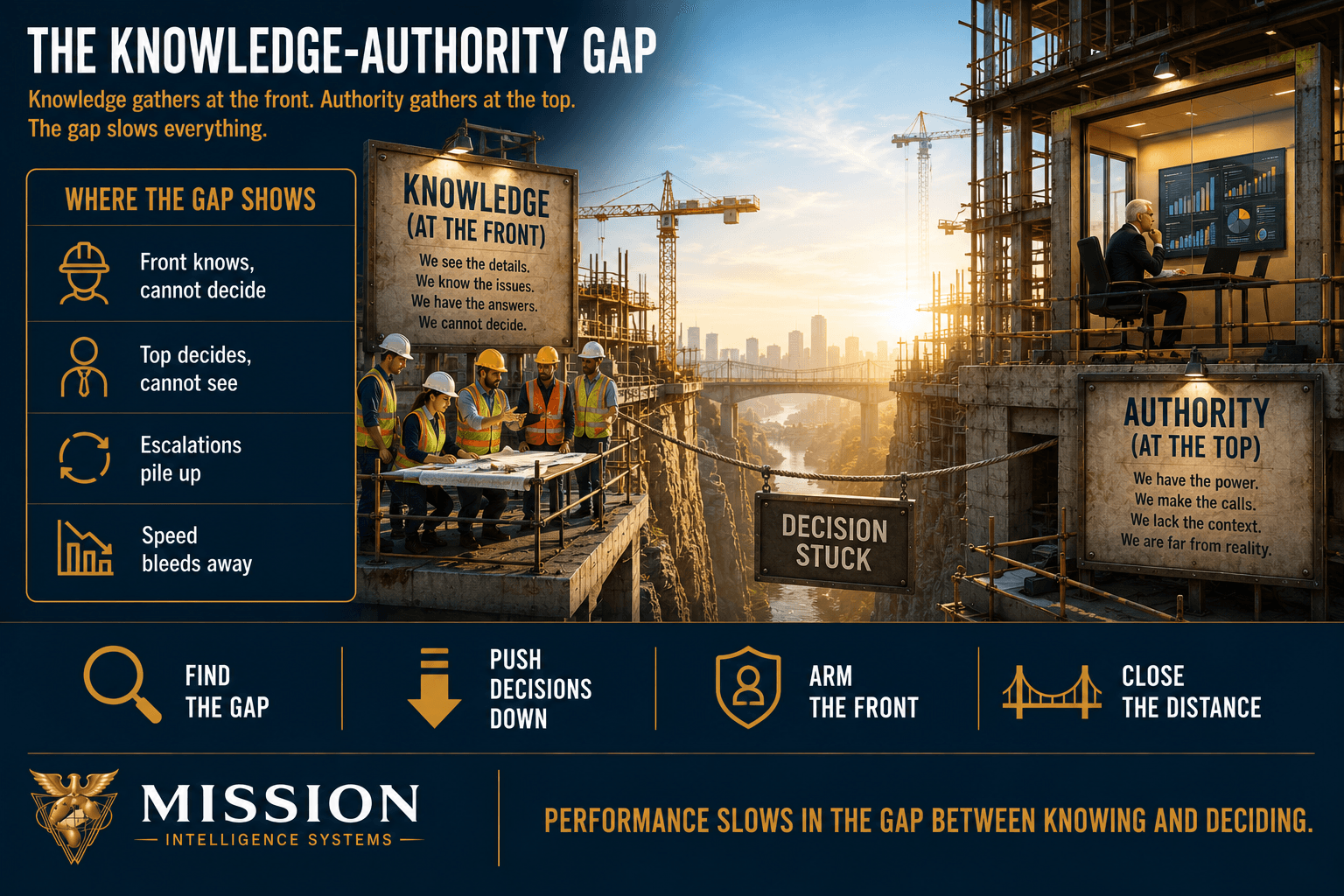
Knowledge accumulates at the front. Authority accumulates at the top. The gap between them is where organizational performance goes to slow down.
Key Takeaways
- Knowledge accumulates at the front of an organization where work is done; authority accumulates at the top where decisions are made - the gap between them is where organizational performance slows down.
- The knowledge-authority gap is not a communication problem; it is a structural design problem - information traveling up to authority and decisions traveling down to knowledge takes time the organization cannot afford.
- Closing the gap requires placing authority closer to where knowledge lives, which means building the trust and accountability structures that make local decision-making safe.
The most common authority failure I encounter rarely announces itself as an authority problem.
It announces itself as a slow project. A team that seems resistant to change. A recurring problem that never quite gets solved. A workforce that is technically capable but somehow disengaged. Leaders look at these symptoms and reach for explanations: the people are not motivated, the process is broken, the culture is wrong.
What they rarely examine is the architecture underneath.
Who has the authority to make the decisions that would actually fix the problem? Where does that authority live, and how far is it from the people who have: the information required to use it well?
In most organizations, authority and knowledge have quietly separated from each other over time. Decisions travel upward through layers of review and approval, accumulating delay and losing context at every level. By the time the decision returns as an approval, the person who receives it no longer has the current picture the decision requires.
That gap is not a policy problem or a communication problem. It is an architectural problem. And like most structural problems, it does not announce itself with a dramatic failure. It reveals itself gradually, in the accumulation of small inefficiencies that everyone has learned to work around.
How the Gap Forms
Knowledge and authority travel in opposite directions.
The people who understand a problem most deeply are almost always the ones closest to it. The technician who has been working on the system for three years understands its failure modes in a way no one above them in the hierarchy can. The frontline manager who has run the same process through four different product cycles understands the constraints that will determine whether the next change succeeds or fails. The people doing the work understand the work.
Knowledge accumulates at the front. Authority accumulates at the top.
In a well-designed organization, authority would flow toward knowledge: the people who understand the problem most deeply would have the most ability to solve it. In most actual organizations, the opposite is true. Authority flows upward, toward the people with the most accountability and the least current operational knowledge.
This is not anyone's fault. It is not caused by bad intentions at the top or weak people at the front. It is the predictable result of how formal authority structures are designed and maintained. As organizations grow, the span of what any senior leader can know directly narrows. But the formal authority does not follow that narrowing. It stays concentrated at the top, while the knowledge that should inform it disperses to the edges.
The inversion is structural. It will persist until it is deliberately corrected.
Decisions made at altitude miss the terrain. A pilot navigating by instruments at thirty thousand feet has a very different picture of the ground than the person standing on it.
What the Gap Costs
The cost of the Knowledge-Authority Gap shows up in a specific and recognizable pattern. A decision that the people closest to the work could make in an hour takes three weeks to travel up the hierarchy, wait for the right person's attention, and return. In that time, the situation has changed. The decision: that came back is now answering a question that has already been answered differently, or that no longer matters.
Multiply that pattern across hundreds of decisions, and you get the experience, most people describe when they say an organization is slow, frustrating, or bureaucratic. They are not describing a cultural problem. They are describing: the lived experience of a broken authority architecture.
There is a deeper cost that is harder to measure but more consequential. When authority and knowledge are separated long enough, the people with knowledge stop offering it. They learn that what they know does not change what happens. Problems get reported once, twice, three times, and nothing changes. The worker who had been carrying knowledge that could have improved the work stops raising it. They develop workarounds. They do the job the way the system allows, rather than the way they know it could be done.
The experienced employees who watch initiative after initiative pass through, without touching the thing they know is actually broken: that is what authority separated from knowledge actually looks like in practice. The knowledge exists. The willingness to surface it has been trained out by years of evidence that surfacing it changes nothing.
Authority Is Not Position
Most organizations treat authority as position. You have it because of your title, your tenure, your level in the hierarchy. It flows downward from the top. Decisions travel upward to whoever holds it.
This is a useful framework for accountability. It is a destructive framework for speed.
Authority is not a position. It is an architecture. More precisely: authority is the deliberate placement of decisions as close to knowledge as the situation will allow.
The word deliberatematters. In most organizations, authority doesn't get placed: it accumulates. Almost always in the same direction: upward, away from the work, away from the people with the most current information. The accumulation is gradual and unintentional. Each approval cycle, each review layer, each escalation path is individually defensible. In aggregate, they add up to an organization that cannot move at the speed its conditions require.
The diagnostic question is simple and discomforting: who has the knowledge: this decision requires? Not who is senior enough. Not who is accountable enough. Not who has been here long enough. Who knows enough?
The answer to that question is almost always someone closer to the work than: the person currently making the decision.
Authority is not position. It is the deliberate placement of decisions as close to knowledge as the situation will allow.
Authority as Enablement
In too many organizations, authority has become inspection. Leadership arrives to evaluate, to assess, to confirm that things are being done correctly, and then to leave. The people doing the work learn to perform under observation, rather than to solve problems in its absence.
The workers who stop reporting problems because nobody ever fixed them: that is authority as inspection. The teams who give the answer they think leadership wants rather than the answer that is true: that is authority as inspection. The experienced people who watch initiative after initiative pass through without touching what they know is actually broken: that is authority as inspection.
When authority operates as enablement instead: when it exists to remove obstacles, to resource what people need, to make the decision that only authority can make so that the work can continue: something shifts.
People start reporting problems again. Because they believe something will be done about them. People start offering honest answers. Because they believe honesty is what is wanted. People stop developing workarounds. Because they trust that the thing causing the workaround will eventually be fixed.
The shift from authority as inspection to authority as enablement is not a policy change. It is a pattern of behavior, repeated consistently, until the people closest to the work have enough evidence to believe that authority exists to serve them: not to evaluate them.
Closing the Gap
The fastest, most reliable way to accelerate an organization is not to hire faster people or run better meetings. It is to examine which decisions are currently traveling further than they need to, and redesign the architecture so those decisions reach the level where the relevant knowledge lives.
This is not about eliminating accountability. Accountability should live where authority lives. When you move authority closer to the work, accountability moves with it, and the people doing the work shift from nominal accountability to real accountability. That shift changes how people engage with their work. It changes what they report, what they fix, and what they invest in.
My father handed subcontractors their scope of work on a job site and did not follow them around to approve each step. The electrician did not need him to approve every circuit: he needed to know the scope, the standard, and who to call if something was outside it. That clarity was not a loss of control. It was the condition that made complex work possible at all.
The builder-leader's question is not: how do we get the people at the top to make better decisions? It is: which decisions should not be traveling to: the top at all?
The answer to that question, pursued honestly and consistently, closes the Knowledge-Authority Gap. And closing it changes everything about how an organization moves.
The Knowledge-Authority Gap and the Four A's
The Knowledge-Authority Gap is the central diagnostic concern of the Authority dimension in the Four A's of Organizational Readiness™ framework. Authority asks: are decisions being made at the level closest to where the relevant knowledge lives? When the answer is no: when authority and knowledge have separated: the other three conditions suffer as well.
Attention is consumed by the escalation load that a misaligned authority structure produces. Alignment degrades when teams at the front stop trusting: that what they know will influence what gets decided. Adaptability slows when: the feedback loop between knowledge and authority is too long to generate timely responses to changing conditions.
Closing the Knowledge-Authority Gap does not just improve the Authority condition. It creates the structural foundation on which the other three conditions can be built.
About the Author
Dan Flynn
Creator of The Four A's of Organizational Readiness™ · Enterprise Transformation Executive · Author, Builders Build
Dan Flynn has spent thirty years inside federal, defense, and commercial organizations: diagnosing the invisible conditions that determine whether capable people produce extraordinary results. He is the creator of The Four A's of Organizational Readiness™ framework, has reached more than 11,000 professionals across corporate, civic, and national security contexts, and produced a documented 1,033% improvement in delivery velocity by changing organizational conditions: not people.
His book, Builders Build: The Four A’s of Organizational Readiness™, is forthcoming.
Related Articles
Authority
Decision Architecture
The intentional design of who decides what, at what level, with what information, and why most organizations inherit it rather than build it.
Alignment
Alignment Debt
The accumulating gap between what leaders believe is agreed and what teams are actually doing.
AI Readiness
Why AI Transformation Fails
Most AI transformation failures are organizational failures: not technology failures. The technology works. The organization is not structured to use it.
From Builders Build
The Knowledge-Authority Gap is examined throughout the Authority dimension in Builders Build: The Four A’s of Organizational Readiness™ by Dan Flynn: forthcoming soon. The book explores how builder-leaders design decision architecture that places authority close to knowledge, and why that design is the structural foundation of organizational speed, trust, and adaptability.