
Authority
The Quiet Authority Problem
Why capable employees wait for permission even when leaders want initiative.
The escalations you can see are not the most expensive authority failures. The most expensive ones are silent.
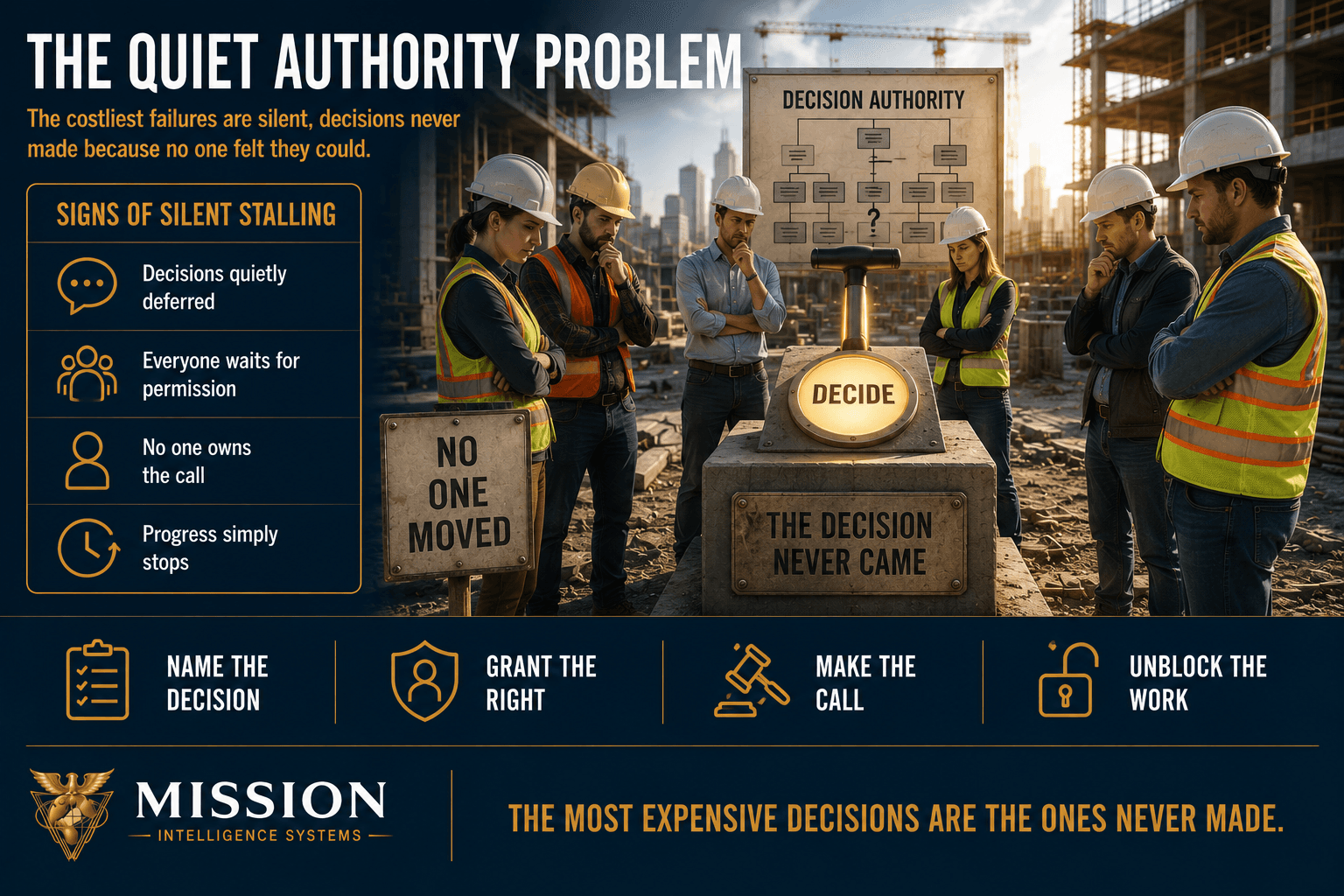
Key Takeaways
- Many leaders have formal authority and no practical ability to act on it - the authority exists on the org chart but is not matched by the resources, relationships, or organizational permission to make consequential decisions.
- The quiet authority problem is most common in matrix organizations, newly promoted leaders, and roles that have responsibility without corresponding decision rights.
- Diagnosing the gap between nominal authority and practical authority is the first step - and it often requires an honest conversation about what the role actually includes, not what the title implies.
When organizations talk about authority problems, they almost always mean the visible version: decisions that travel too high, bottlenecks at the senior leadership level, escalation loops that slow everything down. These are real problems. They are diagnosable and, with effort, fixable.
But the visible authority problem is not the most expensive one.
The most expensive authority problem is quiet. It does not generate escalations. It does not show up as a bottleneck in any review. It is invisible precisely because it produces absence rather than noise: the decisions that were never made, the actions that were never taken, the problems that were never addressed: because the people who knew what to do did not believe they had the right to do it.
This is the quiet authority problem. And in most organizations, it is costing far more than the escalations anyone is tracking.
What Quiet Authority Failure Looks Like
The quiet authority problem is easy to miss because the people experiencing: it do not look stuck. They are working. They are producing. They are attending the right meetings. But there is a layer of action: the intervention that needs to happen, the decision that would unblock the work, the course correction that everyone can see is necessary: that is consistently not being taken.
You can see it in the problems that recur. The coordination failure that happens every quarter between two functions, that everyone on both teams understands and could name precisely, but that no one resolves: because resolving it would require a decision about how the two functions should work together, and no one on either team believes they have the authority to make that call. So it recurs. Every quarter. And each recurrence is managed as an instance rather than resolved as a pattern.
You can see it in the feedback that does not travel. The team member who knows that a project is heading toward a preventable failure but does not say so in a leadership review, because their read of the environment is that surfacing bad news will be received as disloyalty, rather than as useful information. The person who has identified a better approach to a problem the team has been working on for months but frames: it as a question rather than a proposal, because proposals require someone to decide, and deciding feels like authority they have not been given.
The escalations are loud. The decisions that were never made make no sound at all.
Why People Do Not Act on Authority They Have Been Given
Most leaders assume that authority problems are a result of authority not being delegated. The fix, in this view, is to delegate more clearly to tell people they have the authority to decide and trust that they will use it.
This fails consistently, for a simple reason: announced authority and real authority are different things. A person knows whether they actually have the authority to make a decision not from being told they do, but from watching what happens when they make it.
If a leader has delegated a class of decisions but then, when those decisions are made, reliably asks to be briefed, suggests alternatives, or quietly reverses them: the person making the decisions receives a clear signal. The announced authority was conditional. The real authority has been reclaimed. They adjust. The next time a similar decision arises, they escalate: or: they defer, or they frame it as a recommendation rather than a decision, so that the accountability remains with the person who has the real authority.
This is not a failure of trust or courage on the person's part. It is rational behavior in response to accurate information about how the authority structure actually works. They learned the lesson the organization was teaching. The problem is the lesson.
The Cost of Decisions Deferred
Deferred decisions do not disappear. They accumulate: as unresolved problems, as stalled work, as the particular organizational fatigue: that comes from watching the same issue recur without resolution.
The direct cost is delay. A problem that could have been resolved in week one compounds through weeks two, three, and four. The work that depended on the decision waits. The people doing that work find workarounds, which create their own downstream complexity. By the time: the problem reaches someone with the genuine authority to resolve it, the cost of resolution is significantly higher than it would have been at the point of first identification.
The indirect cost is harder to measure but more corrosive. People who consistently know what needs to happen but cannot act on that knowledge develop a particular kind of organizational frustration: not the hot frustration of visible conflict, but the cold frustration of structural futility. They stop proposing. They stop identifying problems early. They stop investing their full perception in work that their experience tells them will not be acted on. The capability is still there. It has simply been directed away from the organization's problems.
Diagnosing the Quiet Problem
Because the quiet authority problem produces absence rather than noise, diagnosing it requires different questions than the visible version.
Ask: What problems have recurred in this organization more than twice, without structural resolution? Each recurring problem that no one has resolved is a candidate for a quiet authority failure: a situation where: the people who understand the problem do not believe they can fix it, and the people who could authorize a fix are not close enough to it to know it needs authorizing.
Ask: What does the feedback in leadership reviews actually look like? If reviews consistently feature positive updates, moderate concerns, and no early warnings of serious problems: that pattern warrants investigation. Either the organization has unusually good conditions, or the conditions have taught people that early warnings are not welcome. The second explanation is more common.
Ask: When you delegate a decision and it comes back to you anyway framed as a recommendation, an update, or a question: what is the person actually telling you? They are telling you that they do not believe: the delegation was real. Not because they lack confidence in some personal sense, but because the authority structure, as they have experienced it, has taught them that the decision is still yours.
If your team consistently brings you recommendations when you asked for decisions, the authority problem is not theirs. It is the environment's.
Building Genuine Authority
Genuine authority: the kind that actually produces decisions at the right level: is built through a specific sequence of actions that most leaders do not complete.
The first step is explicit assignment: naming specifically which decisions belong to which role, not in a general delegation statement but in a way: that is specific enough that both parties could agree on whether a given situation is covered. Vague delegation ("you have authority over your team's work") creates the conditions for quiet failure because the boundaries are unclear and the default, when boundaries are unclear, is to defer.
The second step, and the one most leaders skip, is behavioral confirmation. The first time the person makes a decision in the delegated domain, the leader's response to that decision either confirms or negates the delegation. If the response is genuine acceptance, including acceptance of decisions the leader would have made differently: the authority is real. If the response is a briefing request, a suggestion for reconsideration, or a quiet modification, the authority has been rhetorically given and behaviorally reclaimed. The person will act accordingly.
The third step is sustained consistency. Authority that is honored in good times and reclaimed in difficult ones is not real authority: it is conditional authority, which produces conditional behavior. The people who have experienced conditional authority learn to treat every delegation as provisional. They act with authority only when they are confident the conditions are favorable, which is a fraction of the situations that actually require it.
Authority and the Four A's
Authority is the third of the Four A's of Organizational Readiness™, and the one whose failures are most often misattributed. When an organization is slow, the instinct is to diagnose an Attention problem: too many priorities, too little focus. When execution is inconsistent, the instinct is an Alignment problem: unclear strategy, divergent assumptions. Authority problems, especially: the quiet version, tend to be diagnosed as people problems: the team member who lacks confidence, the manager who cannot let go.
They are structural problems. The person who lacks confidence to decide is almost always responding accurately to an environment that has, over time, taught them that their decisions are conditional. The manager who cannot let go is doing what the organization's incentive structure rewards: staying close to the decisions that matter, because the accountability for those decisions still flows through them.
Fixing a structural problem with a people intervention: more coaching, more feedback, a development plan: produces temporary improvement at best. The structure is still there. The quiet authority problem is still there. The improvement fades as the structure reasserts itself.
The fix is structural: explicit authority assignment, behavioral confirmation: that the assignment is real, and the sustained consistency that builds the organizational trust that authority, once given, will be honored. That trust is the difference between a team that brings you decisions and a team that brings you recommendations waiting for your signature. It is built slowly, through behavior, and lost quickly, through the first reversal.
About the Author
Dan Flynn
Creator of The Four A's of Organizational Readiness™ · Enterprise Transformation Executive · Author, Builders Build
Dan Flynn has spent thirty years inside federal, defense, and commercial organizations: diagnosing the invisible conditions that determine whether capable people produce extraordinary results. He is the creator of The Four A's of Organizational Readiness™ framework, has reached more than 11,000 professionals across corporate, civic, and national security contexts, and produced a documented 1,033% improvement in delivery velocity by changing organizational conditions: not people.
His book, Builders Build: The Four A’s of Organizational Readiness™, is forthcoming.
Related Articles
Authority
Decision Architecture
The intentional design of who decides what, and why most organizations inherit it rather than build it.
Conditions
What Your Org Chart Doesn't Show
The invisible architecture that actually determines what an organization can and cannot do.
Conditions
Organizational Gravity
The structural force that pulls behavior back toward existing patterns, regardless of what leaders intend.
From Builders Build
The quiet authority problem and how leaders build genuine decision authority are examined within: the Authority dimension in Builders Build: The Four A’s of Organizational Readiness™ by Dan Flynn: forthcoming soon.