AI Readiness
Why AI Transformation Fails
And It's Not the Technology
Why most AI transformations fail for organizational, not technical, reasons.
The technology works. The vendor is credible. The senior team is committed. And the transformation still stalls. Here is what is actually happening.
of enterprise GenAI initiatives return nothing to the business
MIT NANDA, State of AI in Business 2025
The technology works. Most organizations are not built to turn it into value.
Diagnose your constraint →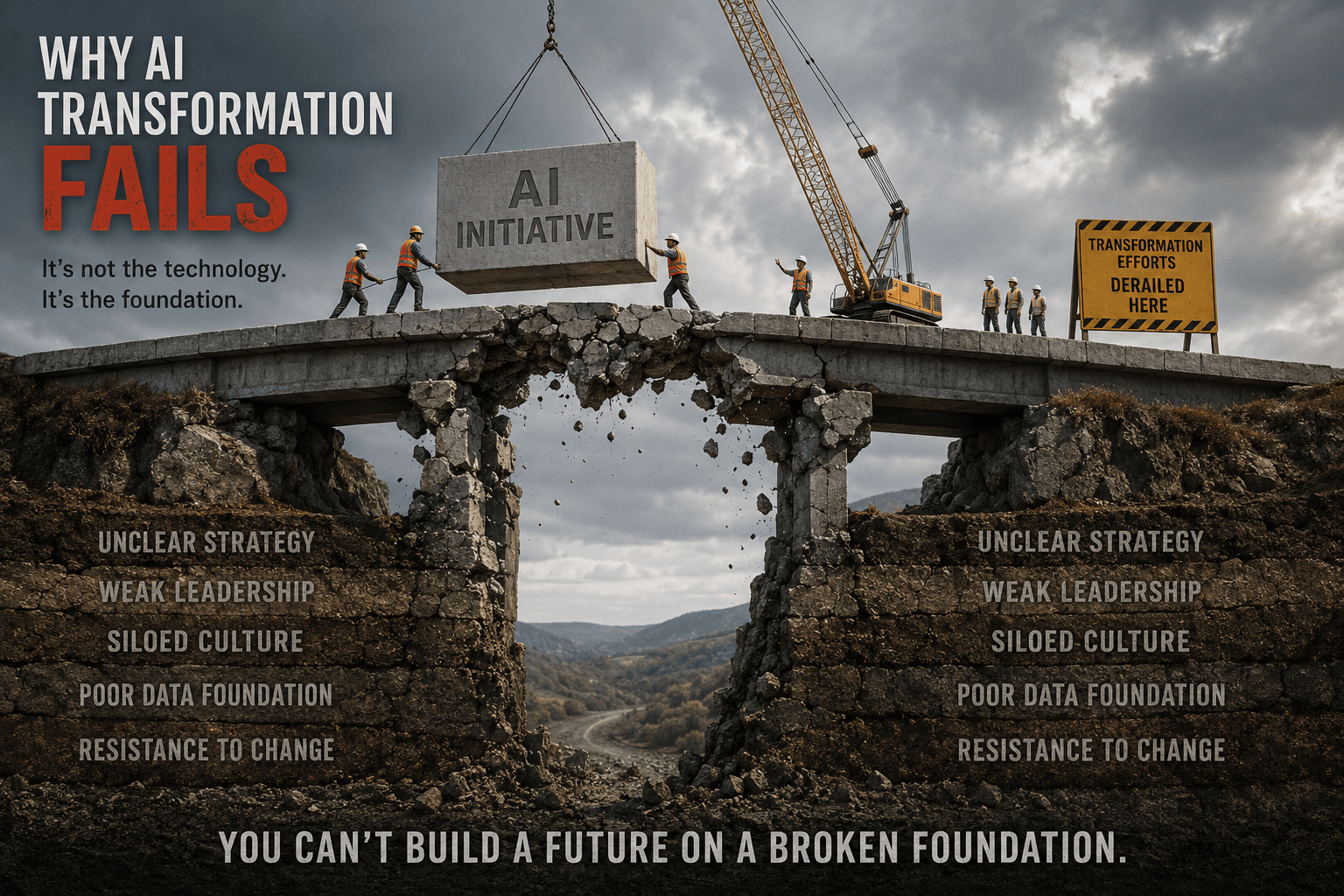
Key Takeaways
- AI transformation failure is almost never a technology problem; it is an organizational readiness problem - the same structural conditions that kill other transformations kill AI initiatives.
- The organizations most likely to fail at AI transformation are those that invest in AI capability before investing in the organizational conditions required to deploy that capability: attention, alignment, authority, and adaptability.
- The diagnostic question before any AI initiative is not 'do we have the right technology' but 'do we have the organizational conditions to use it at the level we are promising.'
I have sat across the table from enough leaders navigating failed AI initiatives to recognize the pattern. The conversation usually begins with a technology explanation: the model was not right, the vendor overpromised, the use case was not mature enough. And then, as we work through what actually happened, a different story emerges.
The technology was fine. In most cases, the technology worked exactly as advertised. What failed was the organizational environment the technology had to operate inside. The structure was not built to receive what AI was producing. And so AI produced outputs that no one had the attention to review, insights that no one had the authority to act on, and recommendations that no one had the shared understanding to apply consistently.
This is not a technology failure. It is an organizational readiness failure. And until leaders understand the distinction, they will keep investing in: the wrong thing.
What AI Actually Does to an Organization
AI does not create organizational problems. It exposes the ones that were already there, and removes the time organizations had to work around them.
Before AI, a fragmented leadership team could compensate. Decisions that should have been made in days took weeks, and that pace was accepted as normal. Misalignment between what one team believed and what another team believed produced costly rework, but the rework was spread across long enough time horizons that it looked like ordinary organizational friction rather than a structural failure.
AI compresses time. It surfaces information faster. It generates options faster. It executes work faster. And every pre-existing organizational constraint becomes acute when the pace of information exceeds the pace the organization was designed to operate at.
AI is a multiplier. It multiplies the strength of organizations that are ready. It multiplies the fragility of organizations that are not.
The Four Failure Patterns
Across AI transformation efforts that stall, four structural failure patterns appear consistently. They correspond to the four conditions the Four A's of Organizational Readiness™ framework measures. When any one of these conditions is absent, AI cannot deliver. When more than one is absent, the investment almost certainly fails.
1. Attention Fragmentation
AI generates outputs that require sustained leadership attention to review, interpret, and act on. When that attention is fragmented across too many simultaneous priorities: which is the condition most senior leadership teams are already in before they add AI: AI outputs accumulate unreviewed.
The tool produces. No one acts. Teams notice that the AI-generated insights are sitting in a dashboard that nobody is reading. They stop trusting the tool. They stop maintaining it. The initiative stalls, not because AI failed, but because the organization did not have the attention margin to use what AI was producing.
2. Misalignment on What AI Is For
Senior leaders announce AI adoption. The announcement carries a general direction: AI will improve efficiency, AI will enhance decision-making, AI will give us an edge. But "improve efficiency" is not alignment. It is aspiration. Alignment on AI requires shared clarity on which decisions AI is informing, which processes it is changing, and what success actually looks like in behavioral terms.
Without that clarity, every team implements AI according to its own interpretation. Finance uses it to cut costs. Operations uses it to speed throughput. Product uses it to generate options. Each of these is a reasonable reading of the announcement. None of them is coordinated. The organization ends up with AI in three places optimizing for three different things, and no coherent picture of what the combined effect is.
3. Decision Authority Gaps
This is the failure pattern that surprises leaders most, because it looks like a technology problem from the outside. AI can surface an insight in seconds. If the person who receives that insight does not have the authority to act on it, the insight sits waiting for an approval cycle: that takes days or weeks. The speed advantage of AI disappears entirely.
Worse: the people operating the AI learn that its outputs do not lead to action. They stop treating the insights as decision inputs. They start treating them as reporting artifacts: information that gets documented but does not change what anyone does. The AI is still running. The organization is no longer learning from it.
4. Insufficient Adaptability
AI changes what work is possible, and it changes it continuously. Each improvement in the model, each new capability, each new integration creates an opportunity to reconfigure how work is done. Organizations: that can learn and reconfigure faster than AI is changing what is possible compound its value over time. Organizations that cannot adapt see the advantage erode.
This is the longest-horizon failure pattern. The organization adopts AI. It uses it to do what it was already doing, slightly faster. The operating model does not change. The roles do not change. The decision structure does not change. A year later, the organization has AI, and is not materially ahead of where it started, because it never adapted to what AI revealed about what was now possible.
The Sequence Problem
Most organizations approach AI adoption in the wrong sequence. They invest in the technology first: the tools, the infrastructure, the vendor relationships, the technical talent. Then they discover the organizational conditions are not in place to use what they have built. Then they try to fix the organizational conditions while the technology is already deployed and already failing to deliver.
Fixing organizational conditions is harder when the technology investment is already on the table. There is pressure to show returns. There is resistance to slowing down an initiative that was already announced. There is a sunk cost argument against changing direction. The organization is now paying for the technology and managing a change program simultaneously: which adds exactly: the kind of fragmented attention load that made the original failure more likely.
Build the conditions first. The technology is easy to deploy into an organization that is ready for it. It is very hard to recover an organization: that deployed it before it was.
What AI Readiness Actually Requires
AI readiness is not a technical checklist. It is not about data quality, API integrations, or model selection: though those matter. It is about the organizational conditions that determine whether the technology can actually change how the organization operates.
An AI-ready organization has protected leadership attention: enough focus concentrated on the AI initiative that what the technology surfaces gets reviewed and acted on. It has shared alignment on what AI is for: not a general aspiration, but a specific shared understanding of what AI is optimizing for and what it is not. It has clear decision authority at the level where AI insights arrive, so the team operating the AI can act on: what it produces. And it has the adaptive capacity to keep reconfiguring as AI reveals new possibilities.
These are the Four A's applied to AI: Attention, Alignment, Authority, and Adaptability. The same conditions that determine organizational performance generally are the same conditions that determine whether AI delivers. The technology is a stress test of the organizational structure. Organizations: that are structurally sound get the benefit. Organizations that are not get an expensive lesson.
The Diagnostic Question
Before any AI deployment decision, there is a more important question than "which tool?" The question is: "Are the four organizational conditions in place to use what this tool produces?"
If leadership attention is already fragmented, adding an AI tool adds outputs: that no one has the attention to process. If the senior team is misaligned on priorities, AI will execute that misalignment at scale and at speed. If decision authority is unclear, AI insights will wait in the same approval queues that every other insight waits in. If the operating model cannot adapt, AI will automate the current state, and the current state may not be worth automating.
The organizations that get the most from AI are not the ones who moved: the fastest. They are the ones who built the organizational conditions before: they deployed, and then moved fast into an environment that was actually ready to receive what they built.
About the Author
Dan Flynn
Creator of The Four A's of Organizational Readiness™ · Enterprise Transformation Executive · Author, Builders Build
Dan Flynn has spent thirty years inside federal, defense, and commercial organizations: diagnosing the invisible conditions that determine whether capable people produce extraordinary results. He is the creator of The Four A's of Organizational Readiness™ framework, has reached more than 11,000 professionals across corporate, civic, and national security contexts, and produced a documented 1,033% improvement in delivery velocity by changing organizational conditions: not people.
His book, Builders Build: The Four A’s of Organizational Readiness™, is forthcoming.
Related Articles
Alignment
Alignment Debt
The accumulating gap between what leaders believe is agreed and what teams are actually doing, and why it compounds silently.
Authority
Decision Architecture
The intentional design of who decides what, at what level, with what information, and why most organizations inherit it rather than build it.
Attention
The Attention Tax
The hidden performance cost every organization pays when leadership focus is fragmented across too many simultaneous priorities.
From Builders Build
The organizational conditions that determine AI readiness are examined throughout Builders Build: The Four A’s of Organizational Readiness™by Dan Flynn: forthcoming soon. The book applies: the Four A's of Organizational Readiness™ framework to the full spectrum of organizational performance, including the structural conditions that determine, whether AI transformation delivers value or stalls.