
The Psychology of Organizations · Change
Why Employees Resist AI
Why the resistance to new AI tools is psychological, not technical, and mostly invisible.
Leaders roll out AI expecting adoption and find quiet resistance instead: the tool is used reluctantly, worked around, or abandoned after a single mistake. The reasons are not about the technology's quality. They are about trust, autonomy, identity, and a specific psychology of how people react to machines that make judgments.
of AI users bring their own AI tools to work, often unsanctioned
Microsoft Work Trend Index 2024
Your people already use AI. The question is whether your conditions let them do it in the open.
Diagnose your constraint →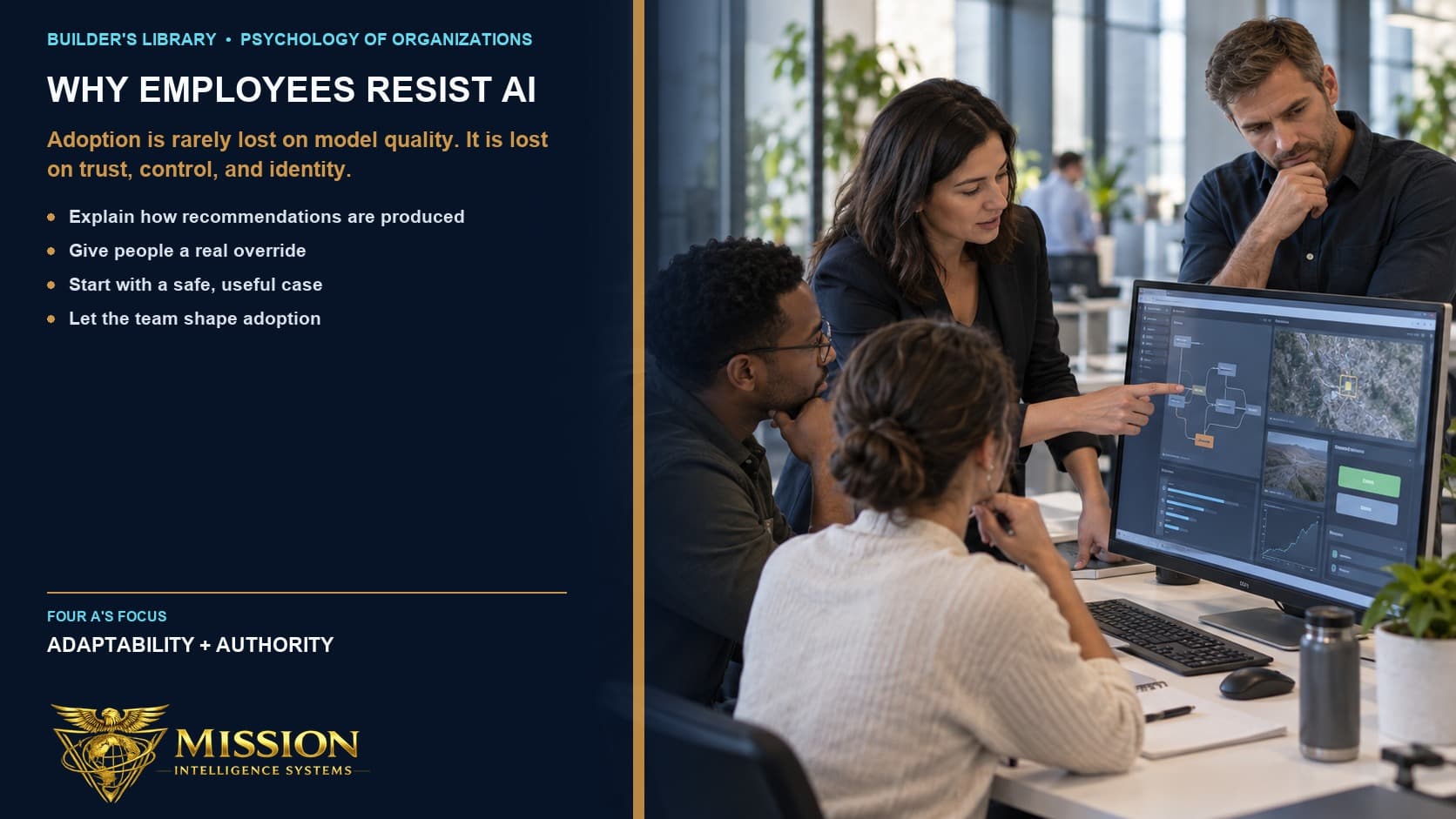
Research Foundation
- Technology acceptance and adoption research
- Behavioral economics and decision research
- Organizational behavior
- Executive and enterprise field experience
- The Builders Build Framework
Key Takeaways
- Whether people adopt an AI tool depends less on its capability than on their perception of its usefulness and ease, their sense of control, and their trust, the same human factors that govern all technology adoption, amplified by AI's opacity.
- People show algorithm aversion: they abandon an algorithm after seeing it err, even when it outperforms humans, and resist machine judgment most in domains they consider human. A single visible mistake can end adoption that logic would sustain.
- Because adopting AI requires the organization and its people to reconfigure how they work and decide, it is an Adaptability challenge, and it is won by building trust, control, and understanding, not by mandating usage.
The better tool they stopped using
In studies by Berkeley Dietvorst and colleagues, people were shown an algorithm that forecast outcomes more accurately than they could. Then they saw it make a mistake. After witnessing the algorithm err, they abandoned it and reverted to their own worse judgment, even though the algorithm still outperformed them. The researchers called this algorithm aversion, and it captures what executives keep encountering. The AI tool is measurably better, and people still stop using it, because a visible machine error is judged far more harshly than the human errors it replaced. Adoption is not lost on the merits. It is lost on the psychology of how people react to a machine that is allowed to be wrong.
What actually governs adoption
Decades of technology acceptance research, beginning with Fred Davis's technology acceptance model and extended by Venkatesh and colleagues' unified theory, established that adoption is driven by perceived usefulness, perceived ease of use, social influence, and the sense of control over the technology, not by its objective capability alone. AI intensifies these dynamics. Its reasoning is often opaque, so trust is harder to form. Longoni and colleagues found people resist AI most in domains they see as requiring human uniqueness, such as medical care, a phenomenon they termed uniqueness neglect. On top of this sit the familiar forces of resistance: status quo bias makes the current way feel safer, psychological reactance turns a mandate to use the tool into a reason to resist it, and for many the tool threatens professional identity, implying that a valued skill can be automated. None of these is about whether the AI works.
People abandon an AI tool that beats them after watching it make a single mistake, then return to their own worse judgment. Adoption is rarely lost on the merits. It is lost on trust, control, and identity, none of which a better model repairs.
Why organizations provoke the resistance they fear
Organizations tend to roll out AI in the way most likely to trigger resistance. They mandate usage, which invites reactance. They emphasize efficiency and headcount, which activates the identity threat that the tool exists to replace people. They deploy opaque systems without building understanding, which prevents the trust adoption requires. And they treat the first machine error as proof the tool has failed, ratifying the algorithm aversion already at work. The organization thus manufactures the quiet resistance it then blames on employees being change-averse, when the rollout itself supplied every reason to resist.
What this means through the Four A's
AI adoption is an Adaptability challenge, because it asks people and the organization to reconfigure how they work and decide, and reconfiguration is exactly what people resist. The research points to conditions, not mandates. Build trust by making the tool's reasoning understandable and by being honest about where it is reliable and where it is not. Preserve autonomy and control by positioning AI as augmenting human judgment rather than overriding it, which also blunts reactance and identity threat. Set realistic expectations so a single error does not end adoption, and normalize that the tool will sometimes be wrong, as the humans it assists already are. Involve the people who must use it in shaping how it is deployed. Adoption follows the conditions, not the capability.
From bias to constraint
The pattern beneath this is general: an individual bias, left unexamined, is adopted, reinforced, and encoded until it becomes a structural limit on the whole organization. The Four A's are where a leader interrupts the chain.
Individual perception
A person reads a situation through their own biases and priors.
Shared interpretation
Colleagues adopt the same read, and it begins to feel like fact.
Group reinforcement
Cohesion and deference harden it; dissent is quietly filtered out.
Process and policy
The interpretation is encoded into how decisions and work get made.
Organizational constraint
What began as one bias is now a structural limit on the whole system.
The Four A's intervention
What are we failing to notice?
Where are our interpretations diverging?
Who can challenge or change the pattern?
What evidence would cause us to revise?
Evidence matrix
| Claim | Research | Field evidence | Four A's |
|---|---|---|---|
| Adoption depends on usefulness, ease, control, trust | Davis (1989); Venkatesh et al. (2003) | Capable tools used reluctantly or abandoned | Adaptability |
| People abandon algorithms after seeing them err | Dietvorst, Simmons & Massey (2015) | One visible mistake ends adoption | Adaptability, Authority |
| Mandates and identity threat provoke resistance | Brehm (1966); Longoni et al. (2019) | Rollouts that trigger the resistance they fear | Adaptability, Alignment |
Executive reflection questions
- Is your AI rollout building trust and understanding, or mandating usage of a tool people do not understand?
- Are you positioning AI as augmenting human judgment, or as replacing it, and what does that do to how people receive it?
- How does your organization react to the tool's first visible mistake, and does that reaction end adoption that its accuracy would justify?
- Did the people who must use the tool have any hand in shaping how it was deployed, or was it handed to them to resist?
Builder actions
Roll out AI as a change in conditions, not a mandate. Build trust by making the tool's reasoning as understandable as you can and by being honest about where it is reliable and where it is not. Preserve people's control and identity by framing AI as augmenting their judgment rather than replacing it, which also defuses reactance and the fear of being automated away. Set expectations that the tool will sometimes err, so a single visible mistake does not trigger the algorithm aversion that ends adoption. Bring the people who must use it into shaping the deployment. And measure adoption as a trust and design outcome, because a better model does not overcome a rollout that supplied every reason to resist.