
Diagnostic · Methodology
How the Diagnostic Works
Most organizational assessments measure how people feel about their work. This one measures the structural conditions that determine whether capable people can do their best work - regardless of how they feel about it.
The problem with most assessments
Engagement surveys, culture assessments, and 360-degree feedback tools all measure outputs - how people experience the organization. They are useful for what they measure. But they do not measure the structural conditions that produce those experiences.
If your people are disengaged, a survey tells you they are disengaged. It does not tell you whether the cause is fragmented leadership attention, misaligned priorities at the senior level, unclear decision rights, or an inability to act on what the organization already knows. Those are structural conditions. And they are the layer where intervention actually works.
What the diagnostic measures
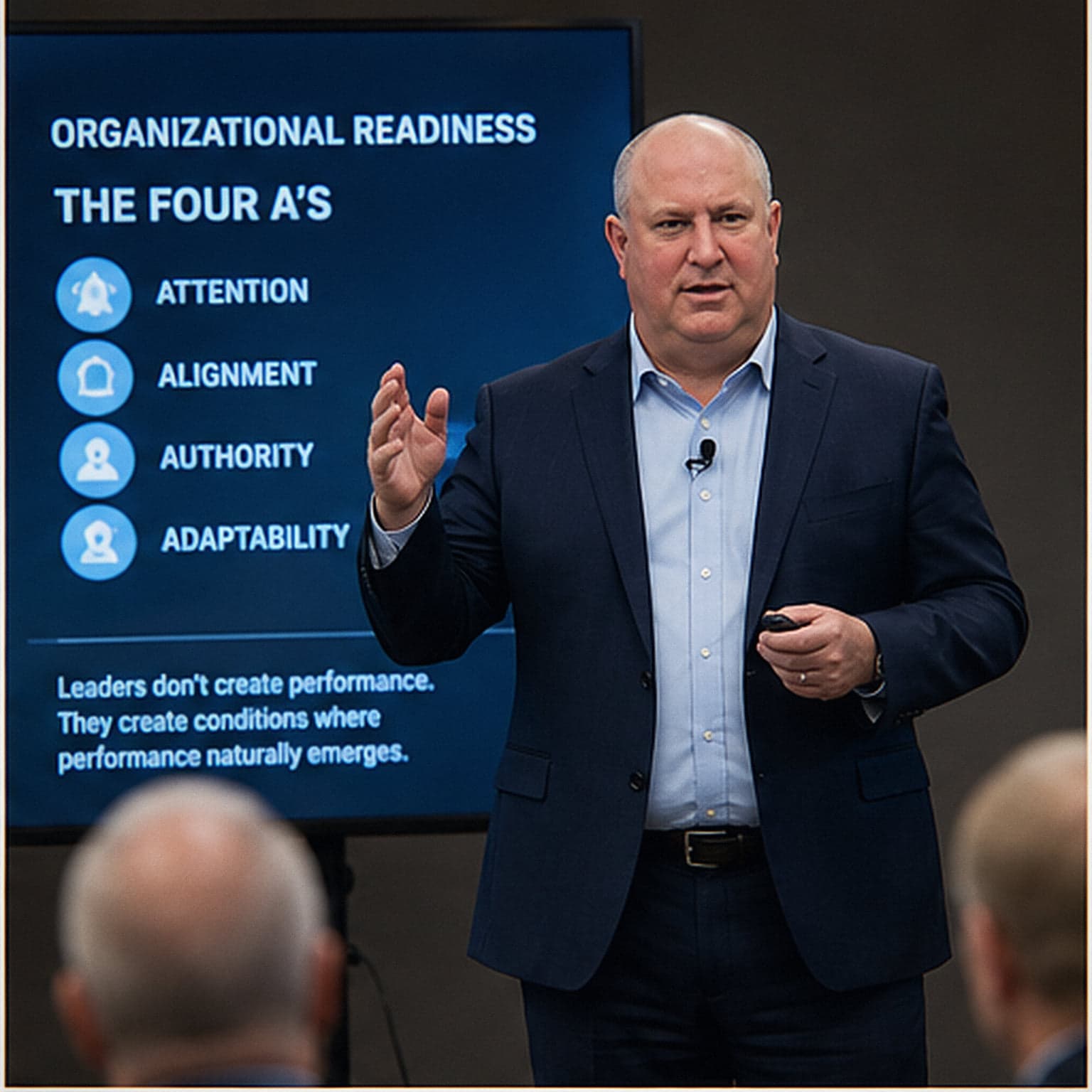
The Four A’s of Organizational Readiness™ diagnostic reads four structural conditions. Not people. Not culture. Conditions - the architectural features of the organization that determine what is and is not possible, regardless of individual effort or talent.
Does organizational focus match stated priorities - in calendars, budgets, and review processes?
Do leaders share a specific, testable understanding of what success looks like and what changes first?
Are decisions made at the right level, with the right information, at the speed the work requires?
Can the organization learn from feedback and adjust before the cost of the wrong path compounds?
How it works
Independent scoring
Each leader completes the diagnostic independently - no discussion beforehand, no consensus in the room. The questions describe observable organizational behavior, not opinions about abstract constructs. This produces honest individual readings rather than a negotiated group answer.
Cross-leader comparison
Results are compared across leaders. Where scores cluster, the organization has a shared view of that condition. Where they diverge significantly, the disagreement itself is the finding - leaders are operating on different understandings of organizational reality. That gap costs you every time a decision is made.
Indicated constraint
The engine normalizes the severity of unlocked metrics and identifies the highest-ranked area for investigation. It is a prioritization rule, not a causal finding: the result tells leaders where to look first and what evidence to gather next.
Debrief and intervention focus
Results are reviewed in a structured debrief that translates scores into a specific, actionable focus. Not a generic improvement plan - a diagnosis of the specific structural condition limiting this organization, and where to start changing it.
What you get - and what you don’t
You get
- →An indicated constraint - the highest-ranked area to investigate first
- →A map of where your leadership team agrees and diverges on organizational reality
- →A specific, prioritized place to look first - not a generic improvement list
- →A business framing, not an HR report
You don’t get
- - A benchmarking comparison to other organizations
- - A culture survey or engagement score
- - A 90-page report of everything that could be better
- - A generic framework applied uniformly regardless of context
Read the scoring rules and limits
The assessment suite contains two different instruments. Each has its own production rules and interpretation limits.
What has been established, and what has not
The rules above describe how a score is produced. They do not tell you whether the instrument measures what it claims to. That is a separate question with a separate answer, and the answer is published as it lands rather than once it is flattering.
Nine analyses are named in advance, each with the minimum sample it needs and the result that would count AGAINST the instrument. The page starts at zero on purpose. A validation program that only becomes visible once it succeeds is a marketing page.
Open the validation status →Who it is for
The diagnostic is designed for executive leaders - people who have the authority to change structural conditions, not just surface them. It is most useful before a major transformation, at the start of a new leadership tenure, when a capable team is consistently underperforming, or when change initiatives keep failing for reasons that are hard to name.
It is not a tool for measuring individual performance, team satisfaction, or culture in the traditional sense. If those are the questions, there are better instruments. This one answers a different question: what is structurally preventing this organization from executing at the level its people are capable of?
Common questions
Why do leaders complete it independently?
When leaders complete a diagnostic together, the dominant voice shapes the result. Independent completion surfaces the actual distribution of views. Where leaders diverge significantly, that disagreement is the finding - not a problem to smooth over before the debrief.
How long does it take?
The self-assessment takes seven to twenty-five minutes depending on format. The team diagnostic takes the same time per leader, plus a debrief session. There is no lengthy pre-work or data collection phase before you see results.
How is this different from an engagement survey?
Engagement surveys measure how people experience the organization. This measures the structural conditions that produce those experiences. Engagement is an output of conditions. The diagnostic reads the conditions.
What happens after the diagnostic?
After a self-assessment, results are immediate. After a team diagnostic, a structured debrief with Dan identifies the primary constraint and what to do about it. The diagnostic is a starting point, not a conclusion.
Start now
Run the diagnostic on your organization
The self-assessment takes seven minutes and identifies which of the four conditions is your primary structural constraint. Results are immediate and private.
Take the Assessment →Go deeper
Book a diagnostic conversation
A structured 60-minute session with Dan Flynn. Bring your self-assessment results, or start fresh. The conversation translates the diagnostic into a specific intervention focus for your organization.
Work With Us →