Alignment
Alignment Debt
Why teams agree in the meeting and diverge during execution.
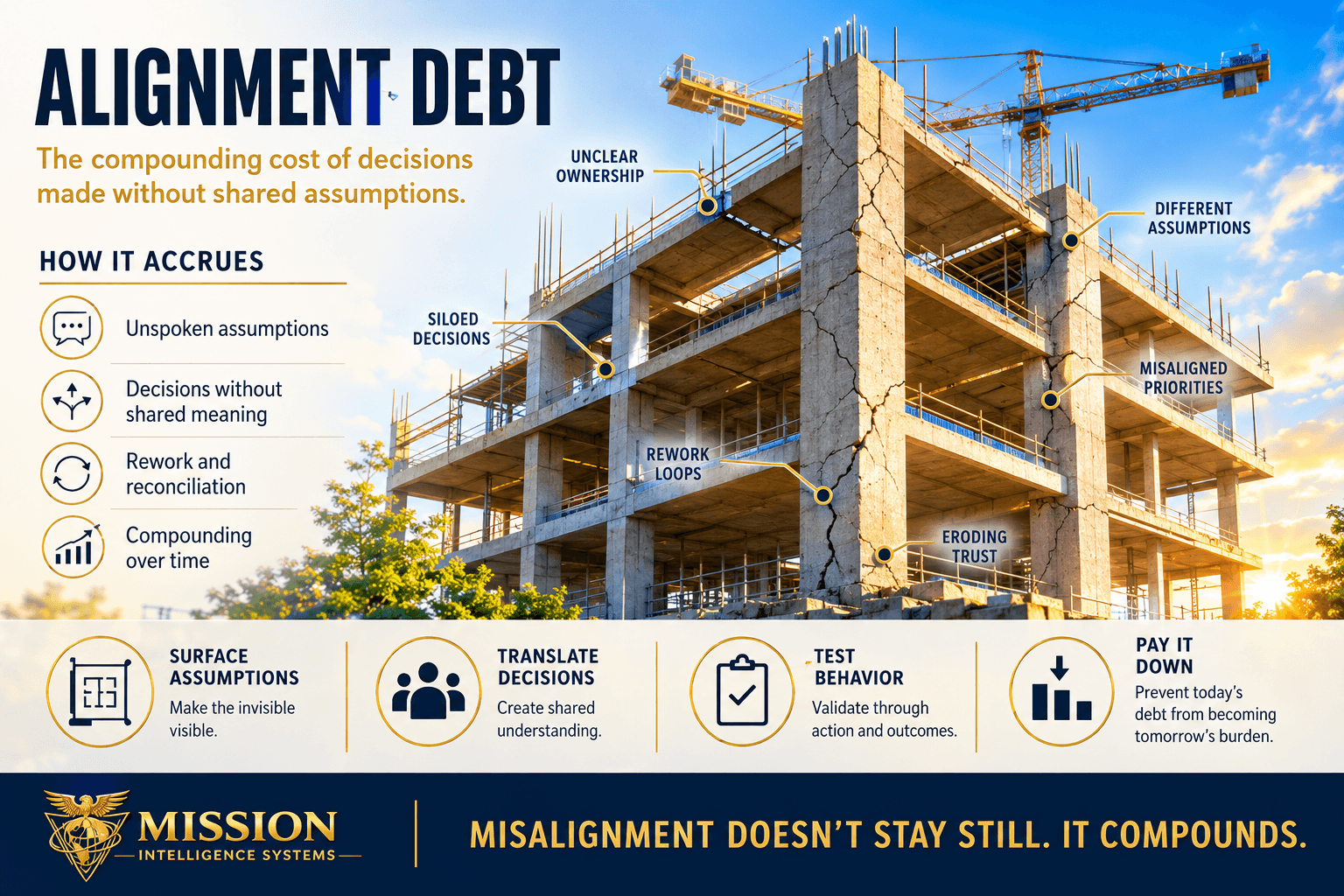
Every decision made without shared understanding is a loan against future execution. The interest compounds silently: until the payment arrives as rework, conflict, or a transformation that stops midway through.
Key Takeaways
- Every decision made without genuine shared understanding is a loan against future execution - the interest compounds silently until it arrives as rework, conflict, or a transformation that stops midway through.
- Alignment debt is different from misalignment: it accumulates when teams believe they are aligned but have only agreed on words, not on the trade-offs those words would require in practice.
- The only way to retire alignment debt is to surface the actual disagreements that created it - which requires the safety to challenge assumptions and the authority to act on what is discovered.
A leadership team I worked with had spent three days in an offsite. By every measure, it was a productive session. They had worked through the strategy. They had named the priorities. They had agreed on the operating model changes required to execute. They left the room aligned.
Six weeks later, I sat in a working session with four of the teams: those leaders oversaw. I asked each team the same question: when a decision comes up that touches two priorities at once, how do you know: which one wins?
Four teams. Four different answers. None of them wrong, exactly. All of them different enough that teams operating on each interpretation would make fundamentally different choices, and produce fundamentally different outcomes: from the same leadership direction.
The leadership team had agreed. The organization was not aligned.
Agreement Is Not Alignment
This is the most important distinction in organizational leadership, and: it is the one most consistently missed.
Agreement means that people in a room said yes to the same statement. Alignment means that people who were not in the room will make consistent choices when they face a situation the statement did not anticipate. Agreement is produced in a conversation. Alignment is tested in the field.
Most leadership teams are very good at achieving agreement. They have developed sophisticated processes for it: offsites, alignment sessions, cascades, all-hands meetings, strategy documents. What they have not developed is a practice of testing whether that agreement has produced shared understanding at the level where decisions actually get made.
Alignment is not what people say when you ask them if they understand. It is what they do when you are not in the room.
How Alignment Debt Accumulates
Alignment Debt accumulates the same way financial debt does: through a series of individually manageable decisions that are made without the shared understanding those decisions require.
A strategy decision is made at the senior level. The understanding required to execute it: which tradeoffs are acceptable, which constraints are real, what success actually looks like: is not built into the organization with the same rigor the decision received. Teams receive the decision and fill the gaps with their own interpretations, their prior experience, and their best guess about what the leaders actually meant.
The next decision builds on that gap. And the next. Within months, teams are operating on divergent assumptions about what matters most, and the work of reconciling those assumptions falls to individual contributors, middle managers, and the escalation queue, rather than being resolved at: the level where the misalignment originated.
By the time the debt becomes visible: usually in a program review where outputs do not match expectations: the organization has already paid a significant portion of the interest. The rework is real. The conflict has already happened. The timeline has already slipped.
The Communication Misdiagnosis
When alignment debt becomes visible, it is almost always diagnosed as a communication problem. Leaders say the message did not land. They schedule another all-hands. They produce a more detailed strategy document. They add more reporting requirements so they can see misalignment sooner.
None of these interventions address the actual problem. Alignment debt is, not produced by insufficient communication. It is produced by the absence of shared understanding of tradeoffs, and shared understanding of tradeoffs cannot be built through broadcast. It has to be built through conversation, tested through scenario, and verified through the behavioral evidence that teams can make consistent decisions without constant escalation.
Communication is necessary but not sufficient. You can communicate a priority perfectly and still leave teams without the shared understanding they need to execute on it consistently. The message arrives. The alignment does not.
The Test
The most reliable test for alignment debt is the tradeoff question. Take two priorities the organization has stated. Construct a realistic scenario where they conflict. Ask five senior leaders independently what the right answer is.
If the answers are consistent: not identical, but consistent in the underlying logic: the organization has real alignment on that tradeoff. If the answers diverge significantly, the organization has alignment debt. Every team below: those leaders is making that tradeoff every day, and making it differently.
The second test is the escalation rate. If a significant volume of decisions is traveling up to senior leaders that teams should be able to make on their own, the organization is showing one of two things: an authority constraint, or an alignment constraint. Often both. Teams escalate when they do not trust their own interpretation of what leadership wants: which is a precise description of unresolved alignment debt.
Every decision that escalates unnecessarily is a receipt for alignment debt you did not know you had taken on.
Alignment Debt and the Four A's
Alignment Debt is a direct manifestation of an Alignment constraint: the second dimension measured by the Four A's of Organizational Readiness™ framework. Alignment asks whether leaders and teams share a consistent understanding of what matters most: not just the stated priorities, but: the tradeoffs those priorities require when conditions get complicated.
Organizations with high alignment debt often have other constraints that compound the problem. Unclear decision authority (an Authority constraint) makes alignment harder to test in practice. Fragmented attention (an Attention constraint) means leaders are not present long enough in any one domain to build the shared understanding the organization needs. The Four A's framework identifies which of these constraints is primary: because treating alignment: when the real constraint is authority produces a different fix than treating: the reverse.
About the Author
Dan Flynn
Creator of The Four A's of Organizational Readiness™ · Enterprise Transformation Executive · Author, Builders Build
Dan Flynn has spent thirty years inside federal, defense, and commercial organizations: diagnosing the invisible conditions that determine whether capable people produce extraordinary results. He is the creator of The Four A's of Organizational Readiness™ framework, has reached more than 11,000 professionals across corporate, civic, and national security contexts, and produced a documented 1,033% improvement in delivery velocity by changing organizational conditions: not people.
His book, Builders Build: The Four A’s of Organizational Readiness™, is forthcoming.
Related Articles
Authority
Decision Architecture
The intentional design of who decides what, at what level, with what information, and why most organizations inherit it instead of building it.
Conditions
Organizational Gravity
The structural force that pulls organizations back toward prior patterns regardless of what leaders intend.
Authority
The Operating Model Bottleneck
When the operating model itself becomes the constraint, and what leaders can do about it.
From Builders Build
Alignment Debt is developed as a core diagnostic concept in Builders Build: The Four A’s of Organizational Readiness™ by Dan Flynn: forthcoming soon. The book examines how leaders build the shared understanding that allows organizations to execute consistently, even when the leader is not in the room.