
The Psychology of Organizations · Motivation
Autonomy Drives Performance
Why giving people control over their work outperforms controlling it for them.
The instinct under pressure is to tighten control: more oversight, more approvals, more rules. The research on motivation and job design points the other way. Within clear boundaries, autonomy, real control over how the work is done, produces more engagement, better performance, and more initiative than control ever will.
Research Foundation
- Motivational psychology and self-determination theory
- Job and work design research
- Organizational behavior
- Executive and enterprise field experience
- The Builders Build Framework
Key Takeaways
- Autonomy, the sense of control over how one's work is done, is one of the strongest drivers of intrinsic motivation, engagement, and initiative. It is a basic psychological need, not a perk.
- Job design research shows that autonomy plus meaningful feedback and skill variety predicts performance, while high demands with low control predict strain and disengagement. Control without autonomy is a formula for burnout.
- Because performance depends on decisions and initiative happening where the knowledge is, autonomy is an Authority condition: it is about locating real decision rights close to the work, within clear boundaries.
The cord any worker could pull
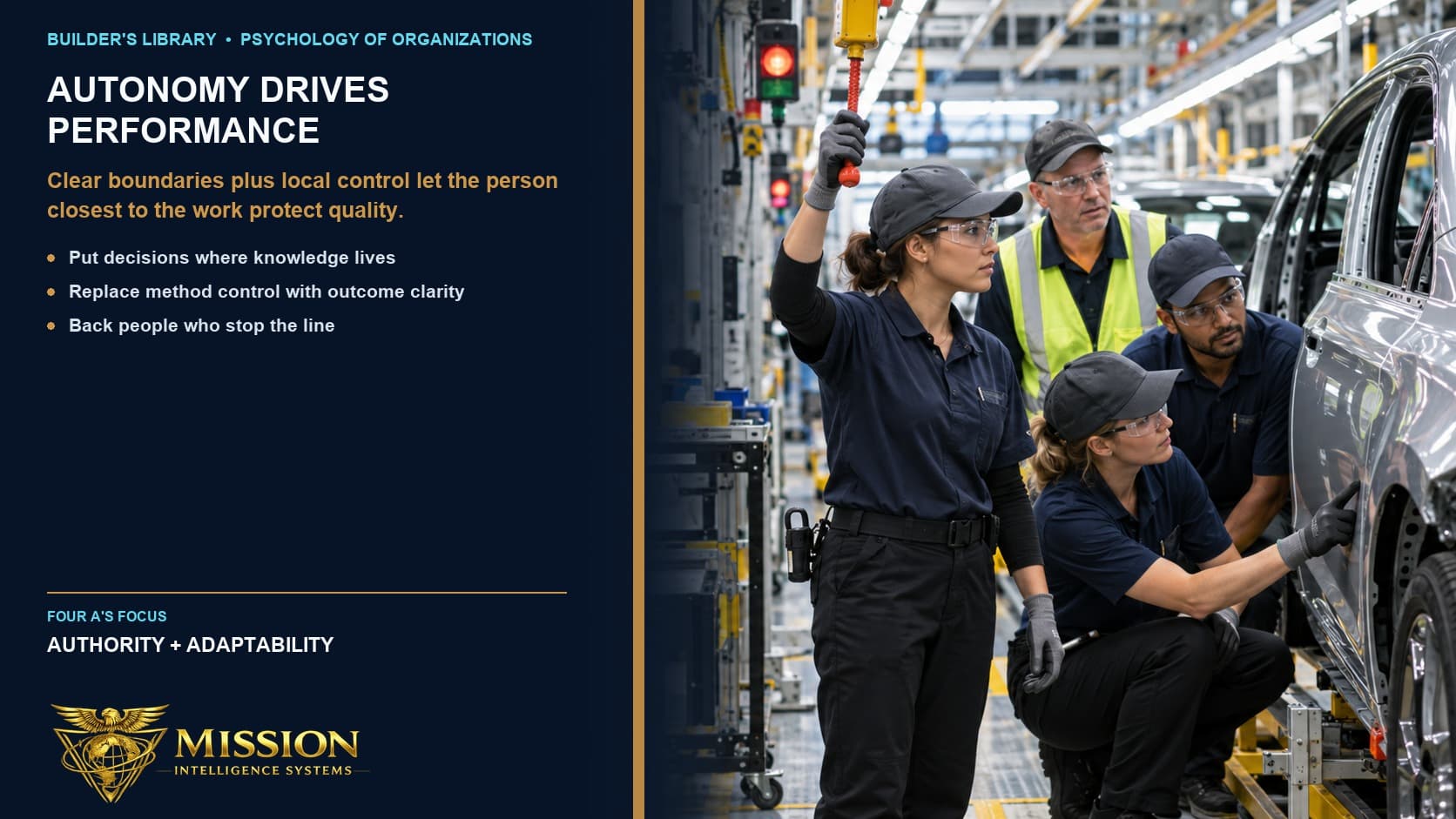
On the Toyota production line, any worker could pull a cord, the andon, and stop the entire line if they saw a problem. To a control-minded executive this looks reckless: you have handed the power to halt a multimillion-dollar operation to a frontline employee. Toyota understood something the research confirms. Giving workers genuine authority over the quality of their own work, including the authority to stop it, produced higher quality and more engagement than any amount of top-down inspection. The cord was not a loss of control. It was the recognition that the person doing the work is the person best positioned to act on what they see, if they are given the authority to act at all.
Autonomy is a need, not a nicety
Self-determination theory identifies autonomy as one of three basic psychological needs, alongside competence and relatedness, whose satisfaction drives intrinsic motivation and well-being. Deci, Connell, and Ryan found that supporting employee autonomy predicted greater satisfaction and trust in a real organization. Richard Hackman and Greg Oldham's job characteristics model established that autonomy is one of the core dimensions that make work motivating, alongside skill variety, task significance, and feedback. And Robert Karasek's demand-control model showed the shadow side: jobs that combine high demands with low control produce the most strain and disengagement, while high demands with high control produce engagement. The pattern is consistent across decades. People do their best work when they have genuine say over how they do it.
Under pressure, leaders add control, because control looks like management. For complex work it is often the opposite of what performance needs: the tighter the grip on how, the less initiative you get, until compliance is all that is left.
Why organizations tighten exactly the wrong screw
Under pressure, organizations add control, because control is visible and feels like management. More approvals, more oversight, more standardization of how the work is done. The research says this is often the precise opposite of what performance requires, especially for complex work. Removing autonomy removes the intrinsic motivation and initiative that produce excellence, leaving people who do only what is specified and nothing more. The organization then interprets that compliance as needing still more control, and tightens further, manufacturing the very passivity it was trying to fix.
What this means through the Four A's
Autonomy is an Authority condition. Authority is about whether decisions sit where the knowledge is and whether people are empowered to act, and autonomy is that principle applied to the individual's own work. The research is clear that the answer is not the absence of structure but the right structure: clear boundaries and goals, paired with genuine control over how the work gets done inside them. Locate real decision rights close to the work. Replace oversight of method with clarity of outcome. And treat the urge to tighten control under pressure as a signal to examine whether you have given people enough authority to perform, because control and performance usually pull in opposite directions.
Evidence matrix
| Claim | Research | Field evidence | Four A's |
|---|---|---|---|
| Autonomy is a basic driver of motivation | Deci & Ryan (2000); Deci, Connell & Ryan (1989) | Andon cord authority at Toyota | Authority |
| Autonomy in job design predicts performance | Hackman & Oldham (1976); Parker (2014) | Say over method raises engagement | Authority, Adaptability |
| High demand with low control drives strain | Karasek (1979) | Oversight produces passivity, not performance | Authority, Attention |
Executive reflection questions
- Where have you added control under pressure, and did performance actually improve or did initiative quietly fall?
- Do your people have genuine authority over how they do their work, or only responsibility for outcomes they cannot control?
- Which decisions currently travel up for approval that the people doing the work are better positioned to make?
- Where are high demands paired with low control, the precise formula for burnout and disengagement?
Builder actions
Design for autonomy within clear boundaries. Set outcomes and constraints crisply, then give people real control over how they meet them, because method-level oversight buys compliance and costs initiative. Locate decision rights close to the work, the way a stop-the-line authority puts quality control in the hands of the person who can see the defect. Replace approvals that add no judgment with clarity about what good looks like. And watch the demand-control balance: where you are asking a lot, make sure people have the authority to deliver it, because high demands with low control is the reliable recipe for the disengagement you are trying to prevent.