
The Four A's · Organizational Readiness
Organizational Readiness for AI
Why readiness, not the technology, decides whether AI creates value.
The dominant question in most enterprises is which AI to buy. The more predictive question, the one the evidence keeps returning to, is whether the organization is ready to turn any AI into value. Readiness is the precondition executives skip, and it is the one that decides the outcome.
of enterprise GenAI initiatives see no business return
MIT NANDA, State of AI in Business 2025
Readiness, not the tool, decides whether AI creates value.
Diagnose your constraint →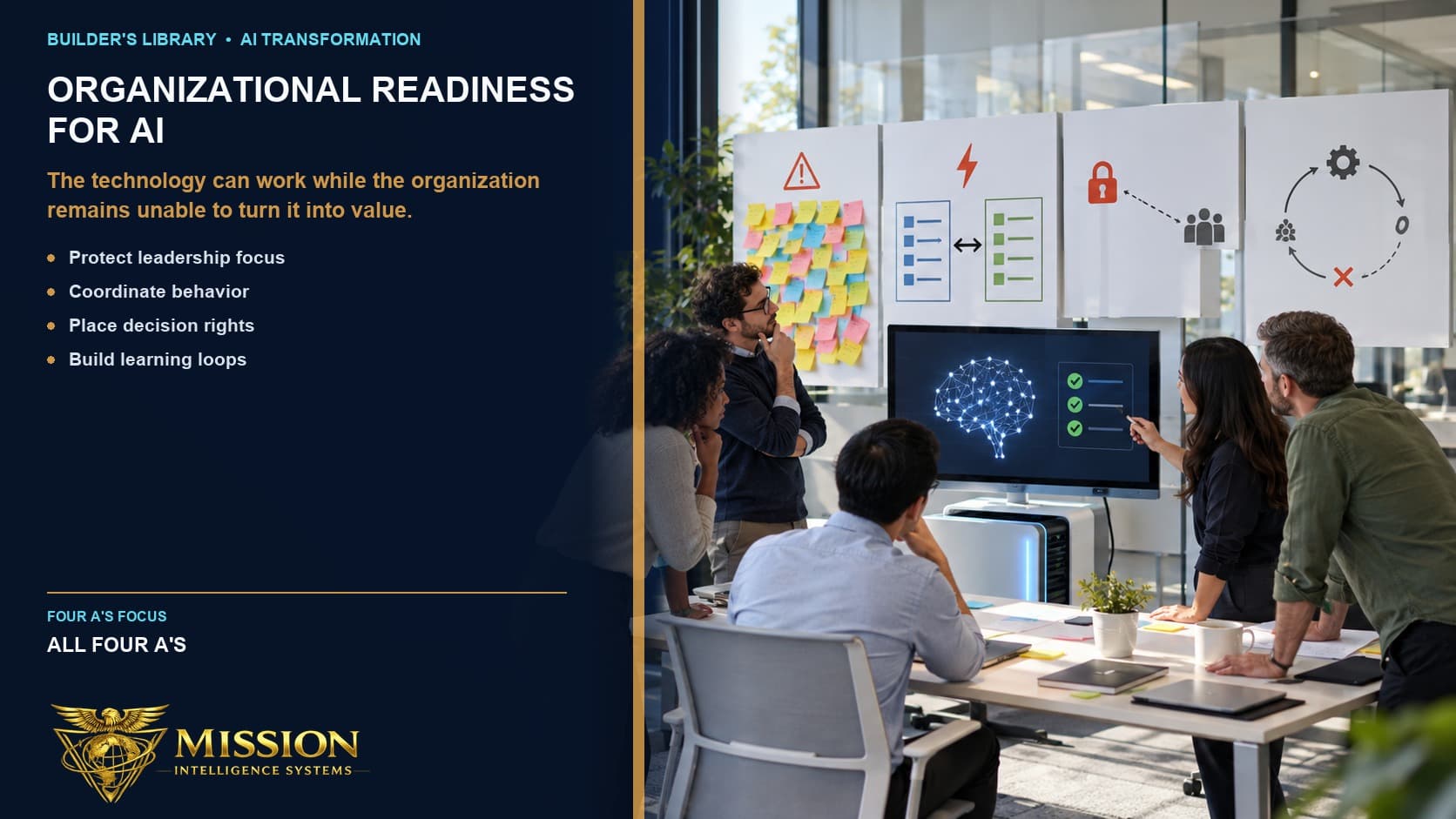
Research Foundation
- Peer-reviewed organizational and cognitive research
- AI and institutional research (MIT, WEF, IBM, BCG)
- Executive leadership literature
- Enterprise transformation field experience
- The Builders Build Framework
Key Takeaways
- The evidence is consistent across sources: MIT found 95 percent of AI pilots return nothing, the World Economic Forum found the skills gap is the top barrier to transformation, and IBM found ungoverned AI is now a leading breach vector. In each case, the constraint is organizational, not technical.
- Technology adoption research has held for decades that value depends on organizational conditions such as leadership alignment, psychological safety, decision rights, and organizational learning.
- The Four A's are a practical synthesis: they render those conditions as four observable constraints an executive can diagnose, Attention, Alignment, Authority, and Adaptability.
The evidence points at the organization
Read the major studies together and one conclusion recurs. MIT's 2025 GenAI Divide found that about 95 percent of enterprise AI pilots produced no measurable return, and named the barrier as organizational learning rather than infrastructure or talent. The World Economic Forum's Future of Jobs Report 2025 found that the skills gap, an organizational capacity, was the single largest barrier to transformation. IBM's 2025 breach research found that ungoverned AI, an authority and governance failure, had become a leading and expensive source of exposure. Different lenses, same finding: the technology works, and organizations still do not get the value, because the constraint sits in the organization.
Research names the conditions; the Four A's make them usable
This is not a new idea in the research, only a newly urgent one. Studies of technology adoption and organizational change have long shown that outcomes depend on conditions: leadership alignment, psychological safety, clear decision rights, and the capacity to learn. Davis established that usefulness inside real work drives adoption. Edmondson showed that safety governs whether people surface and learn. Simon located performance in where decision authority meets knowledge. Argyris, Schon, and Senge showed that durable change requires organizational learning. The scholarship is rich and, for a busy executive, diffuse. The Four A's of Organizational Readiness are a synthesis that makes it operational: they translate a large body of established science into four constraints a leader can actually observe and act on.
Research proves that conditions determine whether technology creates value. The Four A's are the executive instrument for reading those conditions inside a real organization.
The four constraints
Attention asks whether leadership focus is protected and directed, or fragmented across more priorities than it can hold. Alignment asks whether behavior after the meeting is coordinated toward the same end, or only agreed to in the room. Authority asks whether decisions sit where the knowledge is, and whether anyone is empowered to redesign the work a new capability implies. Adaptability asks whether change survives contact with the organization, or reverts once attention moves on. AI readiness is not a score on any single one. It is the state of all four, and the discipline of finding which is the binding constraint before spending against the others.
Evidence matrix
| Claim | Research | Field evidence | Four A's |
|---|---|---|---|
| AI value is limited by organizational conditions | MIT NANDA (2025); WEF (2025); IBM (2025) | 20 to 1,600+ daily processes at OPM | All four |
| Adoption depends on usefulness, safety, rights, learning | Davis (1989); Edmondson (1999); Simon (1947) | Federal and enterprise programs | All four |
| Readiness can be made observable and diagnosable | Argyris & Schön (1978); Senge (1990) | The Four A's in practice | All four |
What executives should do
Before the next tool decision, make a readiness decision. Diagnose the four constraints honestly, find the one that binds, and fix that condition before spending against the others. Treat readiness as the precondition for AI value rather than a byproduct of buying it. The organizations that will capture the next wave are not the ones with the most AI. They are the ones that were ready to use it.