From Research to Readiness · Systems Thinking
From Research to Readiness: Peter Senge
The organizations that endure are not the ones that plan best. They are the ones that learn fastest, on purpose.
Peter Senge's The Fifth Discipline gave a generation of leaders the idea of the learning organization: a company deliberately built to learn, adapt, and see itself as a system. His five disciplines, especially systems thinking, describe the conditions under which an organization keeps getting better instead of repeating its own patterns.
Research Foundation
- Systems thinking
- Organizational learning
- The Four A's of Organizational Readiness
- The Builders Build Framework
Key Takeaways
- The learning organization is deliberately built to learn and to see itself as a system, not a set of isolated events.
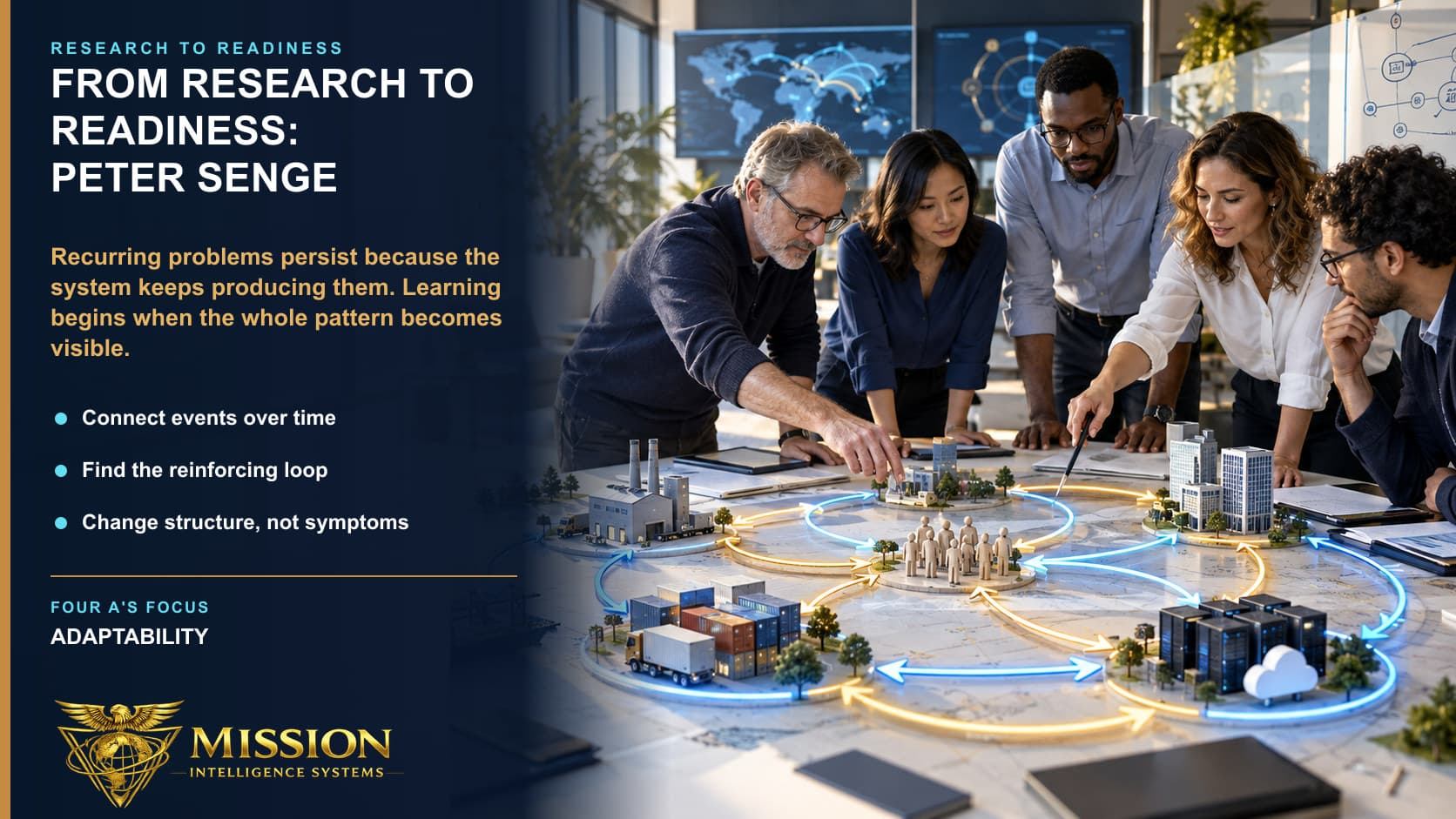
- Recurring problems usually have a structure, and blaming events or people leaves that structure intact.
- This is an Adaptability condition: organizations that learn as a system adapt, while those that react event by event repeat themselves.
What Senge found
Senge described five disciplines that build a learning organization: personal mastery, mental models, shared vision, team learning, and systems thinking, the fifth and integrating one. Systems thinking is the ability to see interdependencies and feedback loops rather than isolated events, and to locate the structure that produces a pattern. The learning organization treats learning not as an accident but as a capability to be deliberately built.
Why it matters inside organizations
Most organizations learn slowly because they explain problems as events and people, not as the systems that produced them. This is why the same problems recur under new names: the underlying structure was never changed, only the symptom. Senge's frame explains the frustration of the leader who fixes the same thing every year, and points at the structure that keeps regenerating it.
Organizations do not fail from a lack of smart people. They fail from being systems that keep teaching their smart people to produce the same result.
The condition it affects
This is about adaptability: whether the organization learns as a system or repeats its patterns. Systems thinking is how a leader stops treating recurring problems as bad luck and starts seeing the structure, the incentives and feedback loops, that keeps producing them.
Through the Four A's
This lands on Adaptability, with Alignment. Adaptability, because a learning organization changes with reality instead of reacting to it event by event. Alignment, because shared vision and shared mental models, two of Senge's disciplines, are what let a team learn together rather than in fragments.
Evidence matrix
| Claim | Research | Field evidence | Four A's |
|---|---|---|---|
| Learning is a buildable capability | Senge (1990) | Fast learners outlast good planners | Adaptability |
| Systems thinking reveals structure behind events | Senge (1990) | Recurring problems have a structure | Adaptability |
| Shared vision and mental models align learning | Senge (1990) | Teams learn together or not at all | Alignment |
Executive reflection questions
- Which problem keeps recurring, and what structure keeps regenerating it?
- Do you explain failures as events and people, or as the system that produced them?
- Does your team share a mental model well enough to learn together?
- What feedback loop, if changed, would break the pattern you keep fixing?
Builder actions
Build learning as a capability, not a slogan. When a problem recurs, stop treating the event and look for the system, the structure, incentives, and feedback loops that keep producing it. Cultivate shared mental models so the team interprets reality the same way and can learn together. Treat systems thinking as a leadership discipline, because the recurring failures in your organization are almost always structural, and the structure is exactly what you have the power to change.