
Organizational Design · Conditions
The Operating Model Is the Intervention
Why no change holds until the operating model itself changes.
Every performance initiative eventually runs into the operating model. New leaders, restructuring, culture programs, and technology all hit the same system underneath. Until that model changes, nothing else will hold.
Research Foundation
- Information economics and decision theory
- Organizational design and structural research
- Institutional transformation evidence (McKinsey)
- Enterprise transformation field experience
- The Builders Build Framework
Key Takeaways
- Organizations in trouble reach for new leadership, restructuring, culture programs, and technology. Each eventually runs into the operating model, the actual system by which the organization decides, allocates, and produces. Until that system changes, the other changes do not hold.
- Most operating models are not designed; they accumulate. Hayek showed that knowledge is dispersed, so models that centralize authority above the knowledge produce slow, poor decisions regardless of who is deciding. Simon showed that bounded rationality keeps leaders adjusting inside structures they treat as given.
- Operating model redesign is the work of answering four structural questions, one per condition: where attention actually goes, whether alignment survives the meeting, whether authority sits with knowledge, and whether the organization can reconfigure rather than only learn.
Everything runs into it eventually
Organizations in trouble tend to reach for the same interventions: new leadership, restructuring, culture change programs, training investments, technology upgrades. Each can be valuable, and each, sooner or later, runs into the operating model, the actual system by which the organization makes decisions, allocates resources, and produces results. When that model is broken, new leaders find themselves constrained by the same authority structures, restructuring moves boxes without changing the conditions inside them, culture programs create language without structural change, and technology is absorbed by workflows never designed to use it. The insight that changes everything for most executives is that the operating model is not the backdrop against which improvement happens. The operating model is the intervention.
What an operating model actually is
An operating model is the set of structural choices an organization has made, explicitly or by default, about how it converts resources and effort into outcomes. It includes how decisions are made and at what level, how leadership attention is allocated, how teams coordinate across functions, and how the organization learns and reconfigures over time. Most operating models are not designed; they accumulate. They are the residue of past decisions, structures, leaders, and conditions that may no longer exist. A company founded when it employed twenty people and needed a founder in every room may still carry a twenty-person model in its decision structures at two thousand employees. The operating model in use and the operating model needed are rarely the same, and the gap between them is where performance disappears.
Why the operating model resists change
In his 1945 paper on the use of knowledge in society, Friedrich Hayek identified the fundamental problem of organizational design: knowledge is dispersed. No single leader possesses all the information required to make the organization's decisions optimally, because the people closest to the work know things the people at the top do not. His conclusion, that decisions should be made by those with local knowledge rather than central authorities acting on summaries, has a direct implication. Operating models that centralize authority above the level of the knowledge required to act on it will produce slow, poor decisions regardless of the quality of the people making them. The problem is structural.
The second reason is what Herbert Simon called bounded rationality: the cognitive limits that constrain every decision-maker's ability to process information, weigh alternatives, and evaluate consequences. Organizations facing complex problems under time pressure do not redesign their operating models from first principles. They adjust what they can see, working within structures that feel like the given rather than the chosen. This is why organizations keep reaching for talent solutions to structural problems. Changing a leader is visible, concrete, and fast. Redesigning the authority structure or rebuilding the alignment mechanisms that determine whether decisions hold is slower, less visible, and requires leaders to examine systems they are standing inside.
The evidence from transformation research
McKinsey research on large-scale transformations puts the failure rate near seventy percent, and the most common root cause is not weak strategy, wrong talent, or insufficient budget. It is insufficient investment in the operating conditions, the structural mechanisms, that let a transformation take hold and sustain itself after the announcement energy fades. Sull, Homkes, and Sull, in their 2015 study of more than 250 companies, found that execution failures were rarely caused by weak vertical alignment between strategy and individual activity. The failures were horizontal, across functions and teams that needed to coordinate, because the operating conditions for cross-functional work had not been built. Work behind the Organizational Health Index, drawn from thousands of organizations and millions of respondents, finds that top-quartile organizational health, measured by the structural conditions that enable performance rather than individual engagement alone, correlates with roughly three times the total shareholder return of the bottom quartile, across industries. The structural conditions are doing most of the work.
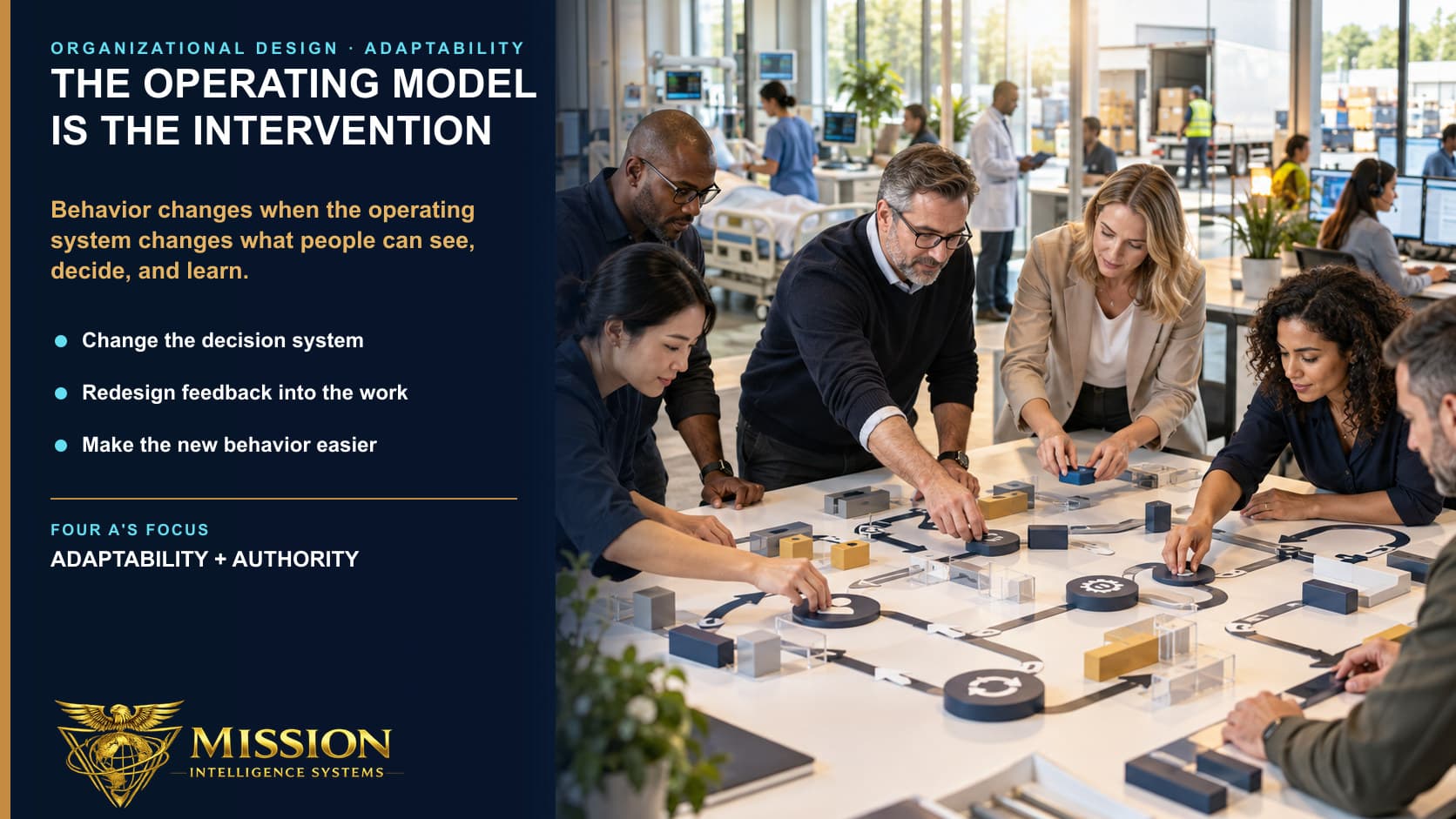
The operating model is not the backdrop against which improvement happens. It is the intervention. Until it changes, no other change will hold.
What redesign actually involves
Operating model redesign is not abstract. It is the work of answering four structural questions, one for each condition that determines performance.
Attention
Where does leadership focus actually go, and does that match what our priorities require?
Not where leaders believe or intend their attention goes. Where it actually goes, as evidenced by calendars, resource allocations, and decision frequency.
Alignment
Are leaders making consistent decisions over time without being re-synced in every meeting?
Agreement is not alignment. Alignment requires shared frameworks, feedback loops that catch drift, and forums designed to surface divergence before it becomes damage.
Authority
Are decisions being made at the level where the relevant knowledge is?
Hayek's insight applied: authority should follow knowledge. When decisions travel above the level of knowledge, they produce answers that do not fit the situation.
Adaptability
Does the organization have the structural mechanisms to reconfigure, not just learn?
Argyris and Schon's distinction matters here: single-loop learning adjusts tactics within existing structures, while double-loop learning, questioning the structures themselves, must be designed in.
The presenting problem is not the real constraint
The most consistent finding across thirty years of working inside federal agencies, defense programs, manufacturing organizations, and technology companies is that the problem leadership is actively managing is rarely the problem actually limiting performance. A team that cannot execute is usually working inside an authority structure that makes execution slow. A leadership team that cannot stay aligned has usually not protected the attention required to build alignment. A transformation that keeps stalling is usually stalling because the operating model was not built to support the change being asked of it. In every case, the presenting problem points toward the operating model underneath it, and the fastest path to sustained performance is through that model, not around it.
Evidence matrix
| Claim | Research | Field evidence | Four A's |
|---|---|---|---|
| Centralized authority above knowledge slows decisions | Hayek (1945); Simon (1979) | Federal and enterprise programs | Authority |
| Transformations fail on conditions, not strategy | Sull, Homkes & Sull (2015); Keller & Price (2011) | ~70 percent transformation failure rate | All four |
| Structural conditions drive returns across industries | Organizational Health Index research | ~3x total shareholder return, top vs bottom quartile | All four |
What executives should do
Ask what the organization could produce if the conditions were designed for what it is actually trying to do. The gap between what current conditions produce and what well-designed conditions could produce is the business case for operating model work, and it does not require new talent, technology, or budget. It requires redesigning the structural conditions you already have. Before the next reorganization or tool purchase, diagnose the operating model against the four questions and fix the condition that binds.