
Attention + Authority
Misdirected
When a well-meaning traveler gave the wrong direction and made it deadly.
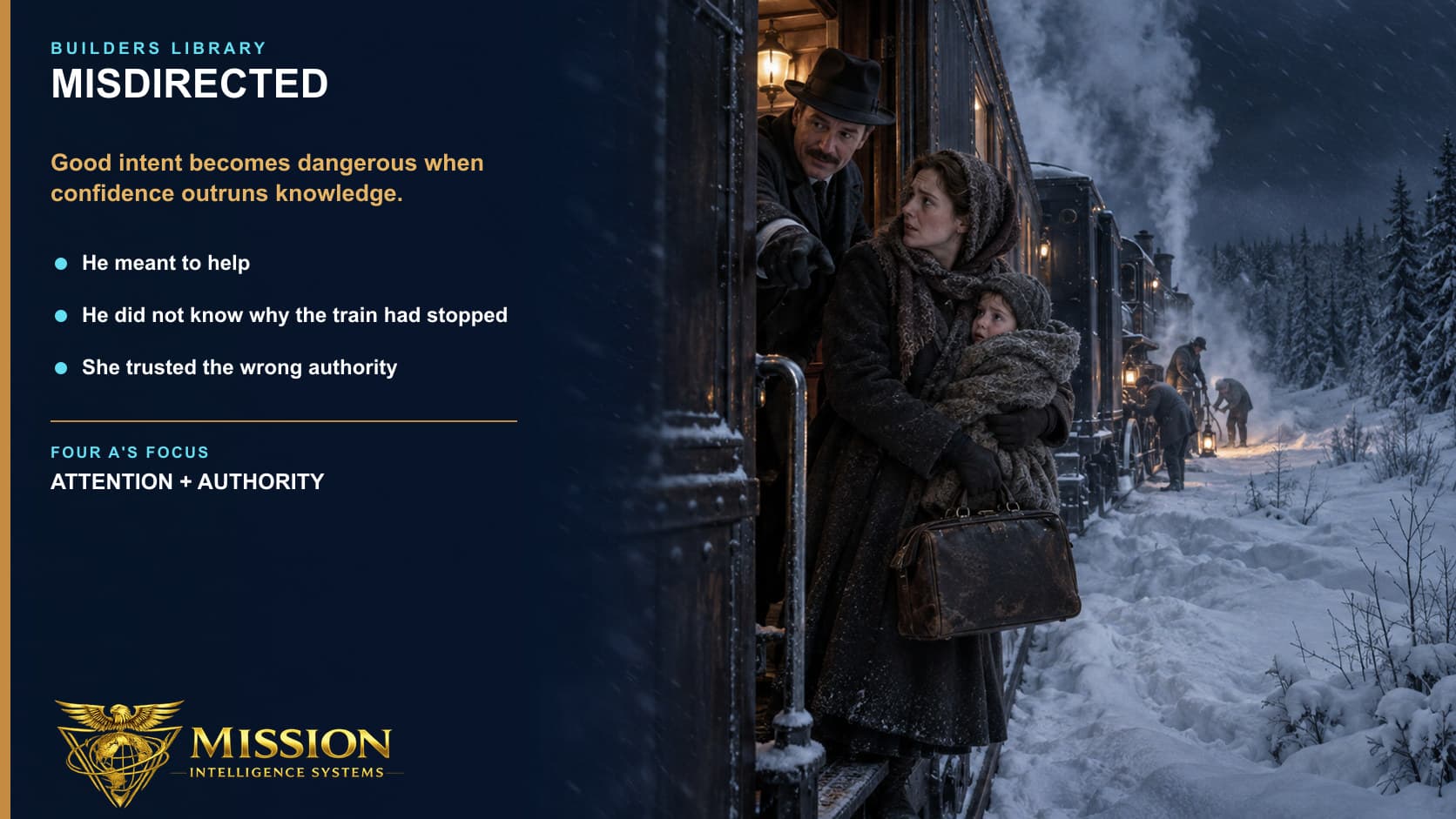
Good intent becomes dangerous when confidence outruns knowledge.
Key Takeaways
- A mother and her child left a winter train on the advice of a fellow passenger. The train had not reached a station. It had stopped between stations for an engine repair.
- The traveler was trying to help. The danger came from treating familiarity as authority and certainty as knowledge.
- Organizations repeat the pattern when people intervene without seeing the whole system, checking the evidence, or respecting the decision rights of those accountable for the outcome.
The Stop That Was Not a Station
A mother was traveling by train with her young child on a bitter winter night. She was anxious about missing her stop and asked a fellow passenger to tell her when they arrived. He agreed.
Later, the train stopped. Certain that this was her destination, the traveler hurried the mother and child off into the snow. The train pulled away. Only then did the crew explain that they had stopped between stations to repair the locomotive. The actual station was still ahead.
By the time the mistake was understood, it was too late. The mother and child had been left alone in the winter cold. They did not survive.
The story has circulated for more than a century as a cautionary illustration. It should be read that way, not as a verified news report. Its warning is still precise. A person can be sincere, helpful, and catastrophically wrong at the same time.
He Meant to Help
The traveler was not cruel. He did not intend harm. He saw someone who needed help and offered it. That is what makes the story uncomfortable. We prefer danger to announce itself through bad motives. Often it arrives through confidence that has not been earned.
He knew the mother's destination. He knew the train had stopped. He connected those two facts and acted as though he understood the system around them. He never asked why the train had stopped. He never checked with the crew. His answer felt complete because he could not see what it omitted.
Good intent matters morally. It does not make advice operationally safe.
Attention Before Intervention
Attention is more than noticing that something has happened. It is the discipline to understand what the event means before acting on it. A stopped train can mean a station. It can also mean a signal, an obstruction, a mechanical failure, or an emergency. The visible event was real. The interpretation was not.
In organizational life, the same mistake happens when a missed deadline is labeled a motivation problem, a quiet room is labeled agreement, or a declining metric is assigned a familiar cause before anyone investigates the conditions producing it. The observation may be accurate while the story built around it is dangerously incomplete.
Authority Is More Than Confidence
Authority is not the person who sounds most certain. It is the placement of decision rights with the people who have the knowledge, context, and accountability to use them responsibly.
The crew knew why the train had stopped. The passenger did not. By giving a definitive instruction without checking, he displaced legitimate authority with borrowed certainty. The mother had no reason to see the distinction. She heard an answer from the person who had promised to help.
This is why leaders must make expertise and decision rights visible. When people cannot tell who knows, who decides, and who is accountable, confidence fills the gap.
The Organizational Version
Misdirection at work is rarely as dramatic, but the mechanism is common. A senior leader bypasses the people closest to the work and prescribes a fix. A consultant imports a pattern without understanding the local system. A manager gives certainty because admitting uncertainty feels weak. A team follows because the direction came from someone who appeared authorized to give it.
The result may be wasted effort, a preventable risk, a capable person leaving, or a customer harmed by a decision no one paused to verify. The well-meaning person can explain the intention. The organization still absorbs the consequence.
The Four A's do not ask people to stop helping. They make help safer. Attention checks the facts. Alignment tests whether the direction serves the mission. Authority places the decision with the right person. Adaptability creates a way to correct the decision when new evidence arrives.
The Question Worth Asking
Before giving consequential direction, ask one question: What do I know, what am I assuming, and who is better positioned to verify the difference?
Help is not weakened by that pause. It becomes credible. The safest guide is not the person who always has an answer. It is the person who knows when the answer belongs to someone else.
Dan Flynn is the creator of The Four A's of Organizational Readiness™ and author of Builders Build: The Four A’s of Organizational Readiness™ (forthcoming).
Related reading: Why Smart People Make Bad Decisions · The Knowledge-Authority Gap · The Four A's Framework
About the Author
Dan Flynn
Creator of The Four A's of Organizational Readiness™ · Enterprise Transformation Executive · Author, Builders Build
Dan Flynn has spent thirty years inside federal, defense, and commercial organizations: diagnosing the invisible conditions that determine whether capable people produce extraordinary results. He is the creator of The Four A's of Organizational Readiness™ framework, has reached more than 11,000 professionals across corporate, civic, and national security contexts, and took a federal data platform from one release every six months to seventy-two every two weeks by changing organizational conditions: not people.
His book, Builders Build: The Four A’s of Organizational Readiness™, is forthcoming.