
The Four A's · Authority and Adaptability
When Hybrid Becomes W-Agile
The PMI-Agile integration test.
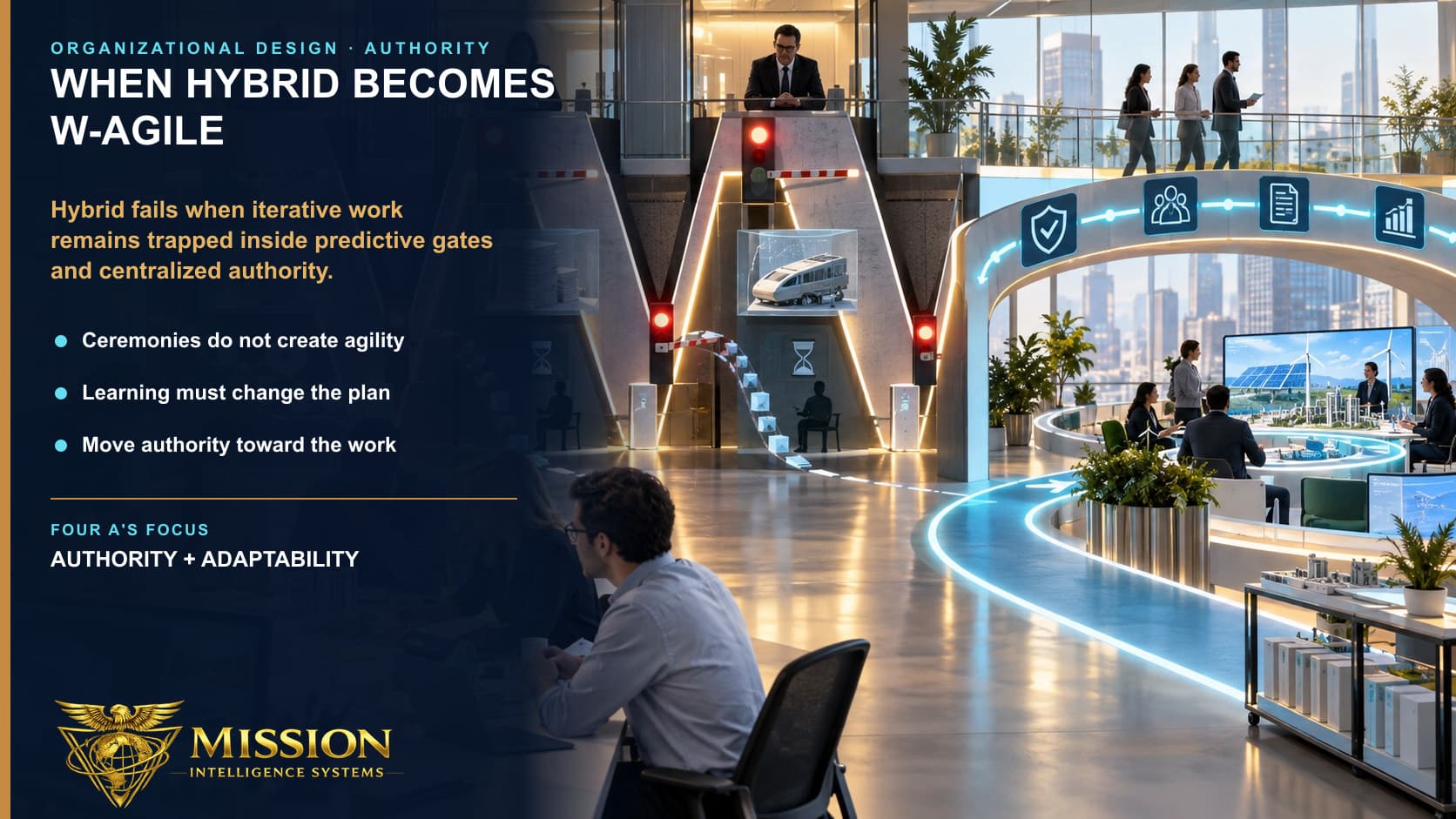
The word hybrid sounds mature. It promises the discipline of project management, the responsiveness of Agile, and an end to the old methodology argument. It can deliver exactly that. It can also give an organization permission to keep every approval gate, every fixed commitment, and every delayed release, then place sprints in the middle and call the result adaptive. The practices were combined. The operating system was not. That is not hybrid delivery. It is W-Agile under an institutional label.
Research Foundation
- PMI standards, guidance, and 2026 examination outline
- Agile Manifesto values and principles
- Empirical studies of hybrid project delivery
- Recent project and Agile practitioner discourse
- Organization design and decision-rights research
- The Builders Build Framework
Editorial note: Mission Intelligence Systems is not affiliated with or endorsed by Project Management Institute or PMI Agile Alliance. PMI, PMP, and PMI Agile are used only to identify the organizations, credential, publications, and conference discussed. Commentary about the conference is attributed to its published sources and does not represent a formal content analysis.
Key Takeaways
- Agile Alliance joined PMI under an agreement signed 31 December 2024. PMI describes an integration; Agile Alliance retains its membership structure and elected board. The 2026 annual conference carried the PMI Agile name, making the tension between project control and adaptive delivery visible rather than theoretical.
- The current PMP examination outline does not contain more than 70 percent Agile questions. It assigns about 40 percent to predictive approaches and divides the remaining 60 percent between adaptive or Agile and hybrid approaches. That still makes adaptive and hybrid work central to the profession rather than a specialty.
- Hybrid itself is not the failure. A 477-project international study found hybrid and Agile approaches produced comparable stakeholder success, while predictive, Agile, and hybrid projects showed no significant difference on budget, time, scope, and quality outcomes.
- The difference between productive hybrid and W-Agile is structural. Productive hybrid states which decisions require governance, which belong to the team, how evidence moves between them, and how quickly learning may change a commitment. W-Agile merely adds ceremonies to the existing gates.
- AI makes this distinction more important. Faster production increases the rate of assumptions, options, defects, and decisions. It does not remove uncertainty. An organization that cannot act on feedback now accumulates the wrong work faster.
The name changed because the institution changed
On 31 December 2024, Project Management Institute signed an agreement through which Agile Alliance joined PMI. The language matters. PMI called it an integration and welcomed Agile Alliance to the PMI family. Agile Alliance called it a strategic partnership. Its staff transferred to PMI, while its membership structure and elected board remained. The arrangement is not accurately described as a simple corporate acquisition, and it is not accurately described as two unchanged organizations sharing a logo.
In July 2026, the annual Agile Alliance conference appeared as PMI Agile 2026. Public attendee commentary described both sides of the transition: some noticed more project-management topics, more attendees from the project-management community, and new process; others praised sessions arguing for guardrails over gates, fewer frameworks, and agility as behavior rather than ceremony. These observations are attributed perspectives, not a scored analysis of the full conference program.
The mixed response is more useful than a verdict on one conference. It reveals the integration question the profession now has to answer. Will project management absorb Agile as a catalog of practices, or will it absorb the governing logic underneath them? The first creates a larger body of knowledge. The second changes where decisions are made.
An institution can acquire Agile language in a day. It acquires agility only when feedback is allowed to change a commitment.
The PMP did not become 70 percent Agile
The claim that more than 70 percent of PMP questions are now about Agile is not supported by PMI's current examination content outline. Effective July 2026, approximately 40 percent of questions represent predictive approaches. The remaining 60 percent is divided between adaptive or Agile and hybrid approaches, with the exact distribution varying by exam form. The outline also expects candidates to manage finance, quantify contingency, manage procurement, maintain risk plans, establish feedback loops, empower teams, and continuously reassess scope or backlog against a changing business environment.
That is not evidence that PMI has abandoned project discipline. It is evidence that the project profession now recognizes that no serious practitioner can work only on one side of the predictive-adaptive spectrum. Cost, schedule, scope, contracts, dependencies, quality, and risk remain real. So do uncertainty, discovery, customer learning, and the need to change direction. The dispute is not whether both sets of capabilities belong. They do. The dispute is how they meet.
PMI's second edition of the Agile Practice Guide, published in July 2026, actually moves in a promising direction. It replaces a binary hybrid label with a continuum and describes itself as framework-neutral. That is a better vocabulary for real work. It also creates a risk: a continuum can encourage context-sensitive design, or it can make any mixture defensible after the fact. Without a structural test, fit for purpose can become the sentence attached to whatever the organization already does.
People are not tired of adaptation. They are tired of Agile theater.
A directional review of public LinkedIn posts and responses published during the ninety days ending 2 September 2026 found a remarkably consistent argument beneath the disagreement. This was not a representative survey and should not be treated as one. It was a scan for recurring claims in the live professional conversation.
The rejection
Ceremony has been mistaken for Agile.
Critics describe forced story points, backlog administration, standups, Jira maintenance, and fixed sprint calendars. Their frustration is often valid. Their target is a process layer that accumulated around Agile, not the manifesto's insistence on customer collaboration, working results, self-organization, and response to change.
The labor signal
Standalone coordination roles are under pressure.
Recent discussion places standalone Scrum Master and Agile coach roles under pressure, while organizations ask for business outcomes, systems thinking, technical awareness, risk judgment, and cross-team accountability. The market is questioning roles whose visible value stops at administering the process.
The AI claim
Faster construction is being confused with lower uncertainty.
AI can draft specifications, generate code, produce tests, and summarize status at a speed that makes a two-week administrative cadence look absurd. It cannot decide whether the problem is worth solving, whether the evidence is sufficient, which risk is acceptable, or whether the customer's behavior invalidated the premise.
The surviving principle
The case for fast learning is getting stronger.
Across critics and defenders, the durable concepts are transparency, inspection, adaptation, customer evidence, small batches, technical quality, and team authority. The vocabulary may be exhausted. The operating need is not.
This explains why replacing every Agile professional with a PMI-certified professional is no solution, and why protecting every Agile title is no solution either. A credential can establish useful breadth. An Agile role can carry deep skill in facilitation, flow, product discovery, and team development. Neither title proves that the person can connect strategy, economics, delivery, risk, and learning into one operating system. The capability has to be demonstrated in the work.
Project management and agility solve different parts of the problem
Competent project management answers questions an organization cannot responsibly ignore. What is the investment? What exposure can the organization carry? Which commitments are contractual? What dependencies cross teams or suppliers? What must be true by a particular date? Who owns the risk, and what contingency is funded? Those are not bureaucratic questions. They are part of governing scarce resources and real consequences.
Agility answers a different class of question. What do we not yet know? What is the smallest credible way to learn it? Who is closest to the evidence? What can be changed safely without waiting for a distant authority? How quickly can a customer or operating environment tell us that our premise was wrong? Agile is not the absence of planning. It is the design of planning so that evidence can revise it.
A legitimate hybrid design uses predictive discipline where the underlying condition is genuinely predictable or externally constrained, and adaptive discipline where the work is uncertain and learning changes value. It does not ask one approach to impersonate the other. A regulatory control can remain fixed while the implementation changes. A funding boundary can remain firm while scope is traded inside it. A contractual date can remain visible while probability and confidence are reported honestly rather than converted into certainty.
Cost, scope, schedule, and risk govern the exposure. Agile governs the learning. Hybrid works only when the exposure can respond to what the learning reveals.
Hybrid is not one thing
The evidence does not support the easy claim that hybrid approaches always fail. Gemino, Reich, and Serrador studied 477 cross-industry projects. Fifty-two percent were categorized as hybrid. Hybrid and Agile projects produced comparable stakeholder success, and both exceeded traditional projects on that measure. The three approaches showed no statistically significant difference on budget, time, scope, and quality outcomes. A separate case study found that a successful transition changed control by moving some authority from the information-systems function toward the business. More recent studies describe hybrid work as negotiated and context-dependent, with persistent tensions between centralized control and decentralized agility.
Those findings do not contradict the W-Agile diagnosis. They separate it from productive hybrid work. The label tells us almost nothing until the decision architecture is visible.
| Design question | Productive hybrid | W-Agile |
|---|---|---|
| What is fixed? | Constraints and exposure are explicit | Scope, date, and budget are all treated as fixed |
| Who may change the work? | The team, inside stated boundaries | A board outside the work |
| What does feedback do? | Reorders, stops, or changes the plan | Creates a finding or change request |
| When is integration tested? | Continuously against the real system | During hardening or release |
| How is progress measured? | Evidence, flow, value, quality, and risk | Plan conformance plus ceremony metrics |
| What is governance? | Boundaries, visibility, and exception handling | Permission before action |
AI does not make Agile obsolete. It makes W-Agile more expensive.
AI reduces the cost of producing an artifact. It can also increase the volume of artifacts, options, defects, and plausible wrong answers faster than an organization can evaluate them. When production accelerates and decision rights do not, the decision backlog grows. When code generation accelerates and integration does not, technical debt compounds. When status synthesis accelerates and nobody may change the commitment, reporting becomes faster without the organization becoming more responsive.
The old two-week sprint may not survive this change, and it does not need to. A ceremony is replaceable. The governing loop is not. Make the work visible. Test it against reality. Compare the result with the intended outcome. Let the people holding the evidence change the next action. Preserve technical excellence, sustainable pace, customer contact, and the right to stop work that no longer earns its cost. Those are Agile principles whether the team uses Scrum, flow, an AI-native operating model, or no branded framework at all.
The organization that responds to faster production by demanding larger specifications has misunderstood the shift. The scarce resource is no longer typing. It is judgment. The answer is tighter evaluation, smaller reversible bets, clearer constraints, and faster authority, not a longer document intended to make uncertainty disappear.
The Four A's expose the counterfeit
Attention
Does the system protect capacity for the most important outcome? W-Agile adds planning, refinement, standups, reviews, retrospectives, stage reviews, status reporting, and change control without removing anything. The calendar reveals that coordination has consumed the capacity it was meant to direct.
Alignment
Can the sponsor, customer, and team name the same outcome and tradeoff? A shared backlog is not alignment when finance funds scope, leadership announces a date, and the team is measured on velocity. Each function is optimizing a different picture.
Authority
Can the people closest to the evidence change the work? This is the primary test. If a review discovers that the requirement is wrong but only a distant body can alter it, the real cadence is the approval cycle, not the sprint.
Adaptability
Does learning change behavior before the next irreversible commitment? Retrospectives without local authority create insight without movement. Dashboards improve while the system repeats itself.
The PMI-Agile integration test
Do not ask a program whether it is predictive, Agile, or hybrid. Ask for one recent decision and follow it through the system. The following eight questions reveal what the label hides.
- 1. What did the last review change? If it changed only the record, the review is reporting theater.
- 2. Which decisions can the team make without escalation? If nobody can name them, empowerment is rhetorical.
- 3. How many days pass from evidence to changed action? That is the real delivery cadence.
- 4. Which variable may move? Fixing scope, date, and budget makes quality the hidden contingency.
- 5. When does the work meet the real system and real customer? A demonstration in isolation is not integration or validation.
- 6. Is risk expressed as exposure and range, or as a colored register? Competent governance makes uncertainty decision-useful rather than pretending it has been removed.
- 7. Which control exists because of a real obligation? Keep controls tied to safety, law, contract, and material exposure. Challenge inherited permission loops with no named beneficiary.
- 8. Can the team stop work that no longer earns its cost? Adaptation without the authority to stop is only reprioritization inside a sunk commitment.
A strong project professional should be able to answer all eight. So should a strong Agile professional. The future does not belong to one title defeating the other. It belongs to people who can govern exposure without governing every move, and help teams turn evidence into results without abandoning cost, risk, or accountability.
What leaders should do now
First, stop buying labels. Map the work from commitment through delivery and mark every place where evidence arrives, every person who may act on it, and every delay between the two. That picture will tell you more than a maturity assessment built around practices.
Second, separate constraints from assumptions. A statutory deadline may be a constraint. The feature list is probably an assumption. A safety threshold may be a constraint. The implementation is probably an assumption. A funding ceiling may be a constraint. The allocation of that money across an annual scope is a decision that can be revisited. Teams cannot exercise judgment when leaders present every prior decision as equally immovable.
Third, develop the complete capability. Project professionals need product discovery, flow, facilitation, technical-delivery awareness, and the humility to let evidence revise the plan. Agile professionals need economics, risk, contracts, dependency management, governance, and the ability to connect team learning to enterprise commitments. Certification can begin that work. It cannot substitute for it.
Finally, measure the joint system. Use decision latency, time from evidence to changed action, customer-visible outcomes, rework, escaped defects, work in progress, forecast reliability, and risk exposure. Do not reward the predictive half for conformance and the adaptive half for velocity, then act surprised when neither optimizes value.
Hybrid is not the middle point between two methods. It is an explicit agreement about where certainty ends, where learning begins, and who has the authority to respond.