
Leadership · Intent
Commander's Intent: Lead by Why, Not How
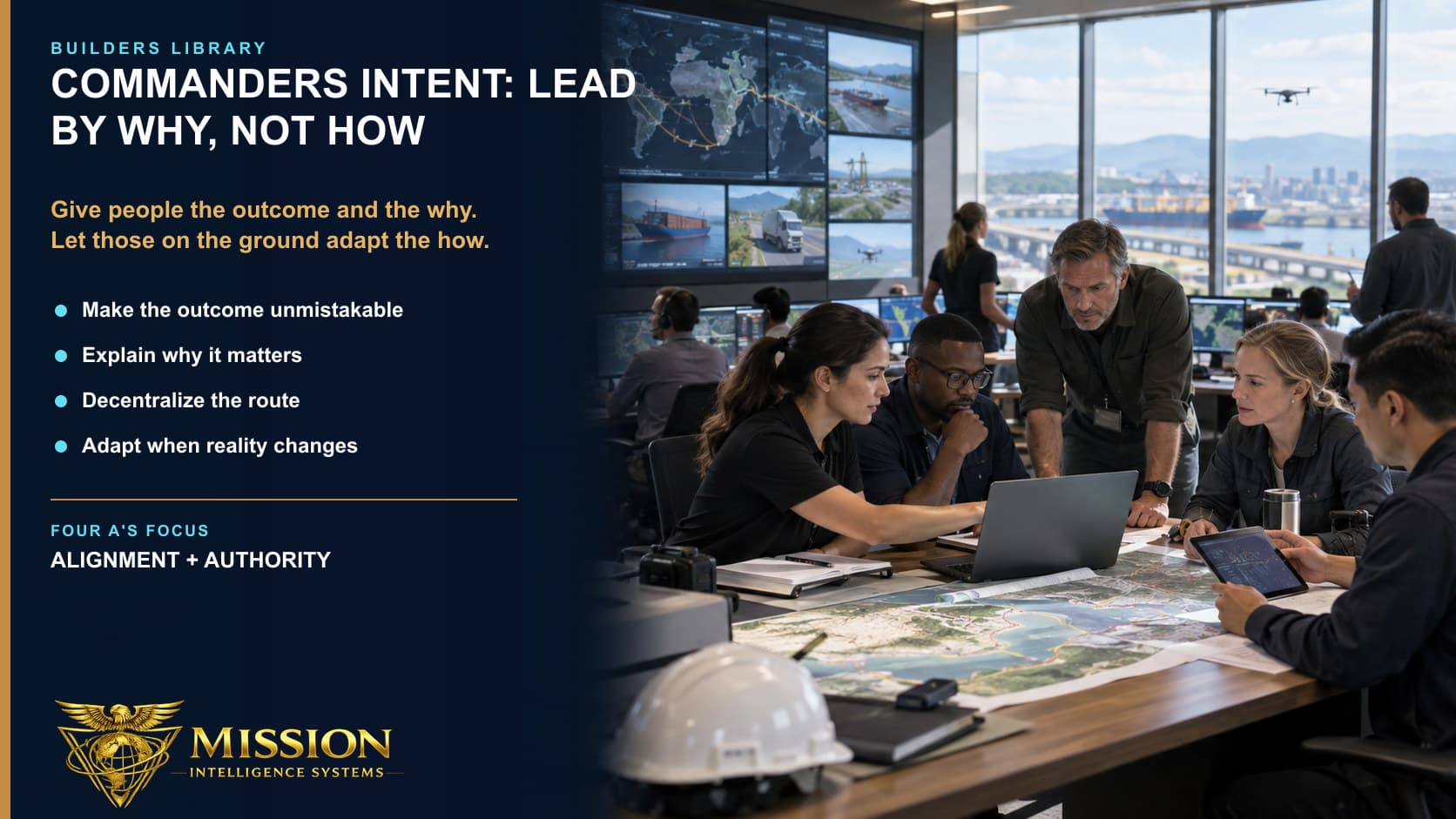
Tell people what to achieve and why. Leave the how to the ones who can see the ground.
Mission command, the doctrine behind decades of military effectiveness, rests on a single move: the commander describes what must be achieved and why, then leaves the how to the people doing the work. That is commander's intent, and it is the most underused tool in executive leadership. Give people clear intent and they act, adapt, and improvise correctly when the plan breaks. Give them only tasks and they stall the moment reality departs from the script.
Research Foundation
- Mission command doctrine
- Shared mental model research
- Goal-setting theory
- The Builders Build Framework
Key Takeaways
- Commander's intent gives people the what and the why, and deliberately leaves the how to those closest to the work.
- Teams that share a mental model of the goal and the reason coordinate and perform measurably better, because they can act without waiting to be told.
- This is an Alignment condition: intent is a shared picture portable enough that people far from the leader still act as one.
Intent survives contact with reality
Every plan meets conditions its authors did not foresee. People given only tasks freeze or execute the wrong thing precisely, because the task no longer fits. People given intent adapt, because they understand what the plan was for. Intent is the thing that lets a team improvise toward the right outcome when the specifics fall apart, which they always do.
What and why, not how
Clear intent answers two questions and leaves a third deliberately open. What must be achieved, and why it matters. It does not prescribe the how, because the people closest to the work will see options the leader cannot from a distance. Prescribing the how discards their judgment and turns capable people into instruction-followers. Intent plus latitude turns them into owners.
Give people a task and they stop when it breaks. Give them the intent behind it and they carry the mission the rest of the way.
Shared understanding is measurable
This is not just doctrine. Mathieu and colleagues found that teams sharing a mental model of the task and how they would work together performed measurably better, because shared understanding improved the team's processes. Commander's intent is how a leader builds that shared model on purpose: everyone holding the same picture of the goal and the reason, so coordination does not require constant checking.
Through the Four A's
This is an Alignment condition. Alignment is everyone holding the same picture of the outcome and the reason, so behavior stays coordinated after the room empties. Intent is what makes alignment portable. It lets people far from the leader, deep in the work, still act as if the leader were standing beside them.
Evidence matrix
| Claim | Research | Field evidence | Four A's |
|---|---|---|---|
| Shared mental models raise team performance | Mathieu et al. (2000) | Shared understanding lets people act | Alignment |
| Clear, committed goals drive results | Locke & Latham (2002) | Intent gives the goal meaning | Alignment |
| Purpose sustains motivation | Ryan & Deci (2000) | Why moves people, how constrains them | Authority |
Executive reflection questions
- Do your people know why the plan exists, or only what the tasks are?
- When the plan breaks, can your team act on your intent, or do they stall and wait?
- Are you prescribing the how, and discarding the judgment of the people closest to the work?
- Could someone far from you make the right call because they understand your intent?
Builder actions
Lead by intent. State what must be achieved and why it matters, then leave the how to the people who can see the ground. Build a shared mental model deliberately, so everyone holds the same picture of the goal and the reason. Give purpose, not just targets, because purpose is what lets people improvise correctly when the plan meets reality. Then trust them to act on the intent, which is the entire point of giving it.