
The Psychology of Organizations · Negotiation & Influence
Influence Without Manipulation
Why the line between ethical influence and manipulation is agency, not intensity.
Every leader influences, constantly and unavoidably. The uncomfortable question is not whether to use influence but where it crosses into manipulation. The distinction is not about how persuasive you are. It is about whether you preserve the other person's ability to understand and choose, or quietly take it away.
Research Foundation
- Social psychology of influence
- Ethics of influence and choice architecture
- Motivational psychology
- Executive and enterprise field experience
- The Builders Build Framework
Key Takeaways
- Influence is unavoidable, so the ethical question is how, not whether. The line is agency: manipulation conceals relevant information or bypasses a person's reasoning, while ethical influence improves understanding and preserves the ability to choose.
- The same psychological levers can inform a good decision or exploit a shortcut against a person's interest. Intent and transparency, not intensity, decide which one is happening.
- Because durable Alignment depends on genuine commitment, and manipulation breeds the cynicism that destroys it, influence without manipulation is not only ethical but strategically necessary.
Two ways to move the same decision
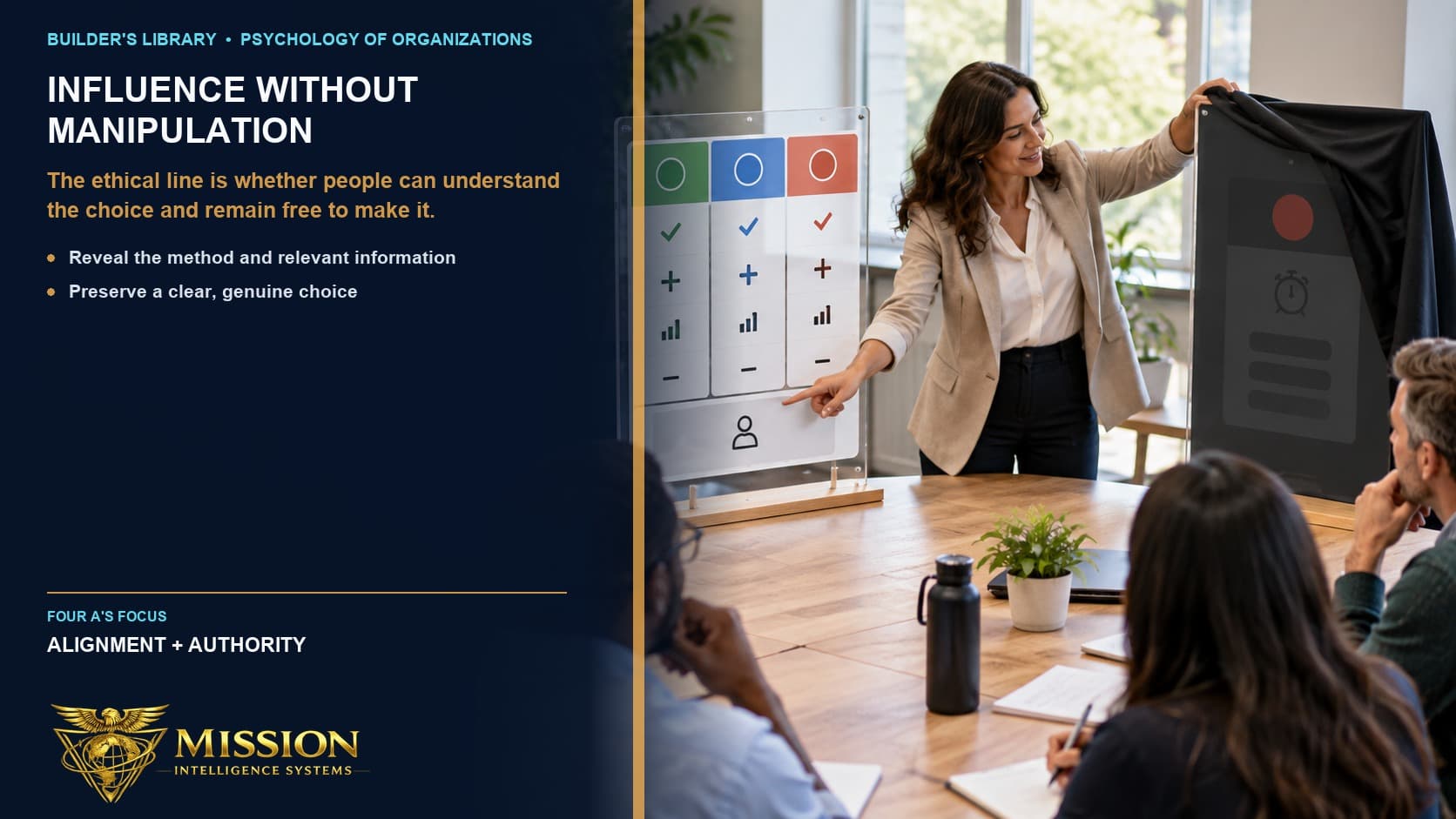
Consider two ways to raise participation in a retirement plan. One makes enrollment the default while leaving everyone free to opt out, and tells people plainly that they can. The other buries the opt-out, obscures the fees, and engineers a false sense of urgency. Both increase enrollment. Only one respects the person deciding. Richard Thaler and Cass Sunstein called the first approach choice architecture, arranging options to help people choose well while preserving their freedom to choose otherwise. The second is manipulation. The behavior changed the same way in both cases, which is exactly why intensity of effect cannot be the test. The test is what happened to the person's ability to understand and decide.
The line is agency, not persuasiveness
Cass Sunstein, in his work on the ethics of influence, locates the ethical line in whether an influence attempt respects a person's agency and capacity to reason, or bypasses them. Manipulation, on this account, works by concealing relevant information or by exploiting psychological weaknesses in a way the person would object to if they saw it clearly. Ethical influence does the opposite: it surfaces information, appeals to reasons a person can examine, and leaves the choice genuinely theirs. This maps onto the psychology of persuasion. Petty and Cacioppo distinguished the central route, where people are moved by the substance of an argument they can scrutinize, from the peripheral route, where they are moved by cues that bypass scrutiny. And self-determination theory holds that motivation which respects autonomy is more durable than motivation which controls. The levers Cialdini catalogued are neutral tools; whether their use is ethical depends on whether it helps a person see what is genuinely in their interest or exploits a shortcut against it.
The test of ethical influence is not how persuasive you are. It is whether your approach would survive the other person seeing exactly what you are doing. Manipulation is influence that depends on them not seeing it.
Why organizations drift toward manipulation
Organizations slide toward manipulation not usually from malice but from pressure and metrics. A team measured only on a conversion, a sign-up, or a yes will find that concealing a fee or manufacturing urgency moves the number, and the number is what is rewarded. Internally, leaders under pressure may withhold context, frame choices to foreclose dissent, or engineer consent rather than earn it. Each move works in the short term and corrodes something that does not show up on the dashboard: trust. Once people sense they have been handled, they discount everything that follows, and the manipulation that bought this quarter's compliance poisons next year's influence.
What this means through the Four A's
Influence without manipulation is an Alignment discipline, because real alignment is genuine, informed commitment, and manipulation produces only the appearance of it while destroying the trust alignment depends on. The research gives a usable test. Before an influence attempt, ask whether you are giving people the information and reasons they need to choose well, or taking their ability to choose away. Would the approach survive the other person seeing exactly what you are doing? Are you appealing to reasons they can examine, or exploiting a shortcut they would object to? Stay on the side that preserves agency, not because it is only virtuous, but because it is the only kind of influence that builds the durable commitment an organization actually needs.
Evidence matrix
| Claim | Research | Field evidence | Four A's |
|---|---|---|---|
| The line is agency, not effect size | Sunstein (2016); Thaler & Sunstein (2008) | A transparent default versus a buried opt-out | Alignment |
| Reasoned persuasion is more durable than bypass | Petty & Cacioppo (1986); Deci & Ryan (2000) | Engineered consent that does not hold | Alignment, Adaptability |
| Influence levers are neutral; use decides ethics | Cialdini & Goldstein (2004) | Manipulation breeds discounting cynicism | Alignment, Authority |
Executive reflection questions
- In your most recent influence attempt, would the approach survive the other person seeing exactly what you were doing?
- Where are your metrics quietly rewarding a team for concealing information or manufacturing urgency?
- Are you giving people the reasons and information to choose well, or arranging things so they cannot really choose otherwise?
- Where have you engineered consent rather than earned it, and what has that cost you in trust?
Builder actions
Hold a simple, testable line. Before you try to move someone, ask whether you are improving their understanding and preserving their ability to choose, or concealing information and bypassing their reasoning. Apply the transparency test: would your approach survive the other person seeing exactly what you are doing? Appeal to reasons people can examine rather than cues that bypass scrutiny. Audit your own metrics for places where they reward manipulation, a buried fee, a false urgency, a foreclosed dissent, and change them. Choose the influence that preserves agency, because it is the only kind that builds durable commitment instead of the cynicism that destroys it.