
The Psychology of Organizations · Negotiation & Influence
What Chris Voss Teaches Executives
Why the former hostage negotiator's tools are really lessons in organizational leadership.
Chris Voss, the former FBI lead international hostage negotiator, built a method around emotion rather than logic. His techniques are practitioner craft, not peer-reviewed findings, but the reason they work is well supported by research, and translated carefully, they are less about negotiation than about how leaders influence people who do not have to comply.
Research Foundation
- Negotiation and influence research
- Social and cognitive psychology
- Behavioral economics
- Executive and enterprise field experience
- The Builders Build Framework
Key Takeaways
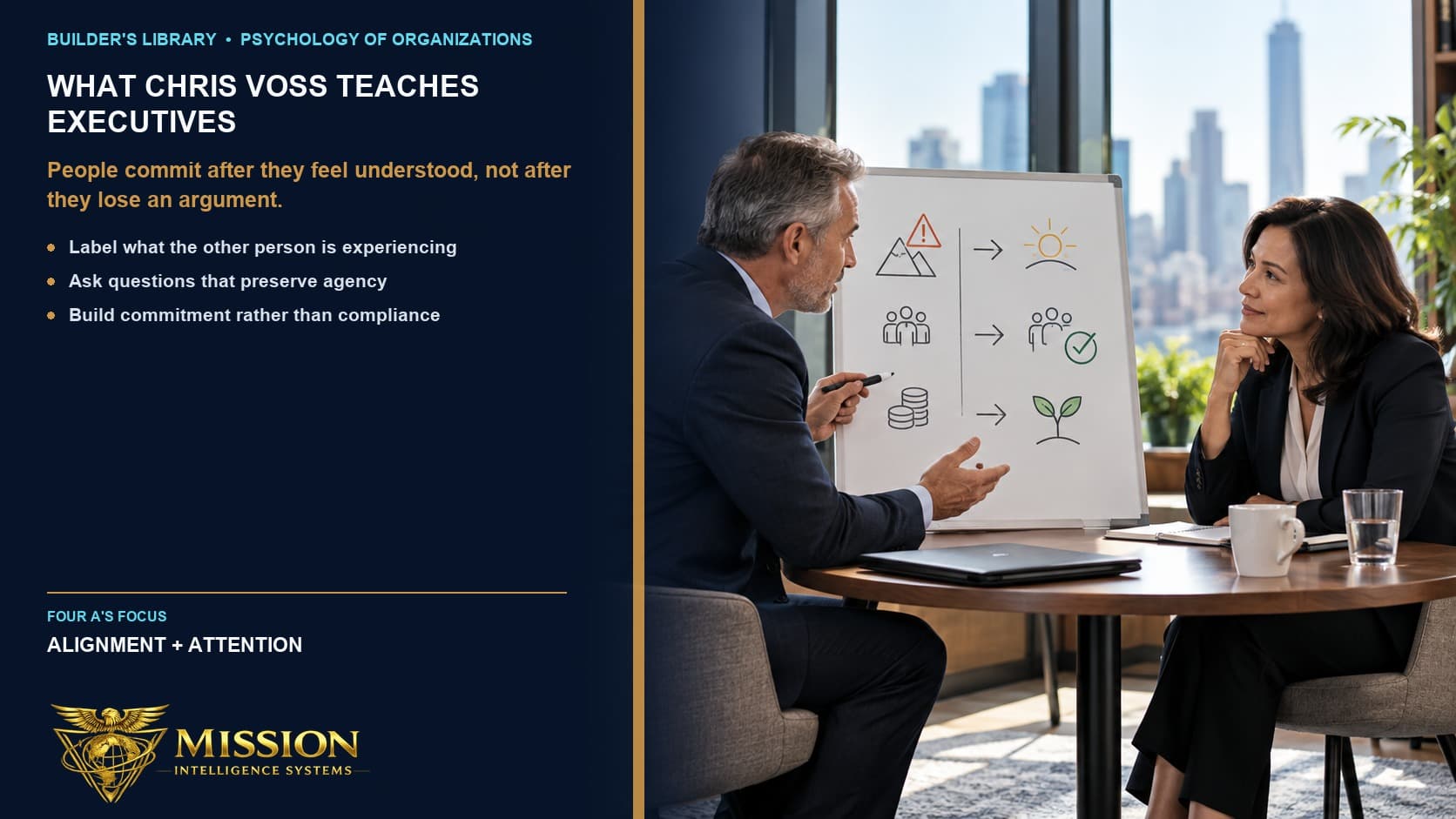
- Voss's central move, which he calls tactical empathy, is to make the other side feel understood before trying to move them. The technique is practitioner-derived, but the underlying mechanism, that feeling understood lowers defensiveness, is well established in research.
- His tools work by managing emotion and perception rather than winning on logic: labeling feelings, calibrated open questions, and letting the other side feel in control. These map onto documented findings about empathy, autonomy, and loss aversion.
- Translated into organizations, this is Alignment craft: leaders mostly influence people who are not compelled to obey, so making people feel understood and in control is how commitment, not mere compliance, is built.
The negotiator who stopped trying to be logical
Chris Voss spent years talking people out of the worst decisions of their lives, and he concluded that logic was rarely the lever. In hostage situations, the other party is flooded with emotion, and an argument, however sound, does not reach them. His method, laid out in his practitioner book Never Split the Difference, starts by making the other person feel deeply understood, what he calls tactical empathy, before attempting to move them anywhere. It is important to be precise about what this is, field-tested craft distilled from experience, not a controlled research program. But the reason it works is not mysterious, and it is exactly what an executive needs when the people they must influence do not report to them.
Why the tools work, in the language of research
Voss's core techniques translate cleanly into established findings. Labeling, naming the other person's emotion out loud, works because feeling understood reduces threat and defensiveness, an insight with deep roots in Carl Rogers's research on how being understood changes people. Calibrated questions, open questions that begin with how or what, work by giving the other party a sense of autonomy and control, which research on negotiation and motivation links to greater cooperation. His attention to how a deal feels, not just its terms, matches Curhan and colleagues' finding that people's satisfaction in negotiation depends heavily on subjective value, the relationship and the sense of being treated fairly, not only on the economic outcome. And his emphasis on loss framing reflects prospect theory: people are moved more by what they stand to lose than by what they stand to gain. The tactics are practitioner craft; the mechanisms are documented.
Being right is how you win an argument. Making people feel understood is how you move the ones who do not have to obey you, which, for an executive, is nearly everyone who matters.
Why executives get influence backwards
Executives are trained to persuade by being right, marshaling the strongest case and expecting reason to prevail. Inside organizations, most of the people a leader must move are not obligated to agree: peers, partners, senior stakeholders, talented people who can leave. With them, being right is necessary and insufficient. Leading with the argument, before the other side feels understood, triggers exactly the defensiveness that closes minds. The executive wins the debate and loses the commitment, then mistakes the compliance they extracted for the alignment they needed.
What this means through the Four A's
This is Alignment craft. Alignment is coordinated behavior that persists after the conversation, and it comes from commitment, not compliance, which is precisely what Voss's methods aim at. The translation for leaders is direct: make the other person feel understood before you try to move them, use open calibrated questions rather than demands so people retain a sense of control, attend to how a decision feels and not only to its terms, and frame stakes in terms of what is at risk. Hold the discipline that these are practitioner tools grounded in research, not laws, and use them to build the willing coordination that real alignment requires.
Evidence matrix
| Claim | Research | Field evidence | Four A's |
|---|---|---|---|
| Feeling understood lowers defensiveness | Rogers (1957) | Labeling defuses a heated room | Alignment |
| Autonomy and subjective value drive cooperation | Curhan, Elfenbein & Xu (2006) | Calibrated questions build buy-in | Alignment, Authority |
| Loss framing moves people more than gain | Kahneman & Tversky (1979) | Stakes framed as what is at risk | Alignment |
Executive reflection questions
- In your last hard conversation, did you lead with your argument or with making the other person feel understood?
- How much of what you call alignment is actually compliance that will not survive contact with reality?
- Where do you rely on being right with people who are not obligated to agree with you?
- Do your most important counterparts leave conversations feeling heard and in control, or handled?
Builder actions
Influence the way you would lead people who can say no, because most of the ones who matter can. Before you make your case, make the other person feel understood: name what they are feeling and what they care about, out loud, so defensiveness drops. Ask open, calibrated questions rather than issuing demands, so people keep a sense of control and talk themselves toward the answer. Pay attention to how a decision feels, the fairness and the relationship, not only its terms, because that is what people actually remember. Frame stakes in terms of what is at risk. And keep the honest discipline that these are field-tested tools grounded in research, aimed at commitment rather than mere compliance.