
The Psychology of Organizations · Group Dynamics
Fawning at Work
When agreement is a protective response, and how it keeps workplace silos intact.
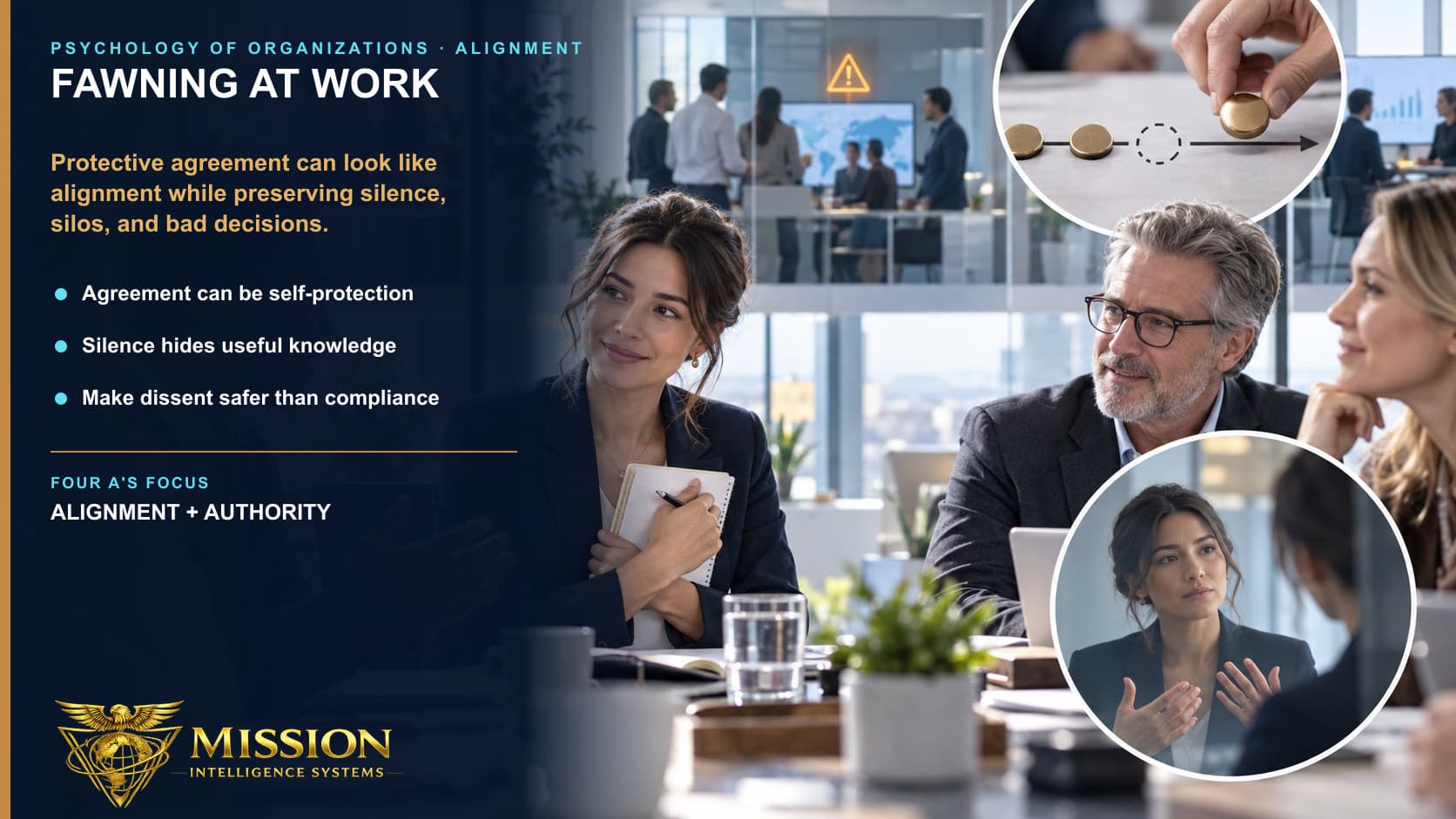
Some of the most dangerous disagreement in an organization sounds like agreement. People read the room, anticipate the cost of friction, and give the answer that preserves safety. The meeting stays calm. Each function returns to its own priorities. Leaders call the room aligned, while the organization remains divided by truths no one made safe enough to combine.
Research Foundation
- Appeasement and threat-response literature
- Employee voice and silence research
- Facades of conformity
- Psychological safety and team learning
- Cross-functional boundary spanning
- The Builders Build Framework
Key Takeaways
- Fawning is popular shorthand for appeasement under perceived threat. It is not a workplace diagnosis. The observable organizational pattern is protective agreement: withholding, softening, over-accommodating, or publicly endorsing what a person does not privately believe.
- Protective agreement creates counterfeit alignment. It makes the room feel coordinated while preserving the separate assumptions, incentives, and local truths that keep functions siloed.
- The remedy is not to demand more courage from individuals. Leaders must lower the interpersonal cost of truth, create shared outcomes across boundaries, place authority where disagreement can be resolved, and build review cycles in which new evidence changes the work.
First, use the term carefully
Fight, flight, and freeze are familiar descriptions of responses to threat. Fawn is newer popular language for appeasement: reducing danger by accommodating, pleasing, agreeing with, or regulating the more powerful person. Research on traumatic entrapment and appeasement helps explain why accommodation can be an adaptive strategy in genuinely dangerous conditions. That does not make fawning a formal diagnosis, and it does not authorize a manager to infer trauma from a colleague's behavior.
At work, the responsible move is to observe the pattern without diagnosing the person. Did someone change a candid answer after a senior leader reacted? Does a function endorse a plan in the meeting and protect itself from that plan afterward? Are concerns translated into harmless language until the decision can no longer respond to them? Organizational research has more precise names for those behaviors: defensive silence, acquiescent silence, self-censorship, and facades of conformity.
Do not diagnose the person. Diagnose the conditions that made agreement safer than truth.
Counterfeit alignment
Patricia Hewlin described facades of conformity as false representations people create to appear as if they embrace organizational values. Linn Van Dyne, Soon Ang, and Isabel Botero distinguished silence driven by resignation from silence driven by fear. James Detert and Amy Edmondson found that employees carry taken-for-granted rules about when speaking is unsafe or inappropriate. These are not simply failures of confidence. They are learned responses to the local cost of candor.
This is where fawning becomes an organizational problem. A leader asks whether everyone is aligned. Heads nod. The operations team does not name the delivery constraint because it does not want to look obstructive. Finance does not challenge the assumptions because the sponsor has already signaled commitment. Technology accepts a date it knows depends on unresolved decisions. Everyone protects the relationship in the room, then protects the function outside it. The organization records agreement and inherits divergence.
Why silos survive good intentions
A silo is not merely a department. Specialization is useful, and boundaries help people develop expertise, protect attention, and execute. A silo becomes a problem when the boundary prevents the organization from combining information, resolving dependencies, or optimizing the whole. Protective agreement makes that boundary harder to see because it suppresses the conflict that would reveal it.
Research on cross-functional teams points toward a more practical answer than forcing everyone to communicate about everything. Shared organizational vision and cooperative goals can increase cross-functional contribution. Quality coordination among functional leaders can reduce boundary conflict and improve project efficiency. Boundary-spanning teams perform better when they connect both horizontally across functions and vertically to the authority that can act. The goal is not boundary removal. It is boundary permeability around a shared outcome.
The silo-appeasement loop
1. Local pressure rises
A function is measured on its own target, deadline, budget, or reputation.
2. Candor feels costly
Naming the cross-functional conflict risks status, delay, or being labeled difficult.
3. The room gets agreement
People soften the signal, accommodate the sponsor, or stay silent.
4. Functions protect themselves
Each team returns to local priorities and privately manages the unresolved dependency.
5. Execution diverges
Rework, delay, escalation, and blame appear downstream.
6. Leaders demand harmony
The next meeting places even more value on consensus, and the loop tightens.
What this means through the Four A's
Fawning at work is primarily an Alignment failure because it substitutes visible agreement for shared understanding and coordinated action. But the loop crosses all four conditions. Breaking it requires a complete operating response, not a workshop on assertiveness.
| Condition | What fails | Builder move |
|---|---|---|
| Attention | The organization sees the polished answer, not the weak signal, disagreement, or dependency underneath it. | Collect independent reads before discussion. Ask what each function sees that the others cannot see from their position. |
| Alignment | Courtesy and compliance are mistaken for shared understanding and commitment. | Name the shared outcome, the necessary tradeoffs, and what each function will do when local and enterprise interests conflict. |
| Authority | People withhold, soften, or translate the truth because status makes candor feel personally expensive. | Define who may challenge, who decides, how disagreement is recorded, and where unresolved conflict escalates without punishment. |
| Adaptability | The team cannot revise the plan because the evidence required to challenge it never crosses the boundary. | Use short review cycles where new evidence can change priorities, ownership, funding, or the plan itself. |
A meeting design that makes truth easier
- 1. Get the independent read first. Before the senior voice anchors the room, ask each function to record what it sees, what it needs, and what it believes will fail. Independence protects information diversity.
- 2. Put the shared outcome above the functions. State the customer, mission, or enterprise result the group owns together. Local metrics are constraints to reconcile, not separate definitions of success.
- 3. Make dependencies visible. For every commitment, name what must come from another team, by when, and what happens if it does not. Silos thrive in invisible handoffs.
- 4. Separate dissent from disloyalty. Ask for the strongest contrary evidence and thank the person who provides it. A challenge to the plan is not a challenge to the relationship.
- 5. Resolve authority before leaving. Name who decides, who must be consulted, and how an unresolved cross-functional conflict will escalate. Do not send people back to negotiate the decision through influence alone.
- 6. Check behavior after the room. Return in one or two weeks and compare the decision with what each function actually did. Alignment is the behavior that survives contact with local pressure.
Evidence matrix
| Claim | Research | Organizational signal | Four A's |
|---|---|---|---|
| Appeasement can function as a protective strategy under asymmetric threat | Cantor & Price (2007); Bailey et al. (2023) | Agreement changes with status in the room | Authority |
| Silence has distinct motives, including resignation and self-protection | Van Dyne, Ang, & Botero (2003) | Known concerns are withheld or softened | Attention, Alignment |
| People create false displays of value conformity | Hewlin (2003, 2009) | Public endorsement, private divergence | Alignment |
| Psychological safety supports learning behavior | Edmondson (1999) | Errors, questions, and contrary evidence surface early | Adaptability |
| Shared vision and cooperative goals support cross-functional contribution | Wong, Tjosvold, & Liu (2009) | Teams optimize the enterprise outcome, not only the local score | Alignment |
Executive reflection questions
- Whose answer changes after the most senior person speaks?
- Where does public agreement repeatedly become private workarounds?
- Which function is rewarded for a local result that makes the shared result harder?
- What happened the last time someone named an inconvenient cross-functional dependency?
- Which decision currently depends on people negotiating through status because authority was never assigned?
- What evidence would cause this team to change its plan, and can that evidence reach the room safely?
Builder actions
Stop treating smooth meetings as proof of alignment. Get independent reads before group discussion. Reward the first person who introduces disconfirming evidence. Put one shared outcome above the functional scorecards, then make every cross-functional dependency and decision right visible. Revisit the decision after local pressure returns. If behavior diverged, do not ask who failed to comply. Ask which truth, tradeoff, or authority gap the room made too costly to name.