The Builder's Library
Field-tested frameworks for leaders who build conditions, not just fix symptoms.
Risk, alignment, authority, adaptability: the Four A's applied to the problems leaders actually face. Each piece is a standalone article grounded in research and field observation.
Featured Article
The Attention Crisis
Why AI cannot fix organizational overwhelm.
The Attention Crisis: Why AI Can't Fix Organizational Overwhelm
AI can accelerate work, but it cannot decide what matters. When an organization is already overloaded, AI often exposes the lack of leadership focus, alignment, authority, and adaptability.
Showing 134 of 134

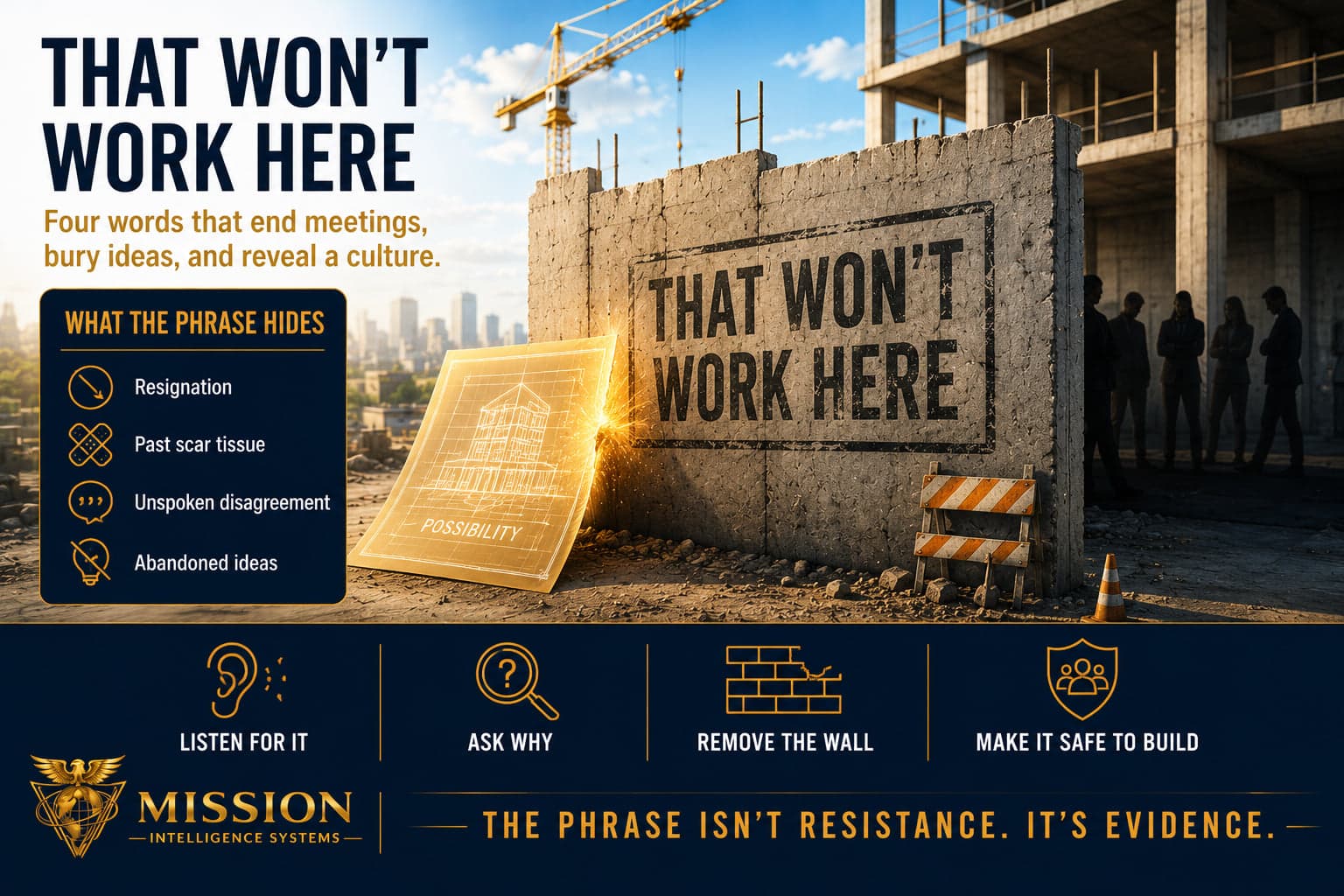
That Won't Work Here
Four words that end meetings, bury ideas, and explain entire organizational cultures, and what leaders learn to hear in them.
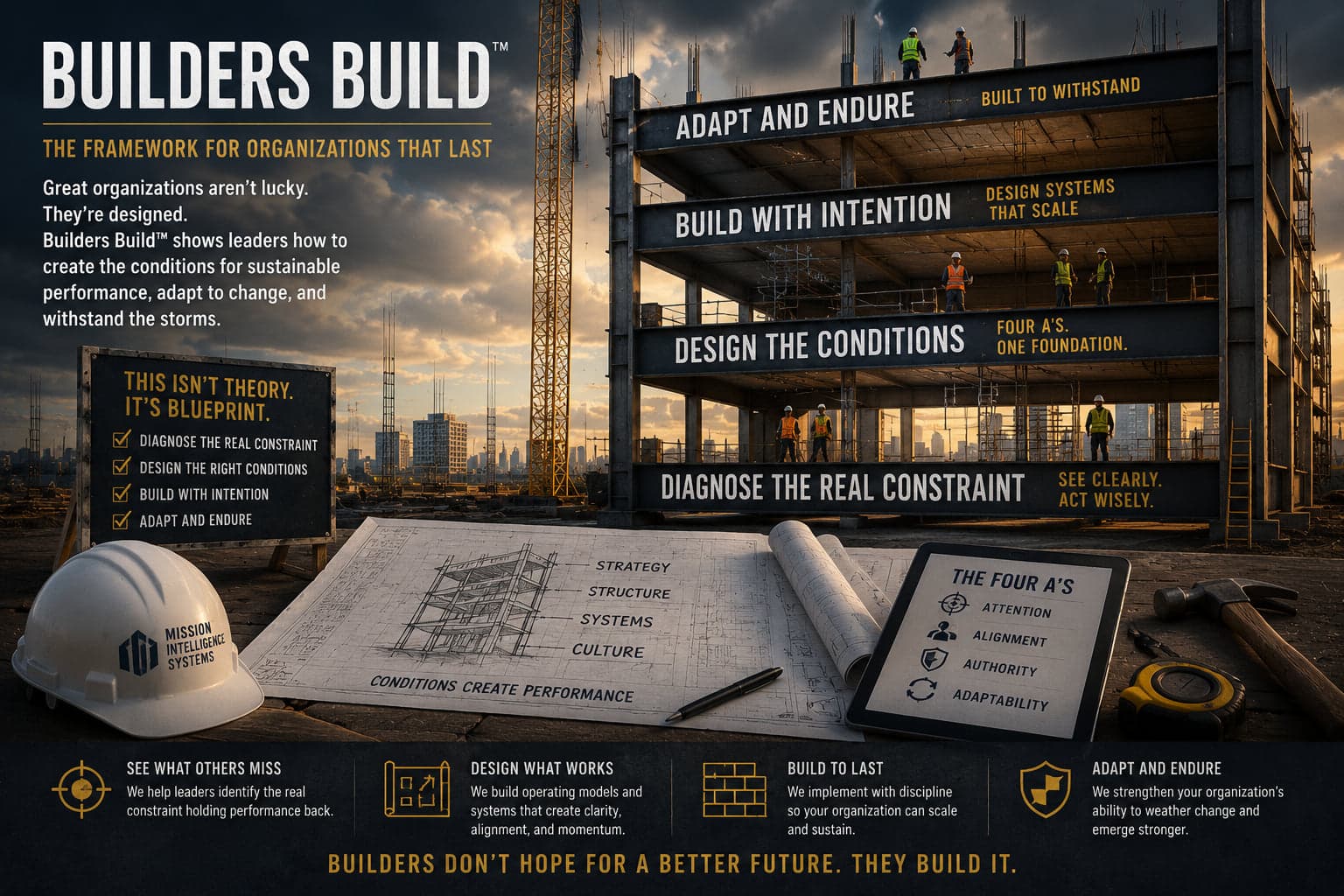
Builders Build
The founding idea: leaders do not create performance, they create the conditions that allow it. Learned on job sites before it was understood in organizations.
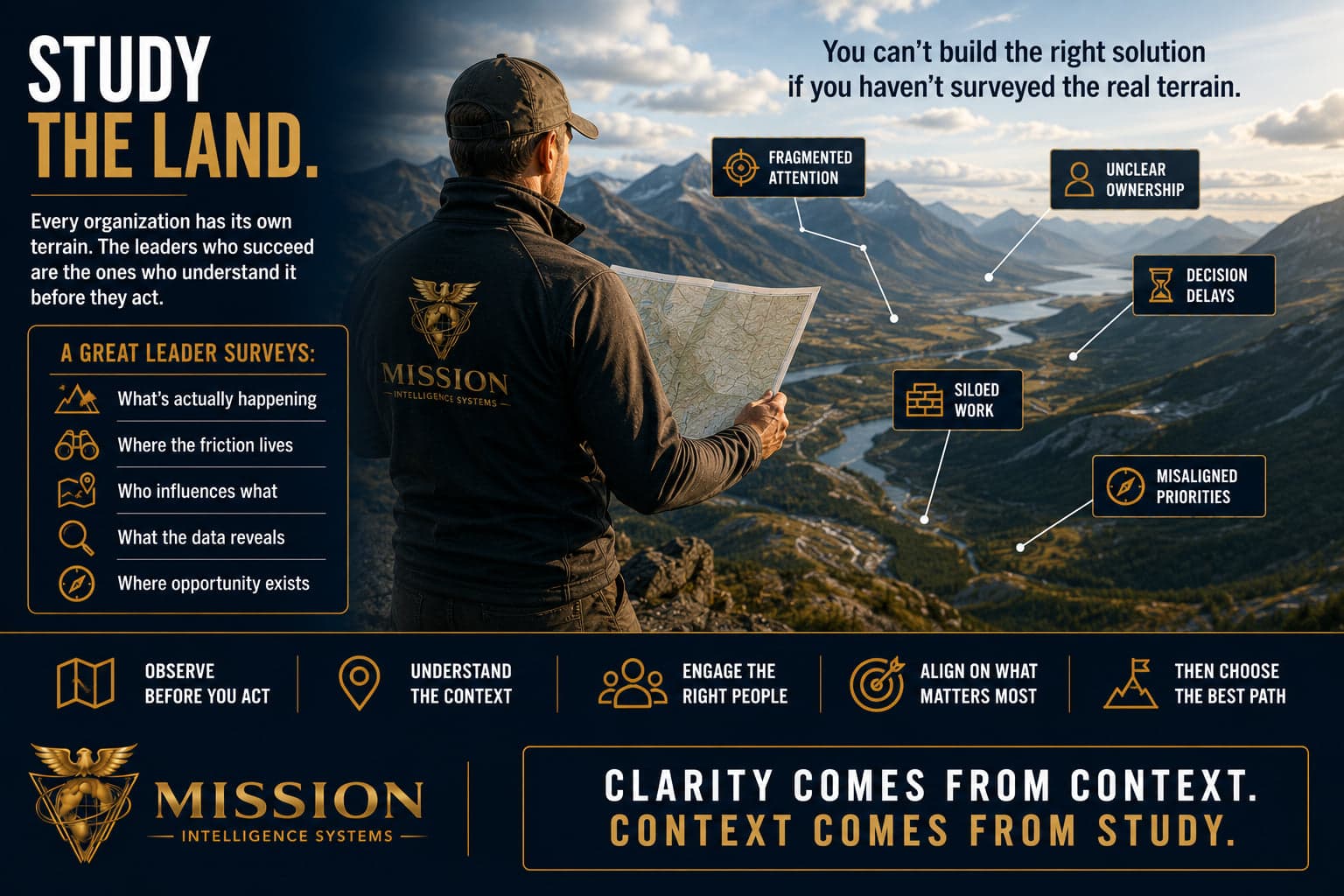
Study the Land
Every engagement begins by reading the ground rather than reaching for answers. Diagnosis before prescription.

Build the Picture
An organization can rarely see itself whole. Diagnosis assembles the picture no single part can assemble on its own.
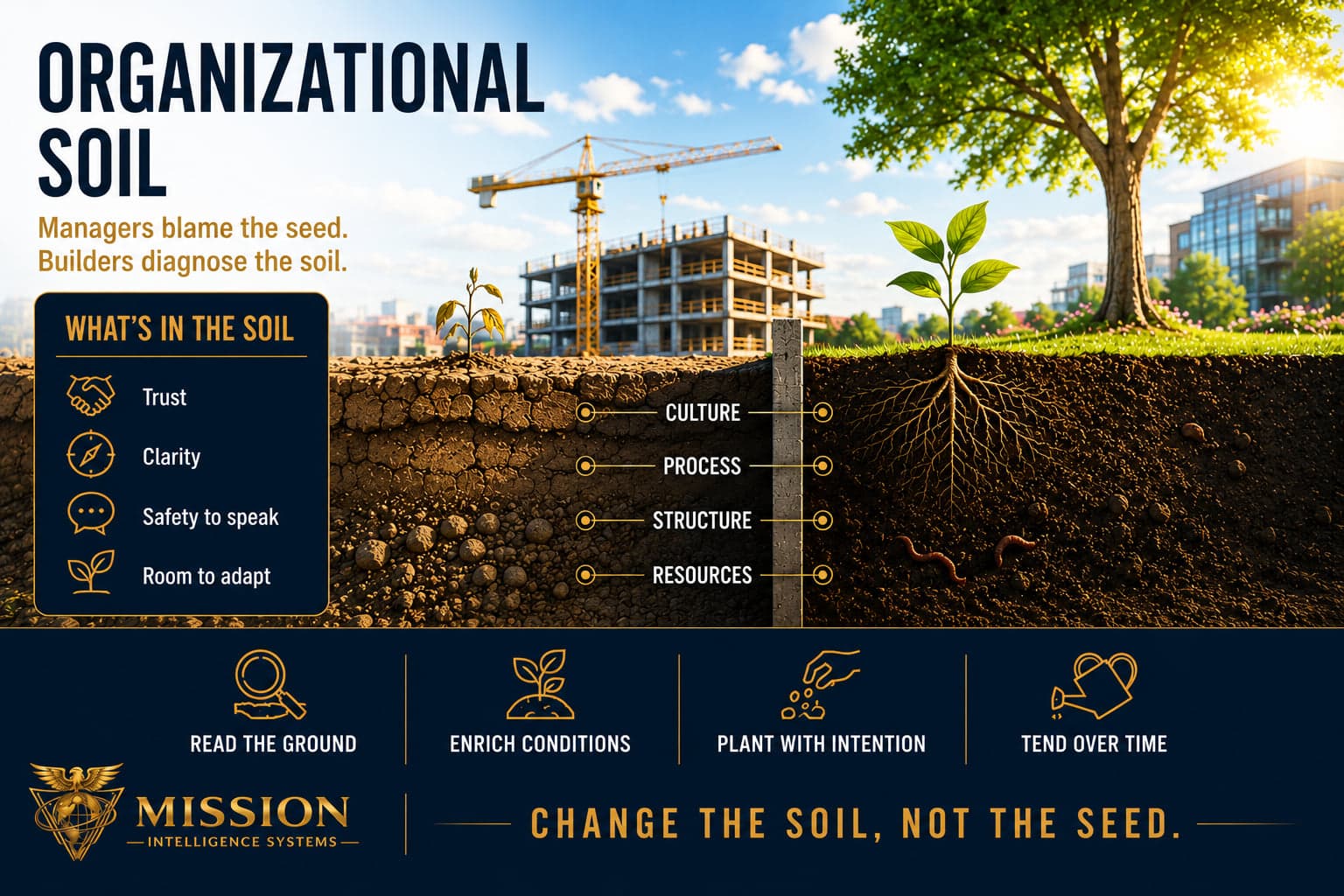
Organizational Soil
Every organization has soil. Builders diagnose it. Managers blame the seed. The difference determines whether change is possible.

People Want to Build
What leaders misread as disengagement is almost always something else: capable people who have stopped believing that effort has anywhere to go.
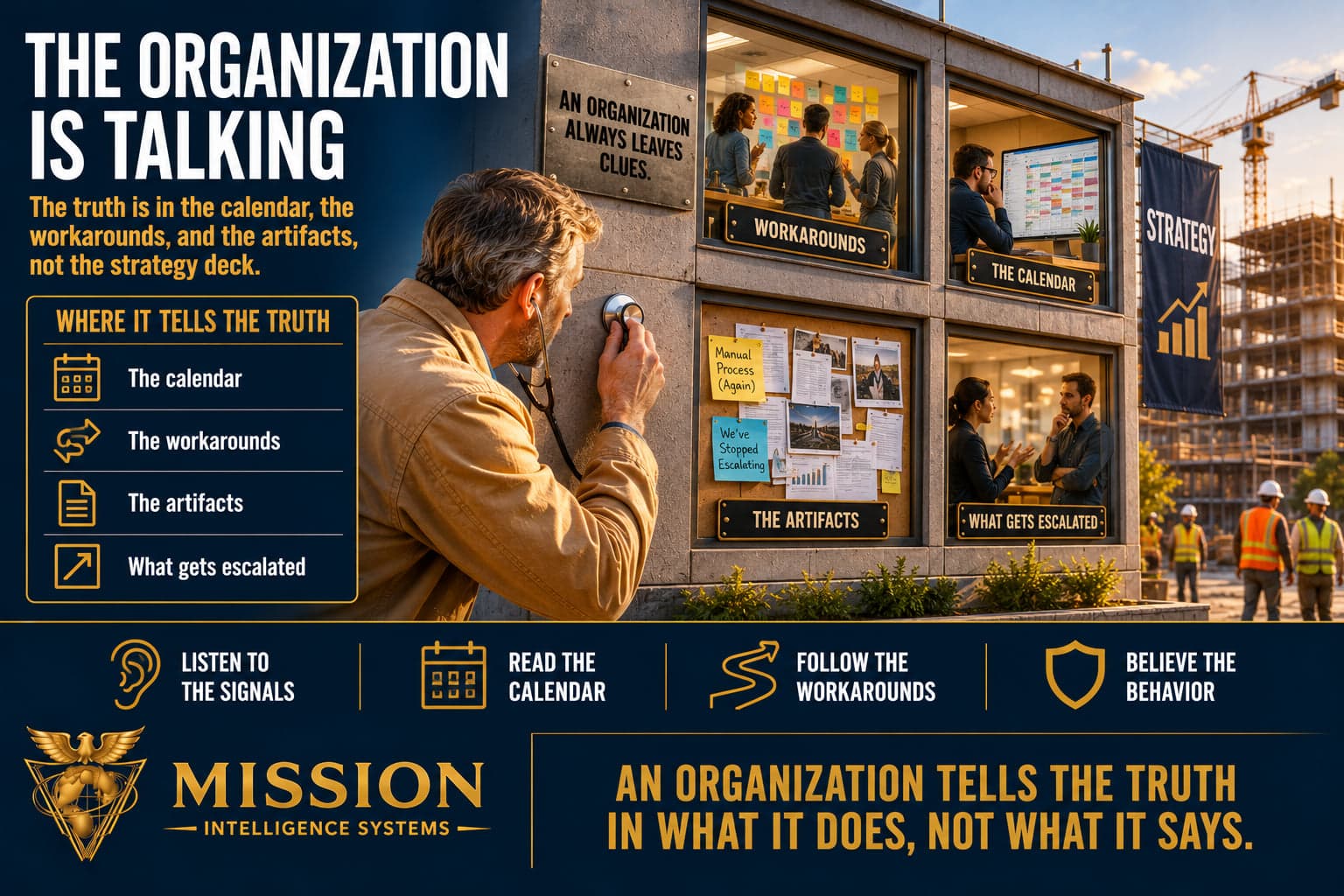
The Organization Is Talking
An organization tells the truth in its calendar, its workarounds, and its artifacts, not in its strategy deck.

What Doesn't Travel
Altitude compression is the distortion that occurs as information moves up the hierarchy. By the time it reaches the executive, the texture that made it actionable is gone.

The Moth Effect
One of the most common, and least diagnosed, reasons capable leaders produce organizations that cannot sustain themselves.
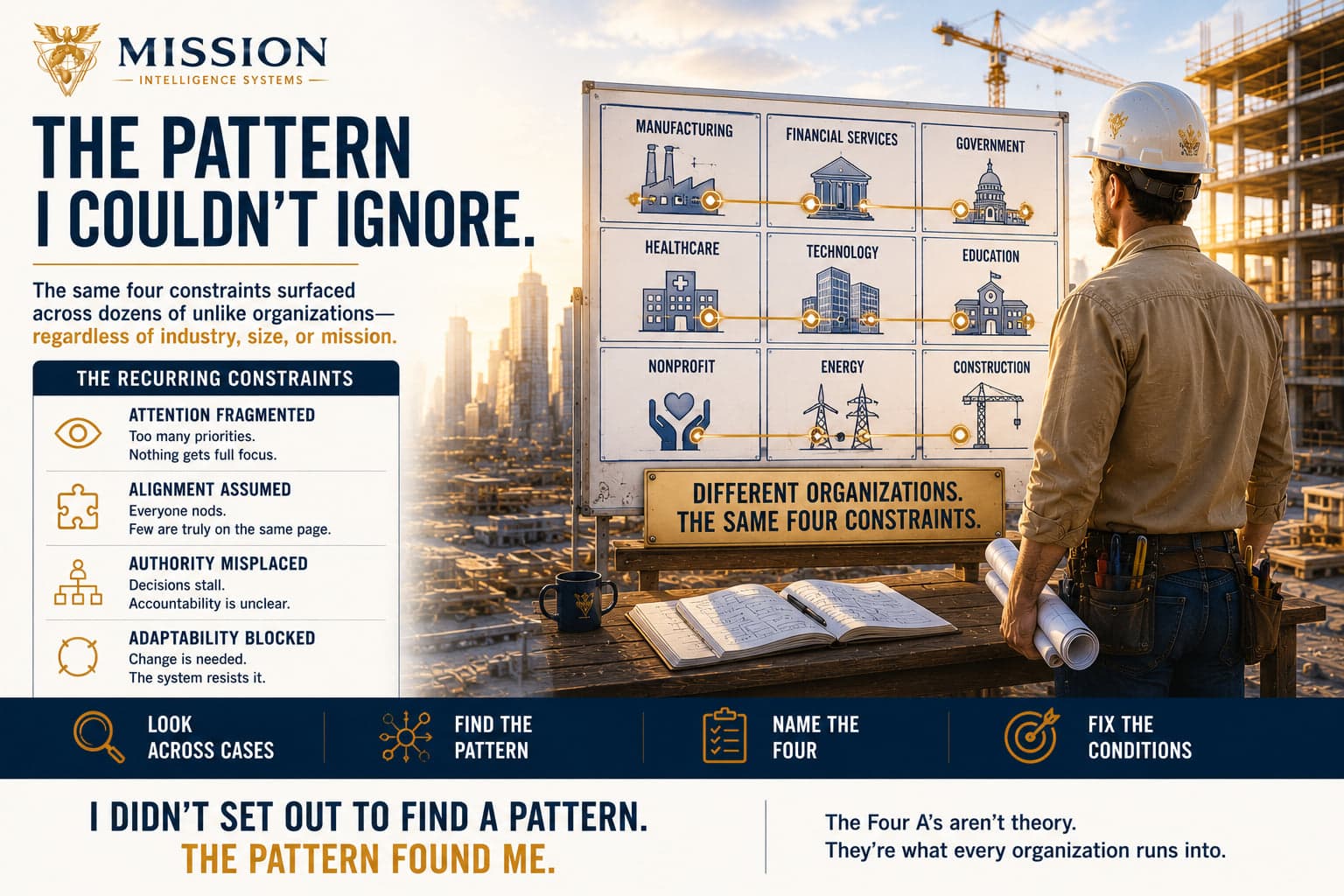
The Pattern I Couldn't Ignore
The same constraints appeared across dozens of unlike organizations. Out of that pattern came the Four A's.
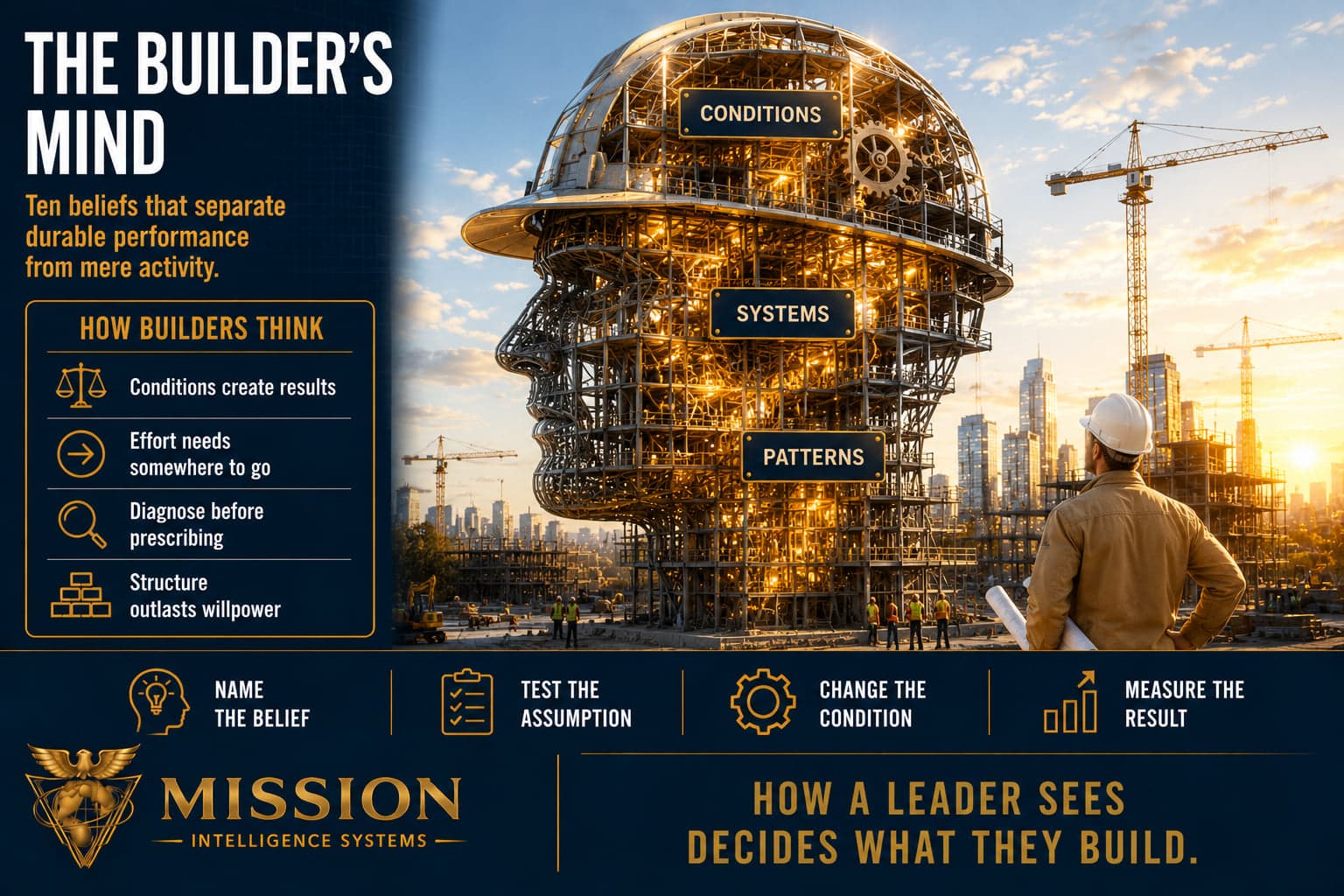
The Builder's Mind
Ten beliefs that separate leaders who produce durable organizational performance from those who produce activity.
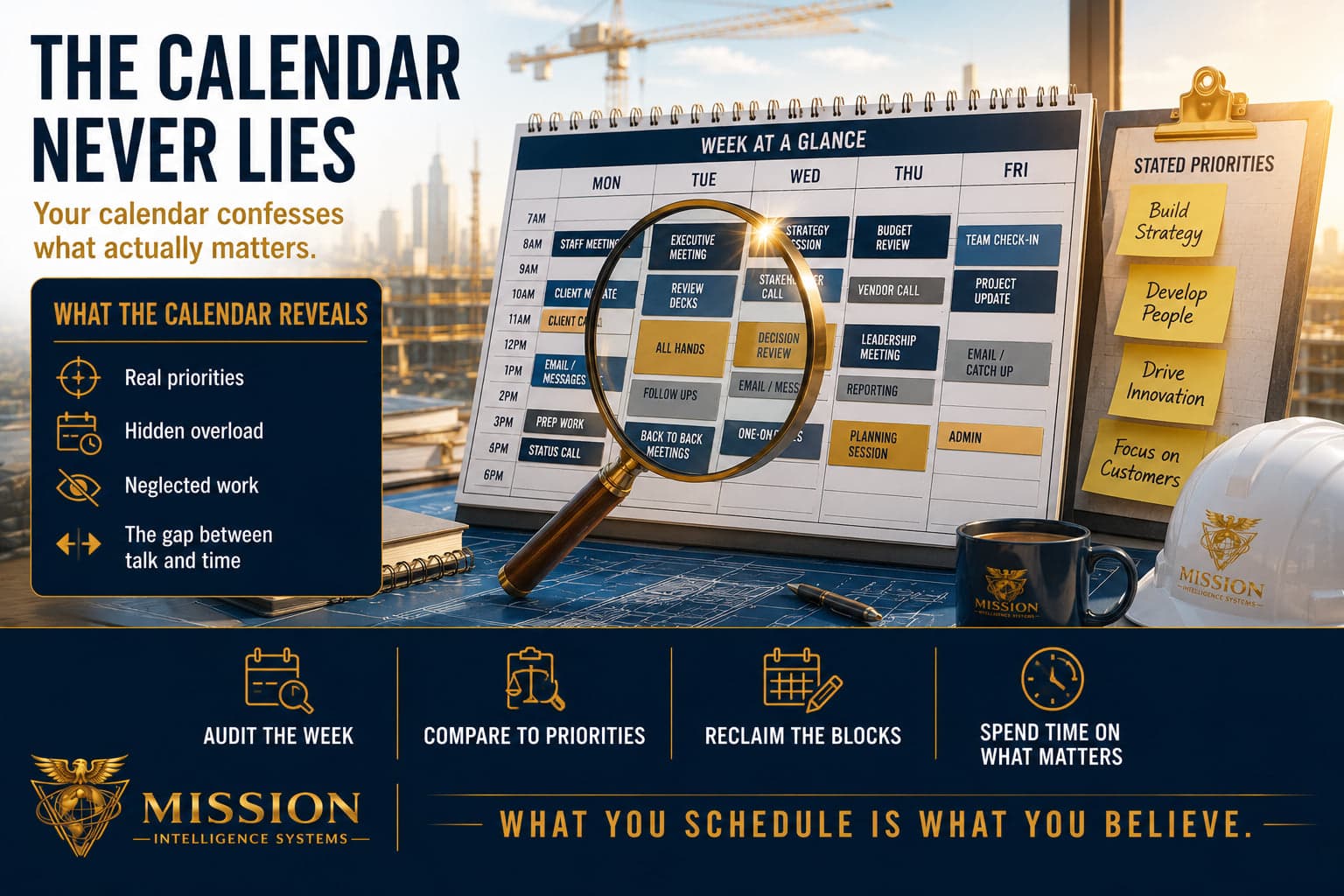
The Calendar Never Lies
The calendar is a confession. Not of what you say matters: of what actually does. A diagnostic for where your organization's attention is really going.
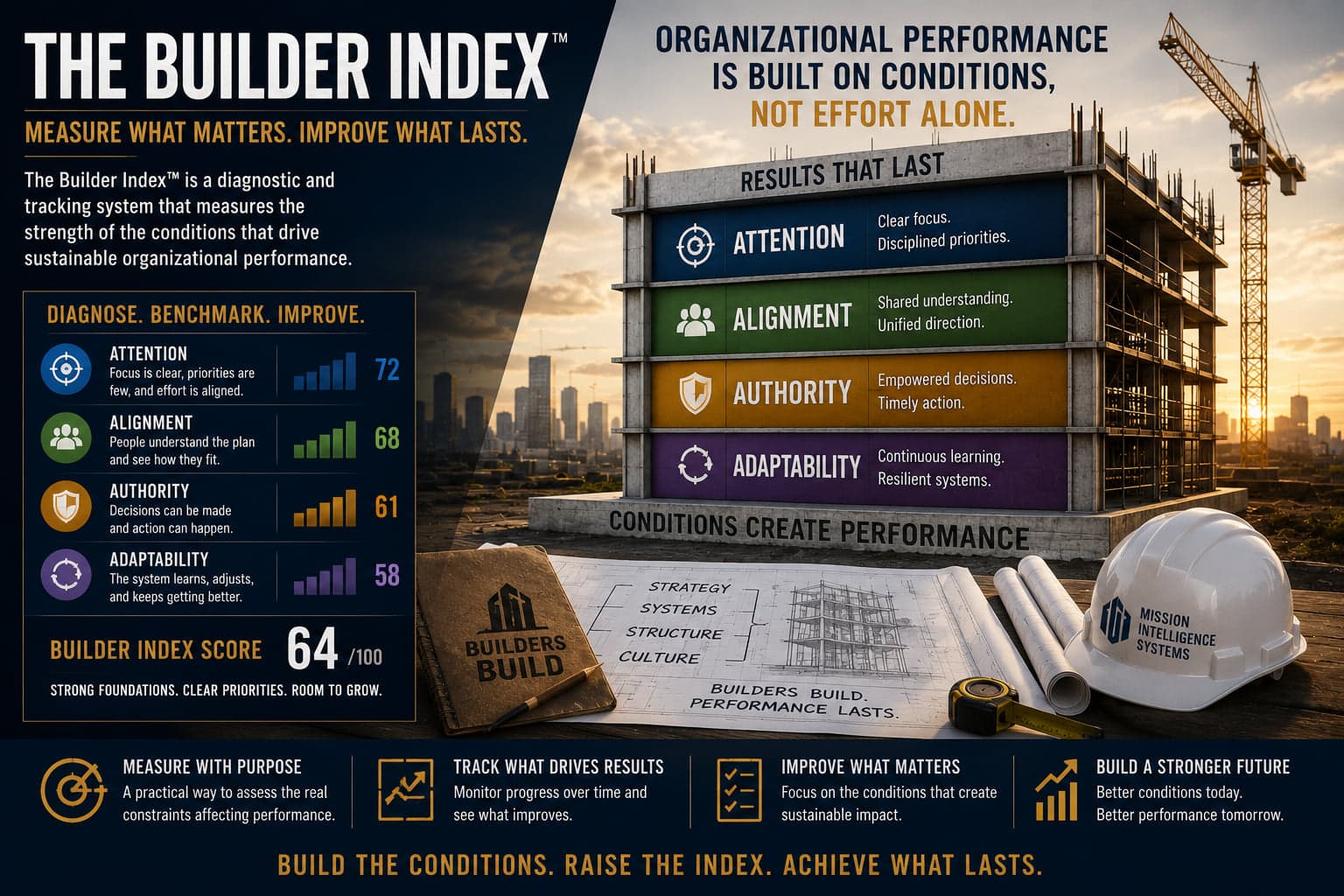
The Builder Index
Your organization's operating health in a single 0-100 number, composited from the twenty conditions that determine whether capable people produce results.
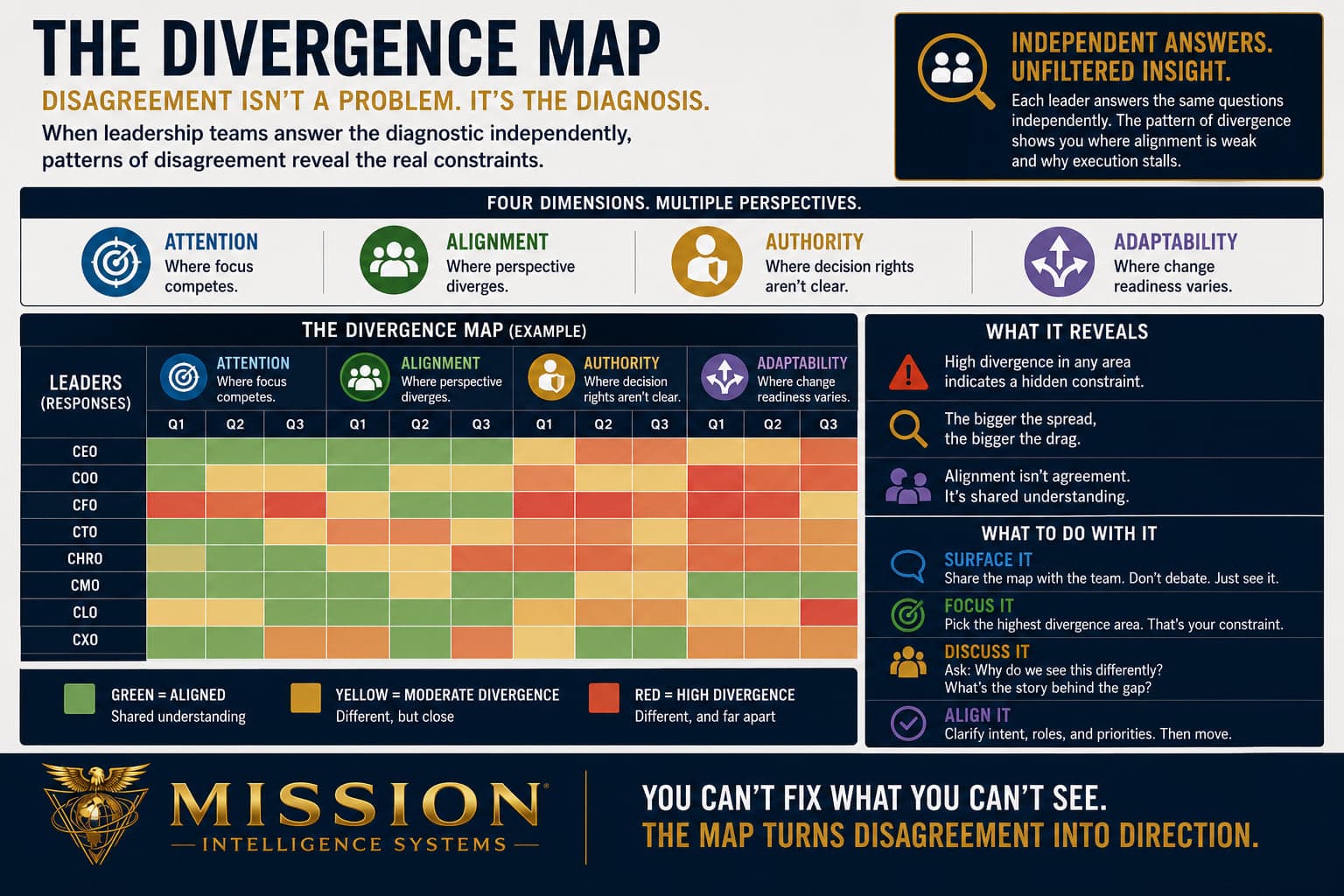
The Divergence Map
When a leadership team answers a diagnostic independently, the shape of their disagreement appears. The gap is the diagnosis.
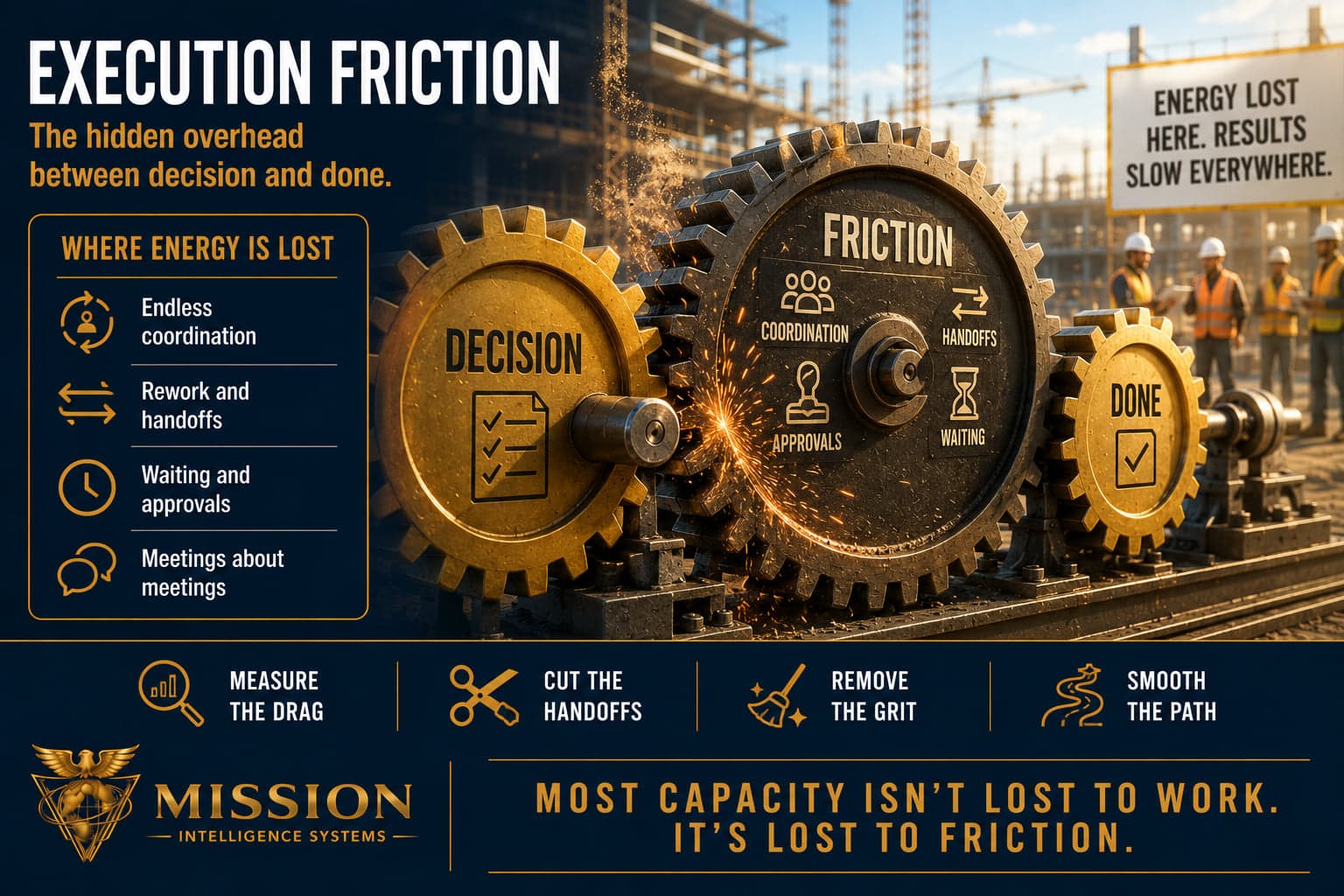
Execution Friction
The total overhead of coordination relative to the value it produces: the largest and least visible drain on many organizations' capacity.

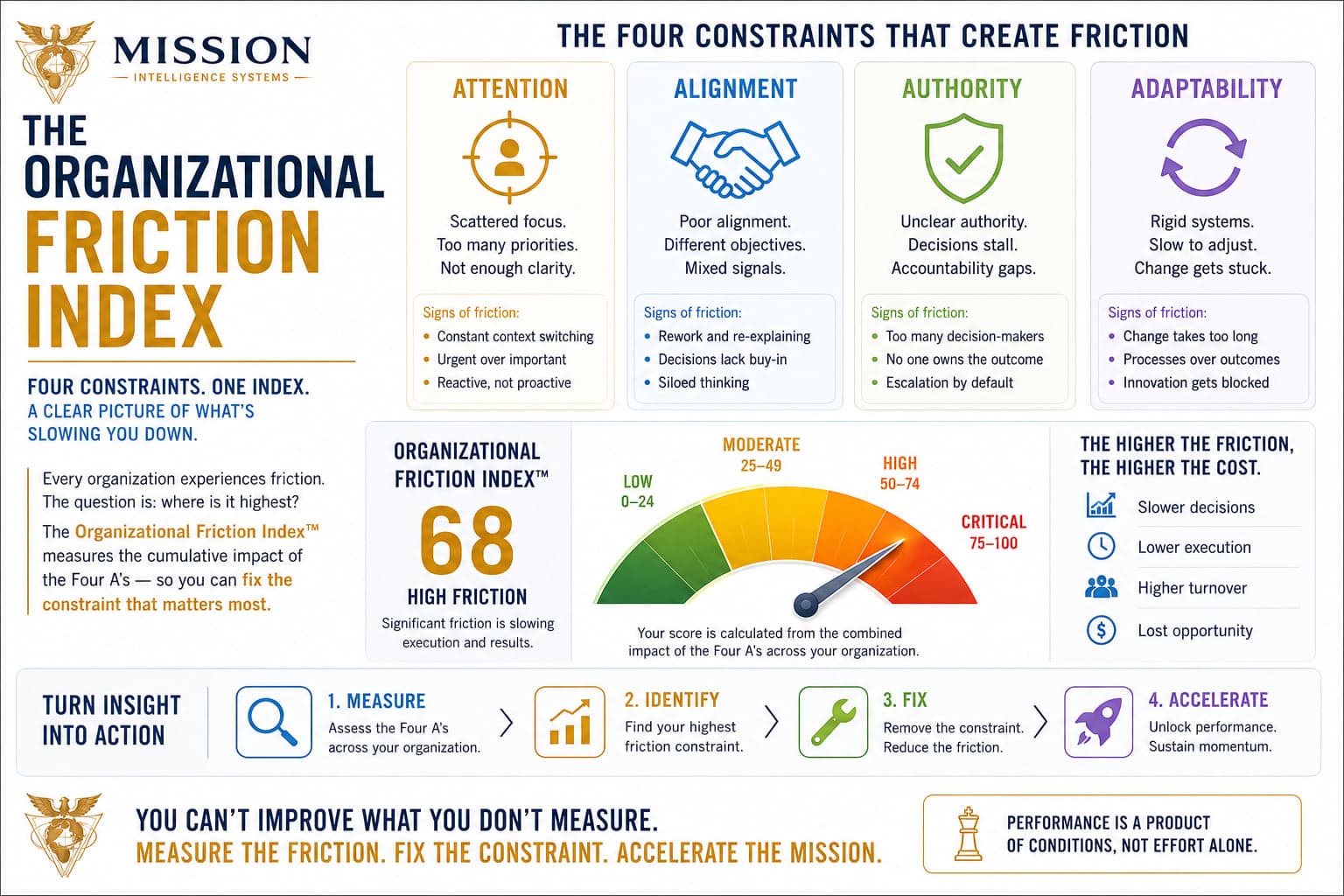
The Organizational Friction Index
Friction is information. It tells you where stress is accumulating before the rupture arrives: if you know how to read it.
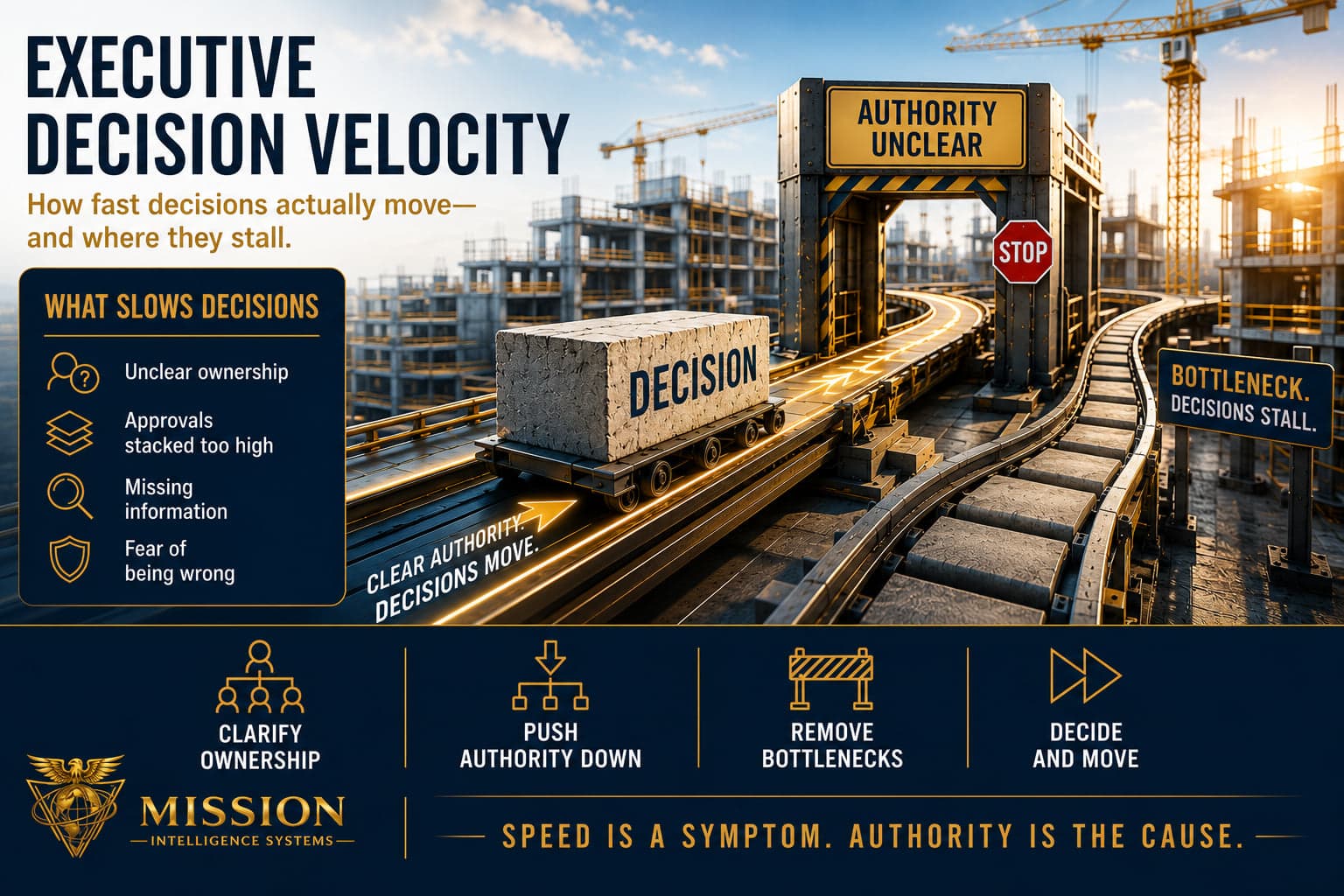
Executive Decision Velocity
How fast decisions actually move, where they stall, and why velocity is an authority problem before it is a process one.
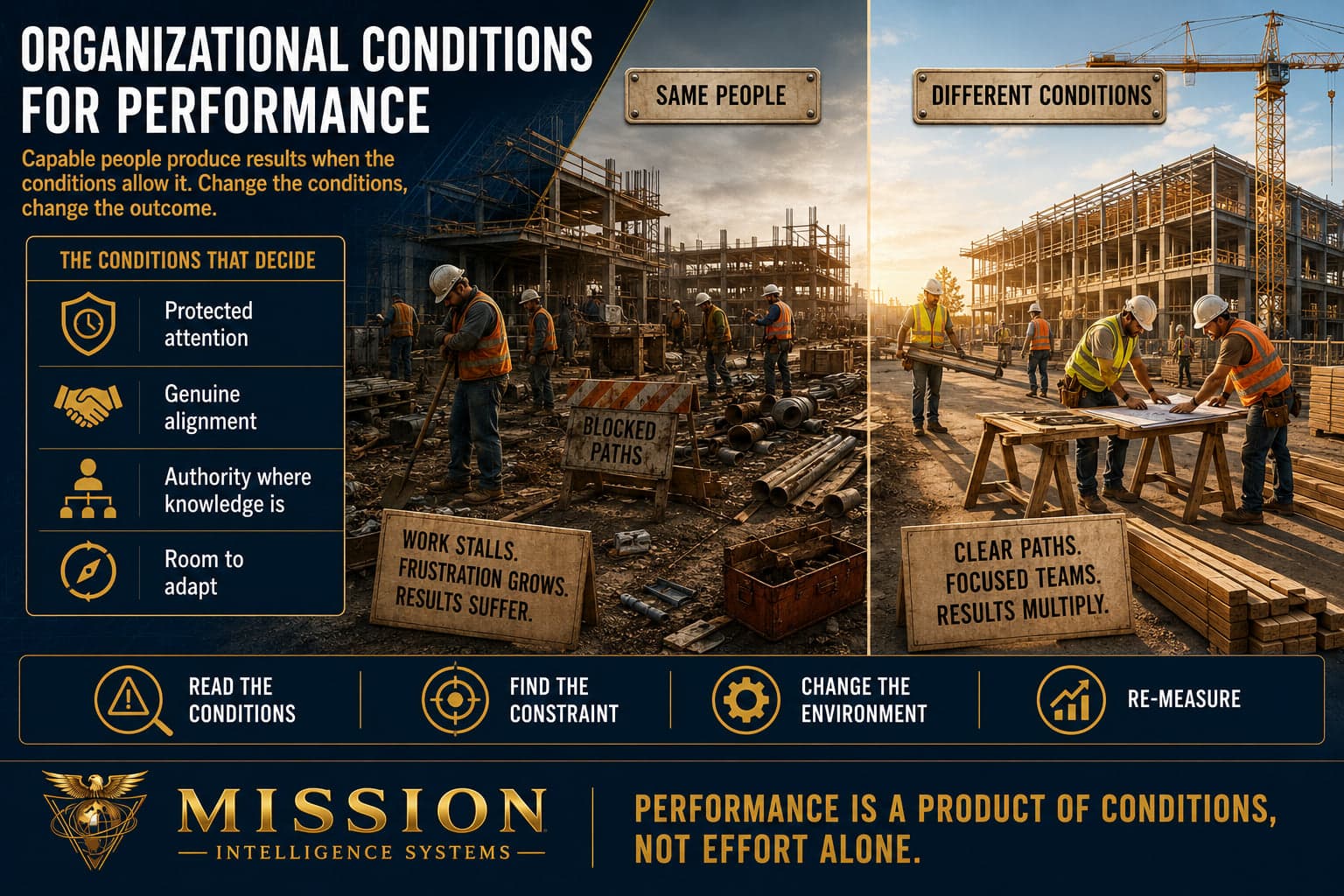
Organizational Conditions for High Performance
The structural conditions that let capable people produce results, and why changing the conditions changes the outcome.
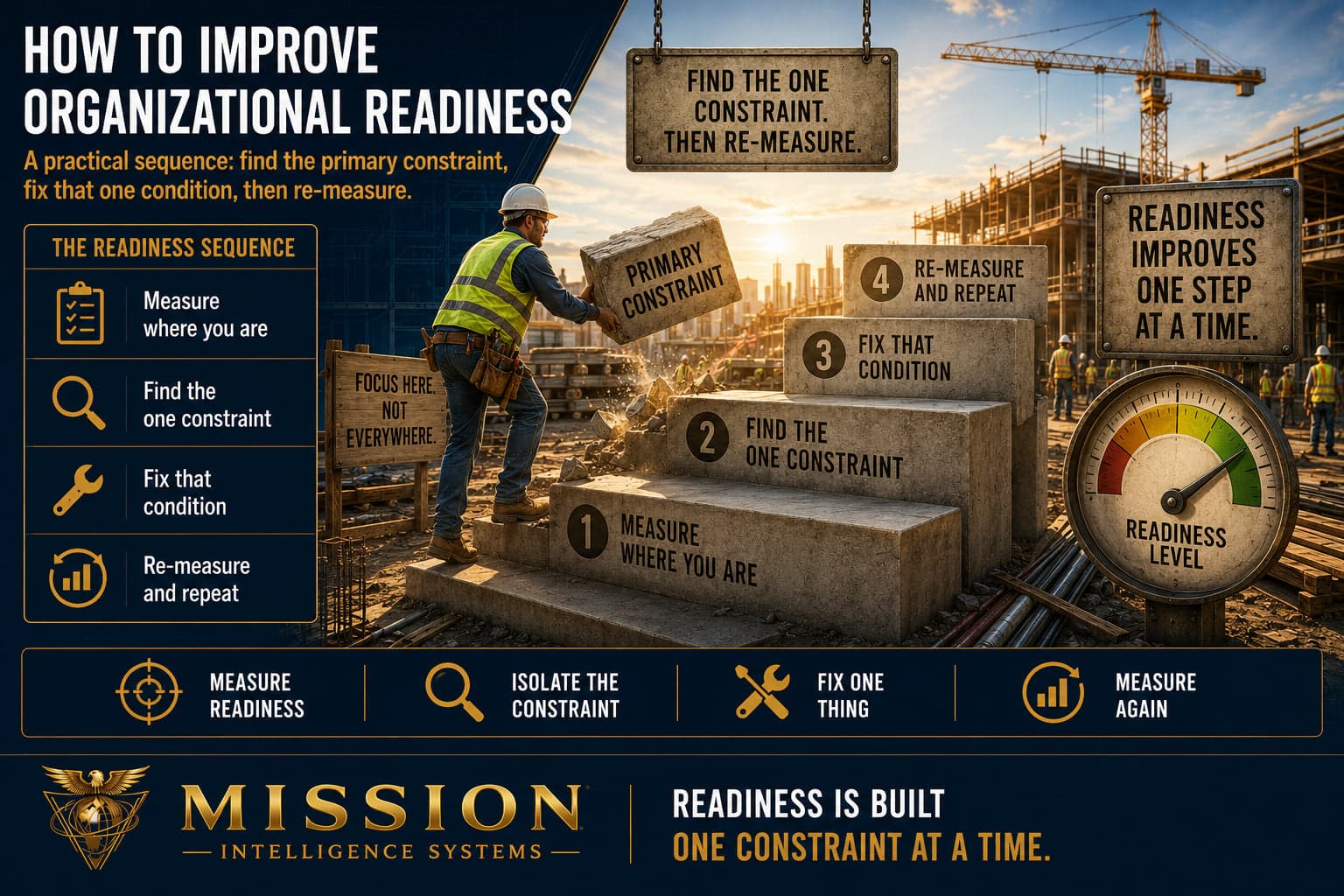
How to Improve Organizational Readiness
A practical sequence for building readiness: find the primary constraint, fix that one condition, then re-measure.
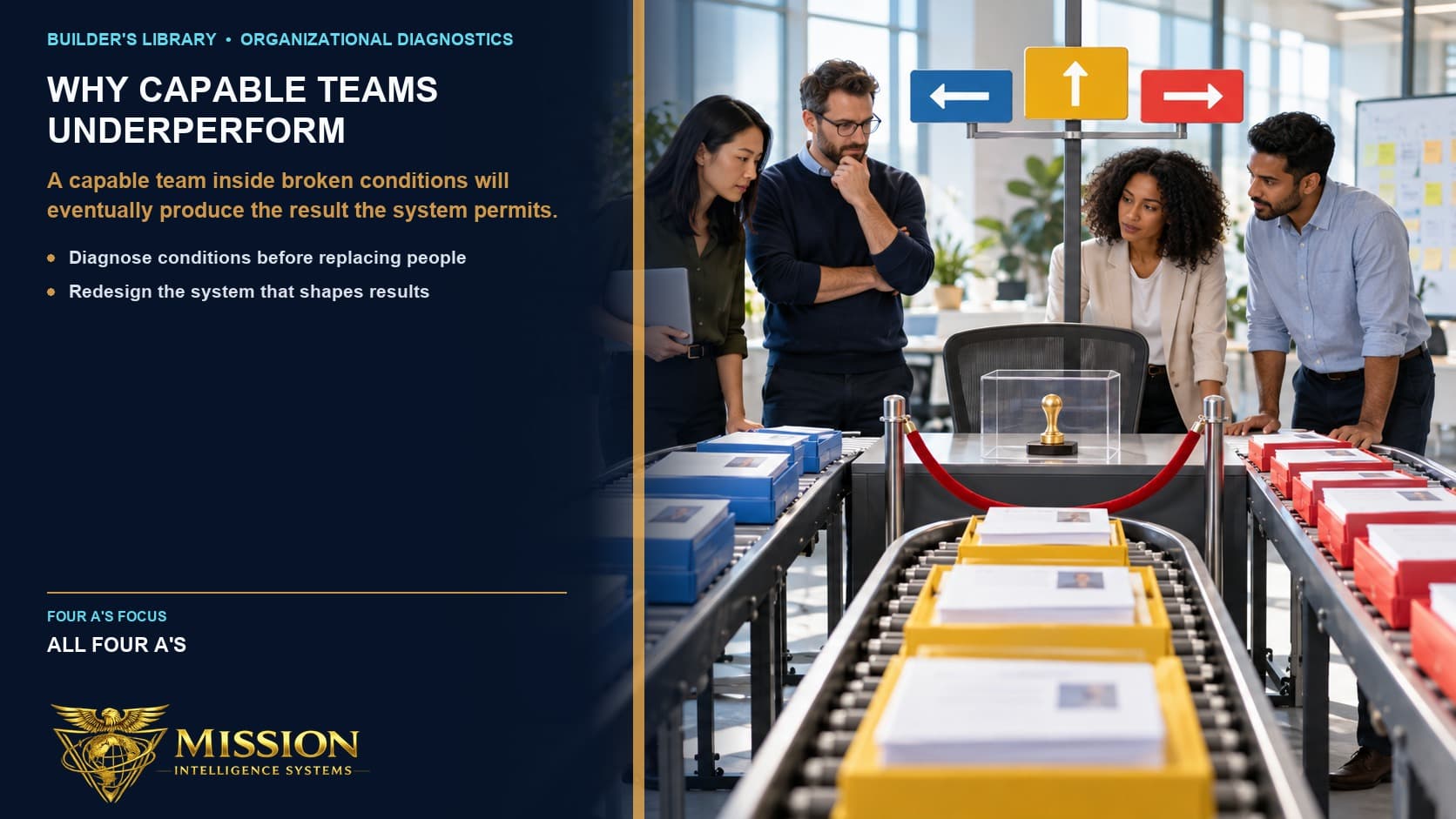
Why Capable Teams Underperform
Most organizational underperformance is systemic, not a people problem. Upgrading talent inside broken conditions rarely changes the result.

The Attention Tax
The hidden performance cost every organization pays when leadership focus is fragmented across too many simultaneous priorities.

Priority Theater
The organizational pattern of performing prioritization without actually doing it, and what it costs.

The Calendar Audit
The calendar is not a scheduling document. It is a confession: the most honest thing your organization has ever produced.

One Goal Tomorrow
The word priority was singular for five hundred years. When we pluralized it, we lost the discipline the word contained.
The Executive Attention Deficit
Attention, not information, is the scarce resource in executive decision-making. Adding more data past a point lowers decision quality rather than improving it.
The Attention Margin
The protected capacity an organization holds for sustained, focused work on what matters most. When it reaches zero, capable people produce far less than their talent warrants.

Alignment Is Not Agreement
Everyone in the room said yes. That is not alignment. Agreement is what happens in the meeting. Alignment is what governs behavior after everyone leaves.

Alignment Debt
The accumulated cost of decisions made without shared understanding. It compounds silently and pays out in failed execution.
The Alignment Tax
Everyone agreed in the room, and nothing shipped. Executives systematically overestimate alignment, and the gap between agreement and coordinated action is where strategy dies.

The Quiet Authority Problem
The most expensive authority failures are silent: decisions never made because no one believed they had the right to make them.

The Knowledge-Authority Gap
Knowledge accumulates at the front. Authority accumulates at the top. The gap between them is where organizational performance goes to slow down.

What Your Org Chart Doesn't Show
The chart shows reporting lines. The invisible architecture, incentives, decision rights, information flows, accountability mechanisms, is what the organization actually runs on.

Learned Helplessness in Organizations
Martin Seligman's dogs didn't stop trying because they were weak. Organizations teach people the same lesson: quietly, through conditions, not cruelty.
The Adaptability Gap
Why capable organizations learn without reconfiguring. Adaptability is a structural design problem, not a cultural aspiration.
Why Smart People Make Bad Decisions
Intelligence does not protect against predictable errors of judgment. The cognitive machinery that makes people capable also makes them systematically wrong, and organizations amplify it.
Why Facts Do Not Change Minds
Presenting more evidence rarely changes minds. Why data loses to identity and motivated reasoning, and how leaders build alignment anyway.
Decision Fatigue
Judgment is not a fixed trait. Why decision quality falls under load and volume, and why protecting attention is a governance issue.
Escalation of Commitment
Why leaders pour more resources into a losing course precisely because they chose it, and how to design the stop before you need it.
The Neuroscience of Trust
Why trust, not talent, is the strongest predictor of team performance, and how leaders build it as a condition.
Psychological Safety vs Accountability
Why safety and high standards are two dials, not a trade-off, and why the learning zone requires both turned up.
Rebuilding Broken Trust
Why trust breaks in an instant and rebuilds only slowly, and what actually repairs it after a violation.
Why Stories Beat Data
Why a story moves people to act when a spreadsheet cannot, and how leaders use narrative to build alignment.
The Psychology of Vision
Why a vivid, meaningful, believable picture of the future changes behavior more than a target does.
What Chris Voss Teaches Executives
The hostage negotiator's tactical empathy, translated through research into how leaders influence people who do not have to comply.
The Psychology of Power
Why power is largely perception, and how holding it quietly narrows a leader's judgment.
The Science of Persuasion
The documented principles behind influence, and how executives apply them with integrity to build genuine commitment.
Why People Resist Good Ideas
Why idea quality does not predict adoption, and how leaders overcome the threat that buries good ideas.
Why Bonuses Fail to Motivate
Why paying more for performance can crowd out the intrinsic drive that produces the best work, and what actually sustains it.
Autonomy Drives Performance
Why genuine control over how work is done outperforms tighter control, and how leaders design authority close to the work.
Why Your Best People Burn Out
Why burnout takes the most engaged first, and why it is a condition to design against, not a failure of resilience.
Groupthink
Why a cohesive team can converge on a decision no member would defend alone, and how to structure dissent back in.
Why People Follow the Crowd
Why the pull of the group overrides individual judgment, and how leaders protect the independent read that catches errors.
Why Nobody Speaks Up
Why a problem everyone sees can still go unspoken, and how leaders make voice safe, expected, and assigned.
Why Employees Resist AI
Why resistance to new AI tools is psychological, not technical, and mostly invisible, and how leaders build the conditions for adoption.
What Gerry Spence Understood About Commitment
Why credibility, fairness, and ownership create commitment where pressure and polish cannot, drawn from a trial lawyer's method and the research behind it.
Influence Without Manipulation
Why the line between ethical influence and manipulation is agency, not intensity, and how leaders stay on the right side of it.

The Dance
Sue Johnson's three negative cycles that trap couples and teams, and why the pattern, not the person, is the thing to change.

Why AI Transformation Fails (And It's Not the Technology)
Most AI transformation failures are organizational failures: not technology failures. The technology works. The organization is not structured to use it.

The Operating Model Is the Bottleneck
Why AI transformation is really a leadership challenge, not merely a technology implementation problem.

The Attention Crisis: Why AI Can't Fix Organizational Overwhelm
AI can accelerate work, but it cannot decide what matters. When an organization is already overloaded, AI often exposes the lack of it.

AI Governance Without Bureaucracy
How leaders can create guardrails for AI adoption without slowing learning, experimentation, and value creation.

From Pilot to Production
From pilot to production: the organizational conditions that decide whether AI deployments produce returns or quietly stall.
The AI ROI Gap
MIT found that about 95 percent of enterprise generative AI pilots deliver no measurable return. The barrier is an organizational learning gap, not the technology.
Why Teams Hide Their AI Use
More than half of employees will not admit using AI on their most important work. That silence is a psychological safety problem distorting how leaders see their organizations.
Governing Agentic AI
Autonomous AI agents are reaching production faster than the authority to govern them. A board framework for decision rights over systems that plan and act on their own.
The AI Talent Trap
Executives treat AI readiness as a hiring problem. The evidence says it is a conditions problem: you cannot hire your way out of an organization that cannot learn.
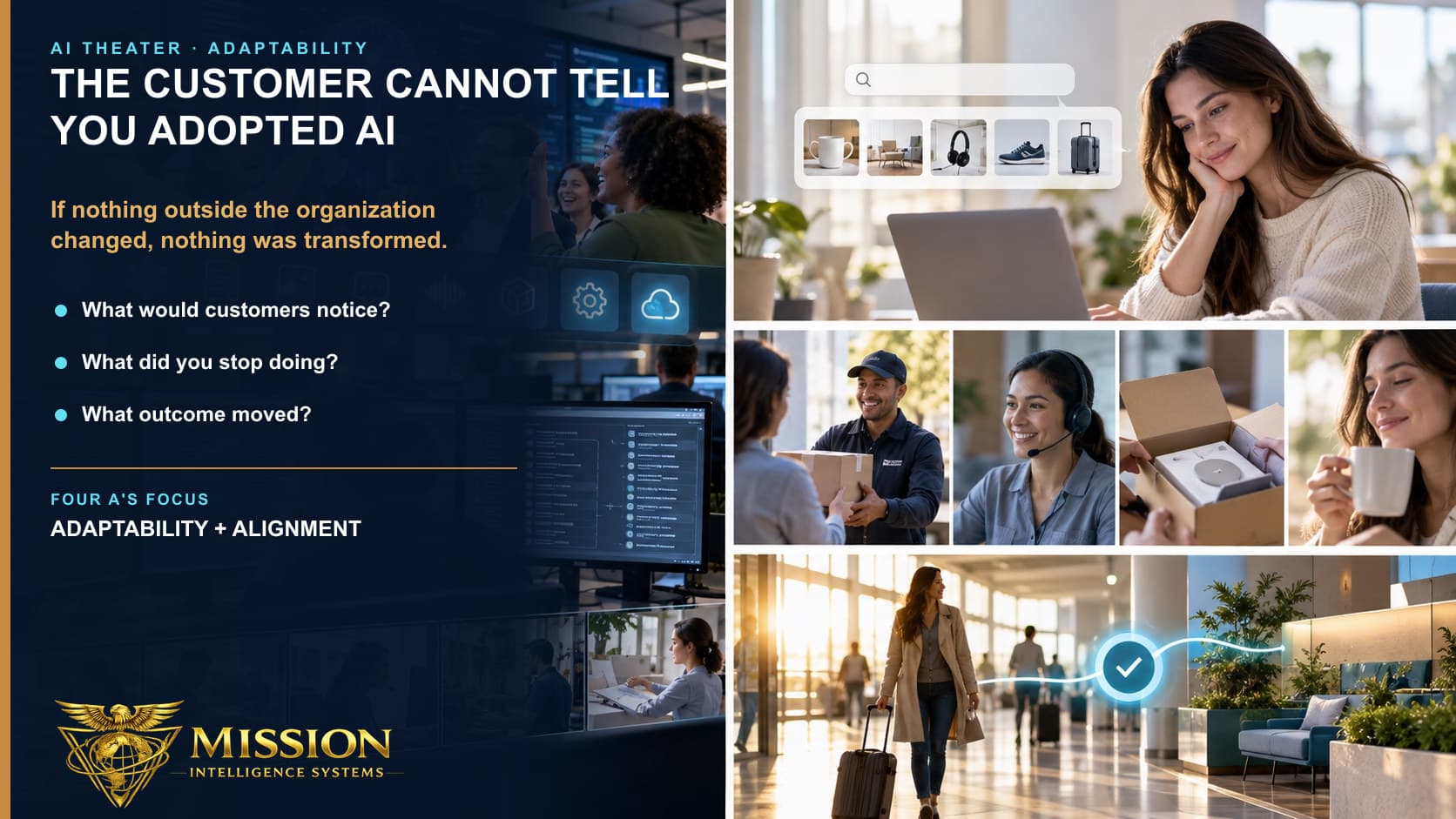
Deployment Is Not Transformation
Installing AI is not transforming with it. The returns come from redesigning how work is done, not from adding a tool to the way it already runs.
What Boards Should Ask Before the Next AI Investment
Boards approve AI spending on the strength of the demo. The research says they should govern the organizational conditions that turn tools into value.
Organizational Readiness for AI
The precondition executives skip. Across the evidence, AI value depends on organizational conditions more than the technology, and the Four A's make those conditions observable.

What Great Builders Do
The gap between leaders who build things that last and leaders who do not is not intelligence or effort. It is how they see.

Why Your Best People Leave
Capable people do not leave companies. They leave environments that have made their capability irrelevant.

The 18-Month Clock
Every capable new hire starts a clock the moment they walk in. Within 18 months, most organizations have converted their energy into calibration.

The Courage to Stop
The builder who cannot stop is not building. They are piling. Knowing when to stop, and doing it well, is one of the highest-leverage decisions a leader can make.
How Do I Hold My Team Accountable?
Externally imposed accountability produces compliance, not ownership. People deliver the minimum the monitoring can see, and the leader becomes the bottleneck of enforcement.
How Do I Have Difficult Conversations With My Team?
Chronic difficult conversations are usually a symptom of missing conditions, not a leadership skill to be perfected.
How Do I Delegate Without Becoming the Bottleneck?
The bottleneck is not a workload problem, it is an authority problem: the tasks were delegated but the decision rights were not.
How Do I Manage an Underperformer?
Managing underperformance as a purely individual failure often treats a symptom while leaving the condition that produced it intact.
How Do I Build Executive Presence?
Presence built on performance is fragile, because people detect the gap between the polish and the person.
How Do I Lead My Team Through Change?
Resistance to change is frequently rational and informative, arising from front-line knowledge the leader does not have.
How Do I Keep My Best People?
Retention is a condition leaders create, not a perk they buy. Your best people stay when their capability has somewhere to go.
How Do I Motivate My Team Without Relying on Money?
Money is mostly a hygiene factor: its absence demotivates, but its presence does not reliably motivate.
How Do I Build Trust as a Leader?
Trust is built from legible signals, ability, benevolence, and integrity, which means leaders can build it deliberately rather than hope for it.
How Do I Think and Communicate More Strategically?
Strategic thinking is synthesis, not solitary analysis; the leader who thinks they hold all the answers has cut themselves off from most of the information.
How Do I Lead People Who Used to Be My Peers?
The promotion changes your title, not your relationships; authority over former peers has to be earned, not asserted.
Why Great Leaders Build Conditions, Not Performance
Performance is a product of conditions, not pressure. Pushing harder on capable people rarely produces more; changing their conditions does.
The Servant Leader Is Not Soft
Servant leadership is not permissiveness. It pairs high support with high standards, and it is more demanding of the leader than command is.
Be, Know, Do: Why Character Comes First
Be, Know, Do puts character before competence before action, and the order is the point: people evaluate who you are before what you know.
Integrity Is What You Do When It Costs You
Integrity is behavioral, not spoken. People judge it by the alignment between what a leader says and what a leader does.
The Discipline of Subtraction
Addition is the default and the trap. More priorities do not produce more results; they fragment the attention that produces any.
Your Calendar Is Your Real Strategy
A leader has two strategies: the stated one in the deck and the enacted one in the calendar. When they differ, the calendar is telling the truth.
Commanders Intent: Lead by Why, Not How
Commander s intent gives people the what and the why, and deliberately leaves the how to those closest to the work.
The Difference Between a Goal and a Target
A target is a metric to satisfy; a goal is a purpose to pursue. People optimize the first and commit to the second.
Trust Is Built at the Speed of Consistency
Trust is built from a pattern, not a gesture, so it accrues at the speed of consistent behavior over time.
The Cost of Leading Without Trust
Low trust is a hidden tax: work must be verified, information is filtered, and the leader becomes the bottleneck.
Disciplined Initiative: The Engine of Decentralized Command
Disciplined initiative pairs clear intent with decentralized authority, so people act on their own judgment within the leader s intent.
Why Approval Chains Slow Everything Down
Each required approval is a stop-and-wait point; chains of them turn decisions into queues and speed into delay.
Accountability Is a Condition, Not a Conversation
Accountability conversations are downstream symptoms. The upstream cause is whether people genuinely own the work.
Match Authority to Responsibility
Accountability without matching authority is a setup: people are held to results they cannot actually influence.
Resistance Is Data: Read the Ground Before You Change It
Resistance to change is often rational and informative, arising from front-line knowledge the leader does not have.
Strategy Is Something You Synthesize, Not Dictate
Strategy is synthesis, not solitary analysis; the leader who assumes they hold all the answers has cut themselves off from most of the information.
The Multiplier: Why Growing Leaders Beats Being One
A leader who performs adds linearly; a leader who develops other leaders multiplies, and the multiplier is what matters at scale.
Lead Through the Transitions Where Leaders Fail
Leadership failure clusters at the transitions between levels, not inside stable roles, because each passage demands a new way of working.
Building Attention When It Doesn't Come Naturally
How to develop the discipline of focus and subtraction when saying no is not instinctive. A practical guide for contributors building the attention habit.
Building Alignment When It Doesn't Come Naturally
How to develop shared understanding as a deliberate practice when you naturally move to execution. Three questions that substitute for the alignment instinct.
Building Authority When It Doesn't Come Naturally
How to build the habit of naming decision ownership when it feels presumptuous or political. One question that removes more friction than any role chart.
Building Adaptability When It Doesn't Come Naturally
How strong executors build the discipline of system-level learning. The one question that turns a finished project into organizational improvement.
The Four Builder Types
Most teams have a mix of four builder orientations: Attention, Alignment, Authority, and Adaptability. Each one creates a different condition for the people around them. Understanding which you are changes how you contribute.

The Wrong Train
The cost of a wrong decision is rarely the decision. It is how long you stay on it. Why builder-leaders learn fast instead of failing fast, and get off at the nearest station.
From Research to Readiness: Daniel Kahneman
Human judgment relies on heuristics that are usually efficient but produce systematic, predictable errors, even among experts.
From Research to Readiness: Amy Edmondson
Psychological safety, the shared belief that it is safe to take interpersonal risks, predicts team learning and performance.
From Research to Readiness: Herbert Simon
Rationality is bounded: people satisfice rather than optimize, because computation and attention are limited.
From Research to Readiness: Karl Weick
Sensemaking is how people construct meaning from events, often after the fact, and it shapes how organizations act.
From Research to Readiness: Chris Voss
Voss reframes negotiation as surfacing hidden information through empathy, not winning an argument through leverage.
From Research to Readiness: Herb Cohen
Cohen taught that outcomes turn on power, time, and information, and that power is largely perceived.
From Research to Readiness: Richard Thaler
People follow how choices are arranged; defaults, framing, and friction reliably shape behavior.
From Research to Readiness: Edgar Schein
Culture operates at three levels: visible artifacts, espoused values, and the underlying assumptions that actually drive behavior.
From Research to Readiness: Peter Senge
The learning organization is deliberately built to learn and to see itself as a system, not a set of isolated events.
From Research to Readiness: Ronald Heifetz
Technical problems yield to expertise and authority; adaptive challenges require the people involved to change themselves.

Decision Architecture
The intentional design of who decides what, at what level, with what information, and why most organizations inherit it instead of building it.

Organizational Weather
The current operating climate determines what is actually buildable right now. Builders learn to read it before they break ground.

Organizational Gravity
Every organization has a structural force that pulls behavior back toward existing patterns, regardless of what leaders decide or intend.

Organizational Antibodies
Every organization has an immune system. It protects existing conditions from change: through procedural friction, social withdrawal, and resource starvation.
Change Fatigue
Employee willingness to support change fell from 74 to 38 percent in six years. Transformations fail from exhaustion, not resistance, and the research points to what sustains them.
Decision Rights When the Model Recommends
When a model recommends and a human approves, automation bias means the machine often decided. Keeping humans genuinely accountable is a decision-rights problem.
The Operating Model Is the Intervention
Every performance initiative eventually runs into the operating model. Until that system is redesigned, no other change will hold.
Buttresses
Some processes exist only to hold up other processes. Each began as a reasonable fix for a real failure, and together they mark where a decision right was never assigned.

The Risk Register Nobody Reads
Most organizations have a risk register. Most risk registers are read once: during the review that required them. This is an attention problem, not a documentation problem.

Why 'Likely' Is Not a Probability
When two members of a risk review assign different numerical meanings to the same word, the risk register is not a shared instrument: it is a collection of individual opinions formatted to look like one.

Risk Appetite Is Not Alignment
Publishing a risk appetite statement is not the same as building an organization that operates within it. The gap between declaration and behavior is where governance fails.

Risk Ownership Without Authority
Naming a risk owner without empowering one creates the illusion of accountability, and leaves every significant risk actually unmanaged.

When the Least Experienced Person Owns Risk
A direct address to the leader who made the staffing decision: what you gave up when you assigned risk coordination to whoever had capacity, and what you can do about it now.

The Risk Experience Deficit
Organizations routinely assign risk coordination to whoever has capacity - often the newest team member. When the role rotates with team changes, risk identification separates from the experience required to recognize the risks that actually matter.

The Organizational Pre-Mortem
The most productive risk tool most organizations never use is not a model or a matrix. It is a question: imagine this has already failed. What happened?
Shadow AI
One in five data breaches now involves shadow AI, at 670,000 dollars more per incident. The ungoverned adoption already inside your organization is an authority vacuum before it is a security failure.
Start with readiness
Is your organization ready for transformation, or just adding more activity to an already overloaded system?
Use the Executive Organizational Diagnostic to identify your primary constraint across attention, alignment, authority, and adaptability.